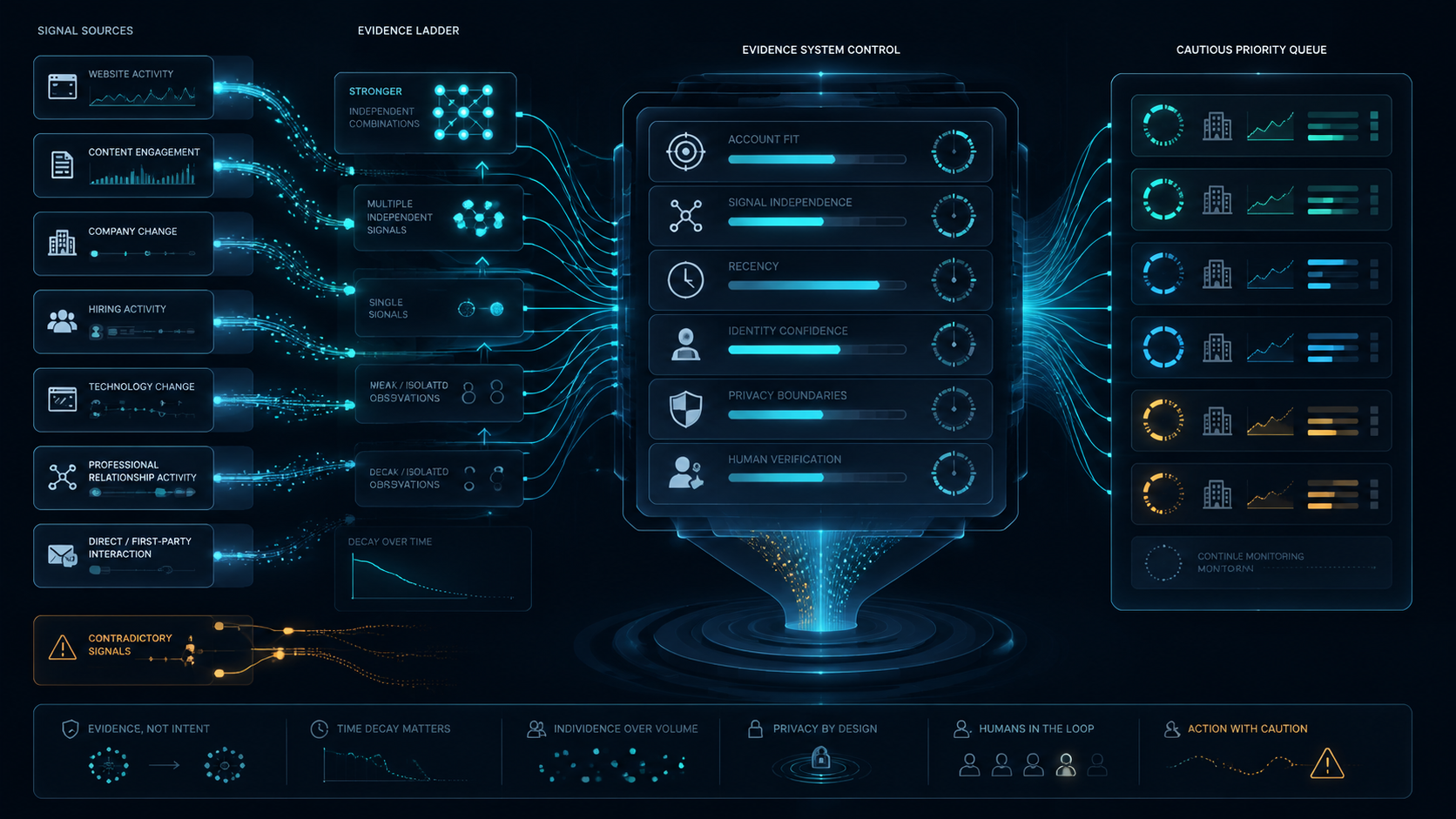
A single behavior is not buying intent; actionable priority comes from signal combinations, time decay, fit, and human verification.
Three observations that teams often misread
Three observations arrive on Monday. A target company's anonymous browser visits a pricing page several times. The company publishes job openings for engineers. A person with a relevant title downloads a guide. It is tempting to label all three accounts 'high intent.' That conclusion outruns the evidence. The visits may belong to one researcher, an employee, or a competitor. Hiring may reflect growth, replacement, or a project unrelated to your offer. A download can support research without authority, budget, timing, or an active purchase. These three observations are useful because they change what deserves investigation. They are not private knowledge of what a company will buy. The aggressive reading says three events equal urgency. Do they? You have activity, but you don't yet have shared identity, cause, or a purchase decision. Your next move should investigate those gaps rather than write a story around them. What would you investigate first, and what would you refuse to claim? Put your answer beside each observation. The three opening cases also show why your action model needs more than a score. A visit, job opening, and download can all be relevant while permitting different responses. You should be able to explain why one event earns research, another earns monitoring, and none yet earns a claim about what a named person intends to buy.
| Observation | Plausible relevance | What remains unknown |
|---|---|---|
| Pricing-page activity | Active research | Identity, purpose, decision stage |
| Hiring | Organizational change | Connection to your problem |
| Guide download | Topic interest | Authority, need, timing |
The analytical reset
Treat a buying signal as evidence that may change priority, not as a verdict. The rest of the model asks how much the observation should change priority and which action it permits. Keep this distinction attached to the record and the decision it supports. A later reviewer should be able to reconstruct the source, scope, time boundary, alternative explanation, and condition that would reverse the conclusion without relying on team memory.
A signal is an observation plus a decision context
First-party signals include direct replies, form submissions, demo requests, sales conversations, product activity, support interactions, event participation, and appropriately measured website or email engagement. Company-change observations include leadership moves, hiring, funding, partnerships, expansion, technology changes, and public filings. Relationship changes and third-party research patterns can add context. The same event can mean different things for different offers. A new warehouse matters to a logistics supplier differently than to a payroll vendor. A signal definition therefore needs an observable event, source, entity, time, decision it may affect, and explicit alternative explanations. Some teams argue that any observable change deserves a score. You should ask a prior question: which decision could this event rationally change? Without that answer, your signal catalogue is only a list of interesting things. Can your team state the decision this event changes? If you can't, you shouldn't score it yet. Carry the disagreement into operations. One side wants speed: capture the event, raise the score, and let volume find the opportunity. The other side wants certainty the market rarely provides. You need neither extreme. You need permissions that allow research, authorize a contextual response, and stop when identity or policy conflicts appear.
Build an evidence ladder before building a score
Place observations on a ladder based on proximity and verifiability, not on the excitement of the label. A direct, verified request tied to a relevant problem is usually stronger for immediate response than anonymous activity. A meaningful sales conversation can support a next step when the participant and context are clear. Product usage can be strong for an existing user decision but irrelevant to a new-logo motion. Public hiring, funding, or technology changes are useful research prompts. Third-party intent and visitor identification require special attention to method, identity, time, permitted use, and false positives. Fit belongs beside the ladder, not inside the event itself. A vendor may call an event strong, while your seller calls it noise. Who is right? You need the source, identity, time, and use case before you decide. Strength lives in that context, not in the label alone. Which rung would you defend to a skeptical seller, and which source would you show them?
| Level | Examples | Default interpretation |
|---|---|---|
| Direct | Reply, request, verified conversation | Respond after context check |
| First-party behavior | Usage or known engagement | Investigate identity and meaning |
| Company change | Hiring, leadership, technology, expansion | Research relevance |
| Third-party pattern | External research or visitor inference | Validate method and identity |
| Stable attribute | Industry, size, location | Fit context, not a signal |
Why fit is not a signal
Industry, size, geography, and ownership can remain useful for months. They describe the organization. A signal describes an observation or change. Combining the two can prioritize work, but merging their labels hides the reason priority moved. Keep this distinction attached to the record and the decision it supports. A later reviewer should be able to reconstruct the source, scope, time boundary, alternative explanation, and condition that would reverse the conclusion without relying on team memory.
Combine independent dimensions, not repeated clicks
Five page views from one anonymous browser are not five independent signals. Repeated events from one source can indicate persistence, but they do not create new identity or context. A stronger case combines dimensions that can fail independently: the account fits a defined market; a relevant company change is observed; a known person engages through a first-party channel; the person's role connects to the problem; and the observations are recent enough for the proposed action. Record contradictions as well. A direct objection, existing exclusion, identity conflict, or evidence that the company cannot be served should lower priority even when activity is high. Counting advocates say more events should always increase confidence. But what if every event came from one browser? You should reward independent evidence and let contradictions lower the score; repetition isn't corroboration. Would you reach the same conclusion if one repeated source disappeared? Your combination rule should answer that.
- Account fit
- Observed change
- Known engagement
- Role relevance
- Recency
- Source confidence
- Contradictions and exclusions
A combination is still not certainty
Multiple observations can justify research or a timely response. They still do not reveal private intent, budget, authority, or a purchasing decision unless those facts were directly established. Keep this distinction attached to the record and the decision it supports. A later reviewer should be able to reconstruct the source, scope, time boundary, alternative explanation, and condition that would reverse the conclusion without relying on team memory.
Let each observation decay at its own speed
Recency should follow the decision window of the event. A direct request can require action today. A leadership appointment may shape account research for months. A technology migration can unfold over a longer program. A stable firmographic trait may remain valid while adding no urgency at all. Store event time separately from collection time and processing time. Define a decay rule by signal type, then show the decayed contribution to reviewers. Do not keep an old event hot because it once correlated with a successful account. A new, conflicting observation should be able to reverse the priority. Teams often keep old signals because they once preceded a win. Would you act on the same event today? If you wouldn't, your decay rule should say so before your dashboard turns history into false urgency. What would you do if this event were thirty days older? Write that answer into your decay policy. Decay is where retrospective bias becomes visible. A team remembers the old event that preceded a win and forgets the many old events that led nowhere. You can resist that story by fixing the window in advance, retaining low-scored accounts, and asking whether the same evidence would change today's action.
| Signal | Review question |
|---|---|
| Direct engagement | Is a response still timely? |
| Product activity | Is the usage pattern current and attributable? |
| Leadership change | Does it still affect the relevant function? |
| Hiring | Are roles still open and relevant? |
| Technology change | What phase is observable? |
| Third-party pattern | How recent and stable is the inference? |
Identity and privacy set the ceiling on action
An account-level observation should not silently become a statement about a named person. Anonymous website activity does not justify telling an individual that they visited. A company announcement does not justify inferring a private need. Third-party signals need documented sourcing, identity resolution, access controls, retention, and permissible-use review for the relevant jurisdiction and channel. Sensitive inferences deserve stricter treatment. Keep the original observation, the resolved entity, the derived label, and the proposed action separate. The weaker the identity and consent basis, the more conservative the action should be. Personalization advocates may want to name the inferred behavior in a message. Should you? If identity or permissible use is uncertain, your action must stay more general. Your confidence doesn't expand the person's consent. Would you be comfortable explaining the inference to the person concerned? If not, narrow your action.
The reversal rule
An objection, suppression request, identity correction, or compliance restriction must override a high score. A prioritization system that cannot stop is not a decision aid; it is an escalation mechanism. Keep this distinction attached to the record and the decision it supports. A later reviewer should be able to reconstruct the source, scope, time boundary, alternative explanation, and condition that would reverse the conclusion without relying on team memory.
Convert evidence into an action-permission ladder
Replace vague hot, warm, and cold labels with permissions. The respond band requires a direct, verified interaction and an appropriate human response. The research band can combine fit with a relevant company change or ambiguous engagement, allowing account investigation but not a personalized claim about intent. The monitor band holds weak or stale observations until something independent appears. The hold band contains identity conflicts, compliance questions, or contradictions. The reject band records exclusions and objections. Give each band an owner, response window, allowed message boundary, evidence requirement, and condition that returns the account to a lower band. A single hot score feels easier than five permission bands. Easier for whom? Your reviewer still decides whether to respond, research, wait, hold, or reject. Put that choice where the team can see and challenge it. Which action can your reviewer authorize, and which evidence would make them lower the account?
| Band | Evidence | Permitted action |
|---|---|---|
| Respond | Direct and verified | Human response in context |
| Research | Fit plus relevant observation | Investigate account |
| Monitor | Weak, single, or stale event | Wait for independent evidence |
| Hold | Identity or policy conflict | Resolve before action |
| Reject | Exclusion or objection | Suppress and record |
Let OKKI Go carry a reviewed hypothesis, not an intent claim
OKKI Go's verified scope does not include autonomous buying-intent detection. Its role can begin after a person has reviewed the observation and written a bounded company hypothesis: product, buyer type, countries, relevant change, and exclusions. OKKI Go can return candidate companies for review, accept route corrections, support selective unlock, find contacts for selected companies, and prepare drafts from company context and supplied materials. The user confirms recipient, subject, and body before sending, while status and failure reasons remain visible. This workflow preserves action control. It does not convert opens, clicks, hiring, funding, or research patterns into certainty about a buyer's mind. The strongest automation claim says the system should carry the signal straight into outreach. What happens when the premise is wrong? You should preserve the reviewed hypothesis and confirm the recipient and message before action. Where can you stop the handoff? Your workflow should give you more than one safe exit. The handoff creates a clean test of the argument. If you can state the observation, its alternatives, the company criteria, and the permitted action, automation can carry a bounded hypothesis. If you can't, the workflow will turn an interesting event into confident outreach before anyone notices what was inferred.
Audit the mistakes the score would rather forget
Each month, sample high-priority and low-priority accounts. Inspect original sources, entity resolution, duplicated events, decay, contradictions, reviewer overrides, objections, and downstream reversals. Review false positives and missed opportunities, but do not judge the system only by pipeline attributed to high scores; that selects successful stories after the fact. Compare actions under similar fit and preserve accounts the model ignored. Retire signals whose owners cannot explain their meaning or permitted action. The useful outcome is a smaller queue with clearer reasons, not a larger collection of urgent labels. Revenue stories can make every high score look wise after the outcome. What about the misses and false positives? Your audit needs both, or you are measuring the narrative your model created about itself. Can you find the accounts your score ignored? You need them if you want an honest audit.
The final rule
Act when fit, independent evidence, recency, role relevance, identity, and proportional action align. When they do not align, research, monitor, hold, or reject. Uncertainty should narrow permission, not increase volume. Keep this distinction attached to the record and the decision it supports. A later reviewer should be able to reconstruct the source, scope, time boundary, alternative explanation, and condition that would reverse the conclusion without relying on team memory.
Audit action permissions against source, identity, independence, recency, contradictions, and proportionality; lower permission whenever uncertainty remains.
Frequently asked questions
What are B2B buying signals?
They are observations—such as direct engagement, product activity, company changes, hiring, technology events, relationship changes, or third-party research patterns—that may change account priority.
What are strong B2B buying signals?
Direct, verified requests or meaningful conversations are often stronger than public or anonymous events, but strength depends on identity, context, recency, fit, and the decision being made.
Does one buying signal prove intent?
No. A single visit, funding event, job posting, technology change, or content interaction has multiple plausible explanations. Combine independent evidence and verify before acting.
How should B2B buying signals be scored?
Use visible factors for fit, signal type, identity confidence, independence, recency, role relevance, and uncertainty. Let reviewers reconstruct and override the score with a recorded reason.