The durable 2026 advantage is not producing more records with AI; it is preserving trustworthy evidence as buyers move across search, AI answers, content, events, outbound contact, and sales qualification.

What counts as B2B lead generation in 2026?
You can no longer define B2B lead generation as form fills alone. A potential buyer may discover an idea in a search result, an AI-generated answer, a partner recommendation, a webinar, a trade event, a product community, or a direct conversation. The operating system has to recognize these paths without pretending they carry equal evidence. A content view shows attention. A product request shows declared interest. An outbound candidate shows seller-selected fit. A qualified opportunity shows that your team has confirmed its own sales criteria. The longer view matters because this decision changes the meaning of later measurements. Once a record moves forward, software and people tend to treat the prior judgment as settled; making the reasoning visible now is cheaper than reconstructing it after the outcome. Keep four states separate: account discovery, identifiable engagement, qualified lead, and sales opportunity. Your team may use different labels, but each transition needs observable evidence and an owner. This prevents a downloadable contact from being called demand and stops an AI score from silently becoming qualification. In 2026, the number of automated touchpoints is growing; the value of a clean state model grows with it because every system needs to know what it may infer and what it must ask. Which state are you actually measuring? If you cannot name it, keep the record where it is.
| State | Evidence | Do not infer |
|---|---|---|
| Discovered account | ICP-relevant company evidence | Interest |
| Engaged person | Observable interaction or request | Fit or authority |
| Qualified lead | Defined marketing or sales criteria | Opportunity |
| Opportunity | Accepted need, role, timing, and next step | Revenue certainty |
Decision checkpoint
Before moving on, record the evidence used, the uncertainty that remains, the person who owns the decision, and the condition that would reverse it. This checkpoint turns guidance into an auditable operating choice. It also prevents a later result from being explained away by changing definitions after the fact.
Why has the channel mix changed?
Search is becoming more distributed. Google's July 2026 guidance says the same foundational SEO practices remain relevant for AI features: accessible pages, useful content, crawlability, structured information, and measurement. Its generative-content guidance also warns that producing many pages without value can violate scaled-content policies. For you, that means AI visibility is not a separate trick. It depends on pages that answer real questions, show first-hand expertise, and make entities and evidence understandable to both people and systems. The longer view matters because this decision changes the meaning of later measurements. Once a record moves forward, software and people tend to treat the prior judgment as settled; making the reasoning visible now is cheaper than reconstructing it after the outcome. At the same time, vendor research on agentic marketing signals that organizations are adding AI agents while struggling with fragmented data and governance. Treat those findings as a vendor-survey view, not a universal fact. The practical conclusion is sound: more channels and agents increase the cost of inconsistent customer data. Your lead-generation plan should therefore connect content, outbound, events, partners, CRM states, and suppression rules before it adds another automation layer. Would you publish this page if an expert could not verify its evidence? Your answer should govern generated content too.
| Shift | Response |
|---|---|
| AI-mediated discovery | Publish useful, accessible, source-grounded pages |
| More generated content | Prioritize original value over scaled volume |
| Agent-assisted workflows | Define data and action boundaries |
| Fragmented journeys | Preserve source and lifecycle state |
Decision checkpoint
Before moving on, record the evidence used, the uncertainty that remains, the person who owns the decision, and the condition that would reverse it. This checkpoint turns guidance into an auditable operating choice. It also prevents a later result from being explained away by changing definitions after the fact.
Which B2B lead-generation strategies work together?
No channel wins independently. Search and educational content create compounding discovery. Webinars and events create time-bounded engagement and richer questions. Partnerships borrow trust and reach adjacent audiences. Product-led or trial motions create behavioral evidence. Outbound prospecting reaches selected accounts that may not be actively searching. Retargeting and nurture reconnect known audiences where permission and platform rules allow. Your best mix depends on deal size, market maturity, buyer concentration, sales cycle, available proof, and the evidence your team can actually process. The longer view matters because this decision changes the meaning of later measurements. Once a record moves forward, software and people tend to treat the prior judgment as settled; making the reasoning visible now is cheaper than reconstructing it after the outcome. Build a portfolio with different jobs. Use one channel to create demand, another to capture declared interest, another to reach a known account gap, and a lifecycle program to move appropriate people forward. Do not evaluate them with one cost-per-lead number. A partner introduction, an anonymous search visit, and a cold outbound reply do not begin at the same point or require the same work. Compare cost and conversion within a defined state transition. What distinct job does this channel perform for you? If two channels produce different evidence, do not score them as twins.
| Channel | Primary job | Strong evidence |
|---|---|---|
| Search and content | Answer active questions | Query and content engagement |
| Events | Create shared context | Attendance and questions |
| Partners | Extend trusted reach | Introduction or referral |
| Outbound | Reach selected accounts | Account fit plus response |
| Lifecycle | Develop known interest | Progression and declared need |
Decision checkpoint
Before moving on, record the evidence used, the uncertainty that remains, the person who owns the decision, and the condition that would reverse it. This checkpoint turns guidance into an auditable operating choice. It also prevents a later result from being explained away by changing definitions after the fact.
How do you build the process?
Start by defining an ICP and the lifecycle states you just separated. Then map the questions buyers ask before they can recognize the problem, compare approaches, justify change, and evaluate vendors. Build content or conversations for those questions. Instrument capture so the source, timestamp, consent or marketing context, account identity, and declared request remain available. Enrich only what a decision needs. Score or route only after the required evidence is defined. Finally, send accepted records to a named owner with a service level and a reason.
The process is a loop, not a funnel graphic. Sales responses should correct targeting. Lost opportunities should change content and qualification. Search and AI-discovery performance should reveal missing questions. Outbound objections should identify poor assumptions. You need a field for no decision, bad timing, wrong person, wrong account, missing capability, and suppression; a generic lost status cannot teach the system. The most useful dashboard shows where evidence weakens between states. Can you show why the record changed state? You need that answer before the next system acts on it.
Decision checkpoint
Before moving on, record the evidence used, the uncertainty that remains, the person who owns the decision, and the condition that would reverse it. This checkpoint turns guidance into an auditable operating choice. It also prevents a later result from being explained away by changing definitions after the fact.
How should AI be used without creating synthetic demand?
AI can help cluster search questions, summarize public account evidence, classify inbound requests, identify missing CRM fields, suggest routing, prepare a draft, and analyze outcome patterns. It cannot turn a generated contact into demand or a fluent summary into truth. Ask of every AI use: what source did it use, what uncertainty remains, what action follows, and who can stop it? If you cannot answer, keep the output internal until you can.
- Tie the task to a lifecycle decision
- Retain sources and freshness
- Label inference and uncertainty
- Require review before material external action
- Measure correction effort and downstream quality
- Never treat generated volume as demand
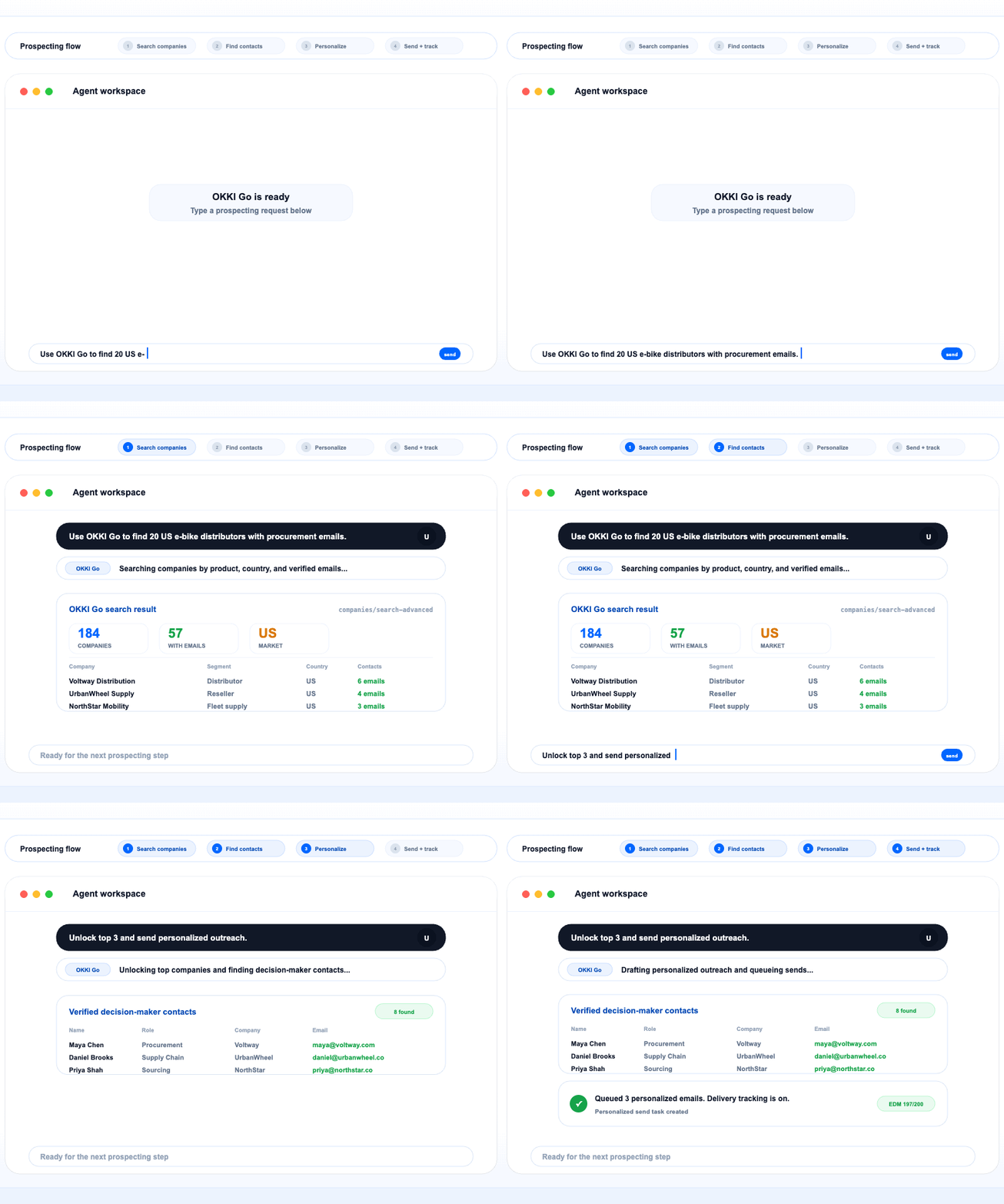
Google's guidance gives content teams a similar boundary. Generative tools can support research and structure, but pages still need accuracy, quality, relevance, and added value. For outbound work, OKKI Go can be described within its official scope: it supports B2B company discovery and outreach preparation in a reviewable workflow. You still own targeting, factual approval, recipient relevance, compliance, and the interpretation of outcomes. Where would an invented inference enter your workflow? Mark that point and require your reviewer to see it.
What changes for China-based exporters?
China-based exporters have to connect destination-market demand with operating capability. The Ministry of Commerce's 2026 outlook emphasizes a difficult external environment alongside policy support and digital development. Jiangsu's 2026-2028 cross-border e-commerce plan focuses on platform, independent-site, overseas-warehouse, service, brand, and industrial-cluster capabilities. These official policy documents do not prescribe your campaign, but they show why lead generation should be linked to market selection, fulfillment, service, and brand readiness rather than treated as a list-building project.
| Decision | Evidence to prepare |
|---|---|
| Market | Demand, competition, rules, and service feasibility |
| Account | Business fit and route to market |
| Buyer | Responsibility and language context |
| Offer | Supportable value and proof |
| Handoff | Owner, response time, and fulfillment path |
Choose one destination-market hypothesis at a time. Define the buyer role, product fit, certification or logistics constraints, language, channel, response owner, and service promise before outreach. Then use account research to test the hypothesis. A team that cannot support the target geography should not let an AI discovery tool create false confidence. The lead system begins with commercial readiness and ends with a handoff that can answer the buyer's operational questions. Can your team serve the market it has selected? Your lead target is only credible when operations can support it.
Which metrics reveal real progress?
Use stage-level measures. For search and content, examine qualified discovery, useful engagement, and assisted progression rather than traffic alone. For events, track attendance quality, questions, and accepted follow-up. For outbound, track accepted accounts, verified relevant contacts, delivery, reply categories, qualified conversations, and meetings. For qualification, measure acceptance, time to action, rejection reasons, and later reversals. For revenue, connect opportunities back to source and touches without forcing one channel to claim the entire journey.
| Stage | Primary metric | Diagnostic metric |
|---|---|---|
| Discover | Qualified reach | Query/account relevance |
| Engage | Meaningful interaction | Content or event quality |
| Qualify | Accepted lead rate | Rejection reasons |
| Route | Time to owned action | Unassigned or recycled records |
| Convert | Opportunity progression | Stage reversal and no-decision |
Avoid vanity precision. Multi-touch attribution models are assumptions, not ground truth. Use them to compare decisions, not to award moral credit. A monthly review should ask where records accumulated, where evidence went missing, and which rejection reason increased. If traffic rises but qualified progression does not, repair intent and content. If outbound replies are irrelevant, repair targeting or contact mapping. If accepted leads wait without action, repair routing before buying more demand. Which stage is leaking for you right now? Repair that stage before you buy more activity upstream.
What should your next 90 days look like?
In days 1-30, define states, audit current records, interview sales about rejection reasons, and choose one audience-question cluster plus one account segment. In days 31-60, publish or improve the core content, run one selected outbound motion, connect capture and routing, and review a small sample weekly. In days 61-90, compare channel evidence, repair the earliest leak, and expand only the motion that produces accepted progression without disproportionate correction work.
You do not need every 2026 trend in the first quarter. You need a lead system that can tell you why a person or account entered, what evidence changed its state, who owns the next action, and what outcome corrected the model. Once that foundation works, AI and additional channels can increase capacity without erasing meaning. That is the practical standard for a current B2B lead-generation program. What will you know after ninety days that you do not know today? Write the decision before you add the channel.
Frequently asked questions
What is B2B lead generation?
B2B lead generation is the coordinated work of creating awareness, capturing or identifying potential business accounts, enriching and qualifying evidence, routing an appropriate next action, and learning from outcomes.
What are the best B2B lead-generation channels in 2026?
There is no universal winner. Search and content, events, partners, outbound, product-led motions, and lifecycle programs perform different jobs. Select a portfolio based on buyer concentration, deal economics, market maturity, proof, and the evidence each channel creates.
How is AI changing B2B lead generation in 2026?
AI increasingly supports research, classification, summarization, routing, drafting, and analysis. It increases the need for source traceability, data governance, state definitions, human approval, and outcome-based evaluation.
How should exporters approach B2B lead generation?
Choose a destination-market and buyer hypothesis, confirm operational readiness, research suitable accounts, use relevant local context, define compliance and response ownership, and measure accepted progression rather than list volume.