B2B data-enrichment platforms should be ranked by decision fitness and verification control rather than the number of returned fields.
The procurement brief: enrich a difficult file, not an ideal one
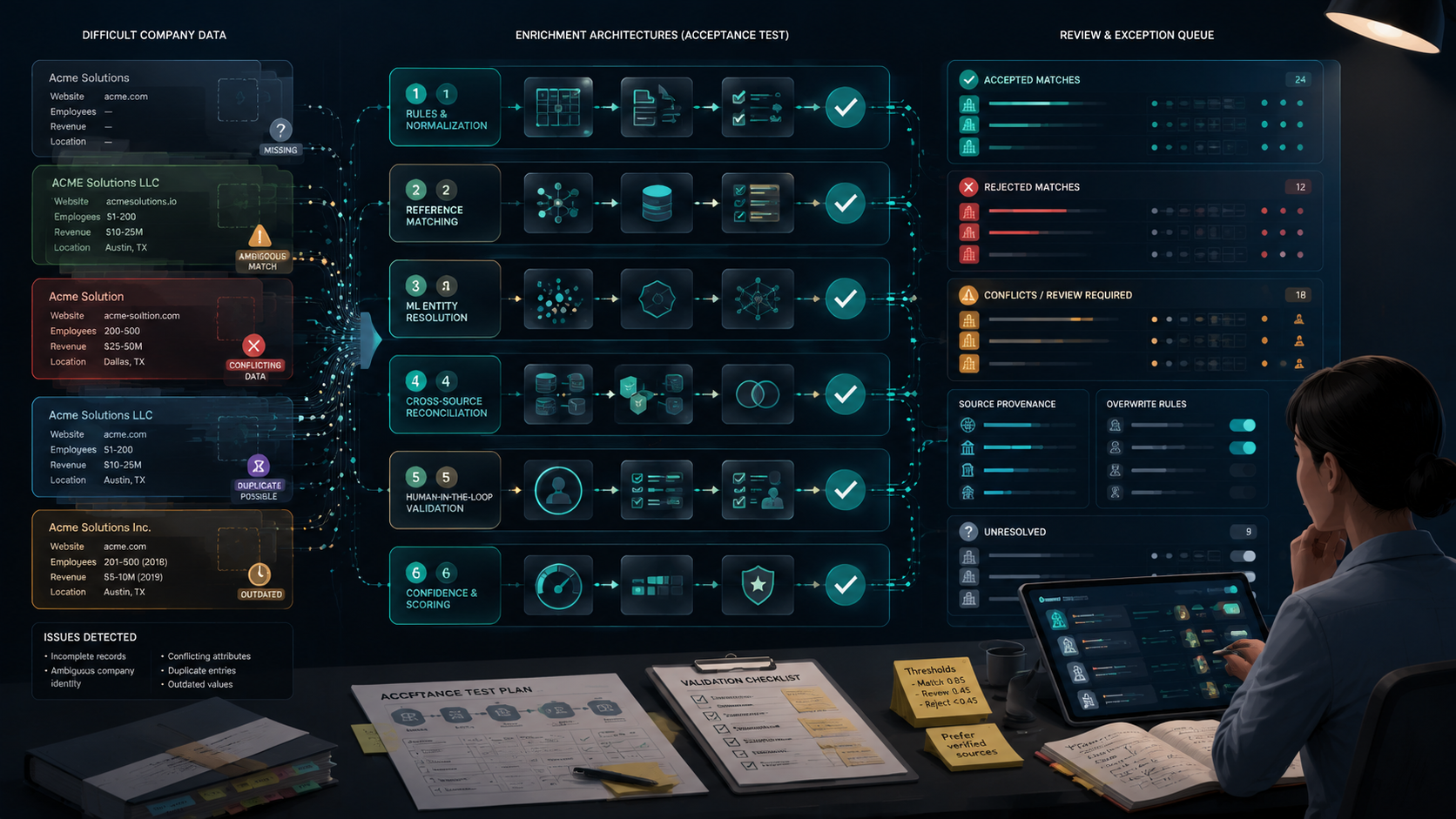
This B2B data enrichment ranking is organized as a procurement evaluation, not as a claim that we ran an undisclosed benchmark. The buyer's job is to choose an architecture for existing company, contact, lead, domain, or event records. The evaluation file should contain known companies, subsidiaries, renamed domains, incomplete rows, similarly named businesses, job changers, regional edge cases, duplicates, conflicting fields, and records that should remain unresolved. That file exposes identity control and conflict handling. A polished set of easy domains mainly proves that enrichment works when the answer is already obvious.
The evaluation question
Which platform makes the buyer's highest-cost uncertainty observable and governable: provider orchestration, integrated revenue operations, API control, CRM maintenance, broad GTM administration, or HubSpot-native enrichment? Keep this distinction attached to the record and the decision it supports. A later reviewer should be able to reconstruct the source, scope, time boundary, alternative explanation, and condition that would reverse the conclusion without relying on team memory.
Build the acceptance file before opening a demo
Give every row an expected disposition rather than an expected pile of fields. Some should match automatically. Some should produce candidates for review. Some should be rejected. Some should update only low-risk properties. Include a gold set whose identity is known, but retain ambiguous examples so the platform cannot score well by overmatching. For contacts, include people who changed employers and names shared by several professionals. For companies, include parent-subsidiary relationships, local domains, brands that differ from legal names, and records with conflicting size or industry values. Define which fields may be overwritten and which require approval.
| Row type | Expected handling | What it tests |
|---|---|---|
| Known company | Match | Baseline identity |
| Subsidiary | Preserve relationship | Entity model |
| Renamed domain | Review/update | Change handling |
| Job changer | Candidate plus date | Person-company identity |
| Ambiguous name | Do not force | Confidence behavior |
| Explicit exclusion | Suppress | Workflow control |
Freeze the overwrite policy
A result is not acceptable merely because it is non-null. Write field-level rules for blank fill, replacement, candidate review, conflict retention, and no-update before the pilot begins. Keep this distinction attached to the record and the decision it supports. A later reviewer should be able to reconstruct the source, scope, time boundary, alternative explanation, and condition that would reverse the conclusion without relying on team memory.
Score decision fitness, not returned-field volume
Use six dimensions across the file. Identity control asks how candidates, confidence, and unresolved records are handled. Data scope asks whether the required company, person, contact, technographic, or contextual fields are present. Freshness asks how observations and updates are dated. Provenance asks whether source and transformation can be retained. Workflow control asks how review, overwrite, permissions, and delivery operate. Architecture fit asks whether the product belongs in an orchestrated workflow, integrated revenue platform, CRM maintenance process, or engineering-owned service. Price and contract terms matter, but they must come from a current quote rather than an undated comparison article.
| Dimension | Pass condition |
|---|---|
| Identity | Correct unit or visible uncertainty |
| Scope | Fields required by the decision |
| Freshness | Observable update or date behavior |
| Provenance | Source and transformation survive |
| Control | Review and overwrite rules are enforceable |
| Architecture | Operating burden matches the team |
1. Clay for multi-provider orchestration
Clay ranks first for the procurement scenario in which the team wants to coordinate several data providers, custom research, enrichment waterfalls, and downstream workflows. Clay's official material documents a multi-provider marketplace, waterfall enrichment, CRM enrichment, signals, custom research, and orchestration. That scope is attractive when no single provider covers the complete task and the operations team can design routing and fallbacks. The acceptance file should test more than retrieval. Review which provider supplied each accepted value, how fallbacks consume credits, how conflicting outputs are resolved, and whether approvals prevent experimental logic from becoming an uncontrolled production update.
Procurement question
Which providers, credits, fallbacks, field rules, audit logs, and approval controls will make the workflow repeatable rather than experimental? Answer this with the fixed acceptance file, current commercial documentation, and the people who will own exceptions in production. A useful answer names what happens to an ambiguous match, a conflicting value, a rejected update, and a record that must remain unresolved.
2. Apollo for enrichment inside a revenue workflow
Apollo is the stronger fit when enrichment sits beside contact and account search, CRM operations, deduplication, signals, and outbound execution. Apollo documents scheduled CRM enrichment, CSV review, API enrichment, job-change monitoring, and duplicate-detection rules. The integrated design can reduce handoffs, but the pilot should keep enrichment quality separate from engagement convenience. Test match logic on difficult records, the behavior of blank and conflicting fields, overwrite rules, regional availability, credit use, and the ability to review changes before downstream action. A team that values one operating environment may rank Apollo above Clay; an orchestration team may reverse them.
Procurement question
How will its match logic, overwrite policy, field freshness, credits, and regional coverage perform against your controlled test file? Answer this with the fixed acceptance file, current commercial documentation, and the people who will own exceptions in production. A useful answer names what happens to an ambiguous match, a conflicting value, a rejected update, and a record that must remain unresolved.
3. People Data Labs for engineering-owned enrichment
People Data Labs fits a team that treats enrichment as data infrastructure. Its official materials document company enrichment and search APIs, configurable match strictness, selectable fields, data feeds, and delivery options. Those capabilities make the engineering team responsible for important choices: request keys, match thresholds, null behavior, schema mapping, storage, licensing, refresh, and observability. The test should inspect candidate behavior at several thresholds and verify that an unresolved record stays unresolved when evidence is weak. API flexibility is valuable when the organization can own the contract around it; it is overhead when the buyer expects a ready-made operational workflow.
Procurement question
What match threshold, null behavior, licensing terms, refresh cadence, and field-level provenance does your production design require? Answer this with the fixed acceptance file, current commercial documentation, and the people who will own exceptions in production. A useful answer names what happens to an ambiguous match, a conflicting value, a rejected update, and a record that must remain unresolved.
4. Cognism for controlled CRM enrichment
Cognism belongs in the evaluation when commercial operations want contact and company maintenance centered on the CRM. Its current official enrichment page describes assessing CRM gaps, choosing the records and fields to update, and running controlled workflows using its data. The buyer should test the exact objects, countries, roles, fields, update events, and integration permissions in scope. Pay special attention to job changes and to records whose current values conflict with returned candidates. The relevant outcome is not a larger completed-field count; it is an accepted update process whose owners can see what changed and stop changes that do not fit their governance model.
Procurement question
Which objects, fields, countries, refresh events, verification methods, and integration permissions are covered in your proposed setup? Answer this with the fixed acceptance file, current commercial documentation, and the people who will own exceptions in production. A useful answer names what happens to an ambiguous match, a conflicting value, a rejected update, and a record that must remain unresolved.
5. ZoomInfo for enrichment in a broader GTM program
ZoomInfo is a fit for larger organizations evaluating enrichment as one part of a broad intelligence and operations environment. Its first-party material describes adding and updating business data for segmentation, routing, maintenance, and GTM workflows. This scenario demands a package-level evaluation. Confirm which modules, data regions, objects, update controls, integrations, permissions, and contract terms are included. Then test whether the accepted fields improve the intended route or segment without erasing internal corrections. A broad platform can consolidate administration, but consolidation is useful only when the operating model and selected package match the work being consolidated.
Procurement question
Which modules, data regions, objects, update rules, contract terms, and admin controls are necessary for the intended use? Answer this with the fixed acceptance file, current commercial documentation, and the people who will own exceptions in production. A useful answer names what happens to an ambiguous match, a conflicting value, a rejected update, and a record that must remain unresolved.
6. HubSpot Breeze Intelligence for HubSpot-centered teams
HubSpot Breeze Intelligence is the natural candidate when enrichment should occur inside an existing HubSpot customer platform. HubSpot's current official material describes contact and company enrichment and property mapping within its AI and CRM environment. The evaluation should identify the subscriptions or credits involved, eligible objects and properties, update behavior, regional coverage, permissions, and the effect on existing automation. Test a copy of the acceptance file rather than allowing early results to rewrite production records. HubSpot-native placement is a meaningful advantage for a HubSpot-centered team; it does not make the product the best architecture for every CRM or data-engineering environment.
Procurement question
Which HubSpot subscriptions, credits, objects, properties, refresh behavior, and regional coverage apply to the current product package? Answer this with the fixed acceptance file, current commercial documentation, and the people who will own exceptions in production. A useful answer names what happens to an ambiguous match, a conflicting value, a rejected update, and a record that must remain unresolved.
Choose the architecture and preserve the exception path
The ranking resolves into an architecture decision. Choose Clay when provider orchestration is the core competency you want to build. Choose Apollo when enrichment belongs inside an integrated revenue workflow. Choose People Data Labs when engineering needs API and delivery control. Choose Cognism when controlled CRM maintenance around commercial data is central. Choose ZoomInfo when enrichment must sit inside a broad GTM program. Choose HubSpot Breeze Intelligence when the existing HubSpot environment should own the experience. OKKI Go is not ranked as a general-purpose enrichment platform because its verified scope does not support that label. Its adjacent role begins after company criteria are clear: it can turn a reviewed company hypothesis into candidates, selected contacts, and a human-confirmed draft workflow.
The governing rule
Prefer the platform that makes uncertainty visible and gives the organization a controlled response. A blank that triggers review can be safer than a confident value attached to the wrong entity. Keep this distinction attached to the record and the decision it supports. A later reviewer should be able to reconstruct the source, scope, time boundary, alternative explanation, and condition that would reverse the conclusion without relying on team memory.
Choose the enrichment architecture that makes ambiguous matches, conflicting fields, review burden, and overwrite rules visible on a fixed acceptance file.
Frequently asked questions
What is B2B data enrichment?
B2B data enrichment adds, updates, standardizes, or connects business information around an existing company, contact, lead, domain, or event for a defined operational use.
What is the best B2B data enrichment platform?
It depends on architecture: Clay for orchestration, Apollo for integrated revenue workflows, People Data Labs for APIs and data infrastructure, Cognism for CRM-centered commercial data, ZoomInfo for broad GTM operations, and HubSpot Breeze Intelligence for HubSpot-centered teams.
Is more enrichment data always better?
No. More fields can add identity errors, stale values, inconsistent definitions, and unsafe overwrites. Required fields should retain source, time, match confidence, and allowed use.
Why is OKKI Go not ranked as a data enrichment platform?
Its verified fact card supports a reviewable prospecting and outreach workflow, not a general-purpose enrichment claim. It is included at the adjacent workflow stage where selected company and contact context becomes a human-approved action.