Firmographic data becomes useful only when field definitions, observation dates, and business rules stay attached to every segmentation decision.
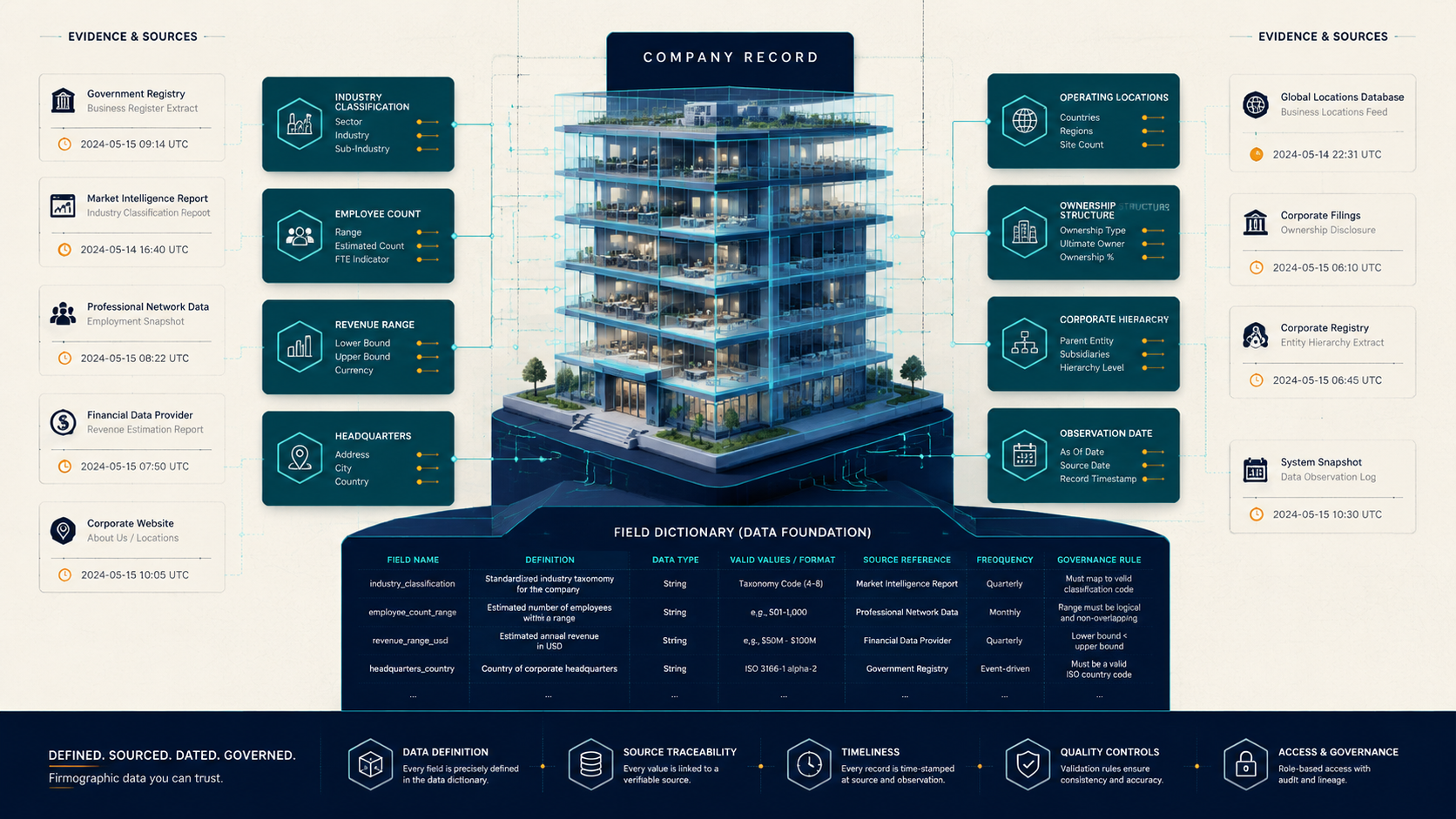
Open a hypothetical company record
Consider a hypothetical company record called Northstar Packaging Systems. The visible website uses the Northstar brand. A legal registry lists Northstar Packaging Systems GmbH. The group page mentions a parent company, two sales offices, and service partners in several countries. A directory labels it industrial machinery; a salesperson calls it a packaging-equipment manufacturer; an imported CRM row says manufacturing. Employee counts differ by source and date. This hypothetical company record is not a customer story. It is a teaching device that shows why firmographic data is more than a neat row of industry, size, revenue, and location. As you read the record, ask yourself: which value can you repeat confidently, and which one still needs a label? Your answer should tell your teammate where fact ends and interpretation begins. A firmographic rule also crosses systems. Your registry record, provider value, CRM account, territory assignment, and campaign segment may update on different schedules. You need enough history to see which layer changed and enough ownership to decide whether the others should follow. Otherwise one correction becomes five unexplained values, and your team will resolve them by choosing whichever screen they opened first.
| Field | Candidate value | Unanswered question |
|---|---|---|
| Company | Northstar Packaging Systems | Brand, legal entity, or account family? |
| Industry | Manufacturing | Which taxonomy and level? |
| Employees | A range | Entity, group, or location; observed when? |
| Geography | Germany plus other markets | Headquarters or operations? |
| Ownership | Parent mentioned | Current and legally confirmed? |
What firmographic data describes
Firmographic data classifies organizations rather than people. Typical fields include industry, employee or revenue bands, location, ownership, legal identity, business model, operating markets, and organizational relationships. A field becomes useful only after its unit, definition, source, observation date, and intended decision are visible.
First decide what counts as the company
The name at the top of a record is not a stable identifier. A brand can represent several legal entities. A legal entity can operate several domains. A parent and subsidiary can share people, products, or addresses while remaining different decision units. Before Northstar receives any segment label, the team must decide whether the record represents a legal entity, an operating company, a selling account, a site, or an account family. Legal Entity Identifier data can support legal-entity resolution where applicable, while company domains and internal CRM relationships may support an operating-account view. Neither source removes the modeling choice. You can test the entity rule with one question: if this subsidiary changes its name tomorrow, which record would you update? If your team gives three answers, your identity model needs work before segmentation starts. You are not managing one tidy example. Your rule will meet subsidiaries, renamed companies, missing dates, and colleagues with different assumptions. When you keep entity, source, time, and purpose visible, you can change one interpretation without rewriting the whole record. Hide them, and the disagreement moves into routing and reporting.
Why identity errors spread
If the wrong unit is chosen, employee count, revenue, technologies, locations, contacts, and engagement may all be attached to the wrong object. Later segmentation can look precise while every downstream rule operates on a mixed entity. Keep this distinction attached to the record and the decision it supports. A later reviewer should be able to reconstruct the source, scope, time boundary, alternative explanation, and condition that would reverse the conclusion without relying on team memory.
Industry is a rule, not a universal label
Northstar can be described as manufacturing, machinery manufacturing, packaging machinery, an equipment exporter, or a service-intensive industrial supplier. Each label may answer a different question. Systems such as NAICS provide a governed classification scheme, but the business still needs to select the taxonomy, edition, hierarchy level, and treatment of multi-activity companies. A sales territory may care about the product sold. Finance may care about the registered primary activity. Marketing may group firms by the problem addressed. Keep the raw source classification, the normalized value, and the business-specific segment separate so a reviewer can see where interpretation entered. Try explaining the industry label to a new colleague. Can you name the taxonomy, level, and business override without opening five tabs? If you can't, your category is convenient, but it isn't governed.
| Layer | Northstar example | Purpose |
|---|---|---|
| Raw | Source's exact category | Preserve provenance |
| Normalized | Mapped taxonomy code and label | Cross-source comparison |
| Business segment | Packaging-equipment target | Current commercial decision |
Nearby data is not firmographic
A named employee is contact or person data. Installed software is technographic data. A website visit is engagement data. A research pattern may be treated as intent data. Those attributes can join an account record, but calling all of them firmographics removes the distinctions needed for consent, freshness, and interpretation.
Size depends on a denominator and a date
An employee number can describe the legal entity, the consolidated group, a single site, an estimate, or a profile's self-reported band. Revenue can be reported, modeled, consolidated, local, annual, or a range. Northstar should not move between small, mid-market, and enterprise segments merely because two providers count different units. Define the denominator and retain the observation date. When sources conflict, do not average values that mean different things. Choose a source hierarchy for the decision, store the alternatives, and mark whether the accepted value is reported, estimated, or derived. Now look at your size field. Do you know who was counted, when they were counted, and why that denominator fits your decision? You don't need perfect precision; you need an honest definition. Imagine your provider changes its employee-count method next quarter. You should be able to identify the affected segments, replay the rule, and explain why an account moved. That is much easier when your accepted value still carries its denominator, date, and source status instead of arriving as an isolated number.
- Entity scope
- Metric definition
- Exact value or band
- Reported, estimated, or derived status
- Source
- Observation date
- Conflict and override rule
A clean number can still be wrong
Validation asks whether the value has an allowed format. Decision fitness asks whether it measures the company unit and period that the segment requires. Both checks are necessary. Keep this distinction attached to the record and the decision it supports. A later reviewer should be able to reconstruct the source, scope, time boundary, alternative explanation, and condition that would reverse the conclusion without relying on team memory.
Geography and ownership answer several different questions
A headquarters country does not tell you where Northstar sells, ships, employs people, owns entities, or can be served. Store headquarters, registered address, office locations, operating markets, and shipping or serviceability constraints as separate fields when the use case requires them. Ownership needs the same care: public or private status, parent relationship, franchise structure, portfolio ownership, and independent operation are not interchangeable. A route-to-market decision may depend more on the company's role as manufacturer, distributor, or service partner than on its headquarters. The correct field set follows the decision, not the convenience of one provider's schema. Ask your territory owner what 'Germany' means in the record. Is it registration, headquarters, operations, serviceability, or ownership? Your schema should let that person answer without guessing. Your segmentation logic will outlive the campaign that created it. A later team may enter a new market, add a product, or redefine serviceability. If you preserve raw values and versioned rules, they can adapt the decision. If you preserve only the label, they must guess what you meant.
| Question | Field |
|---|---|
| Where is it registered? | Legal jurisdiction |
| Where is the main office? | Headquarters |
| Where does it operate? | Operating countries |
| Where can we serve it? | Serviceability rule |
| Which account owns the relationship? | Territory assignment |
Do not infer a market from an address
An address is evidence of a location. It is not automatic evidence of demand, buying authority, export activity, or service fit. Those require their own observations and rules. Keep this distinction attached to the record and the decision it supports. A later reviewer should be able to reconstruct the source, scope, time boundary, alternative explanation, and condition that would reverse the conclusion without relying on team memory.
Trace every field back to source and time
Firmographics can come from official registries, legal-entity systems, filings, company websites, structured directories, licensed datasets, customer-submitted forms, internal CRM records, and modeled estimates. These sources are not interchangeable. A registry may be authoritative for legal status but slow for operating detail. A company website may be current for product positioning but selective about size. A provider can normalize many sources but still needs a match rule. For every critical Northstar field, retain provider or source, locator where available, retrieval time, observation time, transformation, match confidence, and reviewer correction. You will occasionally find two sources that are both credible and still disagree. Don't rush to choose one. Compare their entity, definition, and date first; then your conflict rule can do useful work.
Turn the record into a segment without pretending it is intent
Suppose the team wants European packaging-machine manufacturers with field-service capability. Begin with a named industry mapping, operating geography, business role, and evidence for service capability. Add size only if size changes the offer or route. Exclude distributors if the campaign requires manufacturers. The result is a reviewable company-search hypothesis, not proof that Northstar wants to buy. This is where OKKI Go can support the workflow without becoming a general firmographic-database claim: the user expresses product, buyer type, countries, and exclusions; reviews candidate companies; corrects the route; and selectively proceeds. The company's fit remains a human-reviewed hypothesis. Before you call Northstar a target, read the segment rule aloud. Does each condition describe fit, or has your team smuggled urgency into a company attribute? You want a reviewable hypothesis, not a flattering label. Geography changes in several ways at once. Your company can open an office, enter a market through a distributor, move its legal address, or become serviceable without changing headquarters. You need separate fields and dates so your team can update the relevant decision without pretending every geographic fact changed together.
Finish with a field dictionary, not a prettier spreadsheet
Northstar's record is ready for operational use only when another reviewer can reconstruct it. Give every high-impact field a business definition, allowed values, entity scope, source hierarchy, refresh trigger, conflict rule, owner, retention rule, and list of permitted decisions. Version taxonomies and segment logic. Monitor unmapped values, stale observations, identity conflicts, reviewer overrides, and records that reverse downstream. A field dictionary makes disagreement visible: sales can challenge the serviceability rule without rewriting legal identity, and operations can update a taxonomy without erasing the raw source. Hand the field dictionary to someone who didn't build it. Can they reproduce your accepted value and challenge your override? If they can, you've created operating knowledge rather than another private spreadsheet.
| Control | Question |
|---|---|
| Definition | What exactly does the field mean? |
| Unit | Which entity or location does it describe? |
| Provenance | Which source and date support it? |
| Conflict | Which value wins, and why? |
| Refresh | What event makes it stale? |
| Permission | Which decisions may use it? |
The practical definition
Firmographic data is governed organization-level information. Its value comes from consistent identity, definition, time, and purpose—not from how many company fields a table contains. Keep this distinction attached to the record and the decision it supports. A later reviewer should be able to reconstruct the source, scope, time boundary, alternative explanation, and condition that would reverse the conclusion without relying on team memory.
Publish a field dictionary that fixes entity scope, definition, source, time, conflict rule, owner, and permitted decision for every high-impact firmographic field.
Frequently asked questions
What is firmographic data?
Firmographic data is organization-level information such as industry, company size, revenue band, location, ownership, legal identity, and business model used for classification, segmentation, and account decisions.
What are examples of firmographic data?
Examples include NAICS or another named industry classification, employee band, reported or estimated revenue range, headquarters, operating countries, ownership type, founding year, legal form, and account hierarchy.
Where does firmographic data come from?
It can come from official registries, legal-entity systems, filings, company pages, structured directories, licensed datasets, forms, CRM records, and modeled estimates. Each field should retain source and observation date.
Is firmographic data the same as intent data?
No. Firmographics describe an organization. Intent data interprets research or behavioral patterns. Company fit can be informed by firmographics, but neither category proves that a person will buy.