
The useful question is not how autonomous a sales agent sounds. It is which decisions it may make, which tools it may use, and when a person must take over.

What agentic sales means—and what it does not
A drafting assistant suggests a follow-up. An agentic system may choose the next approved step and carry it out. That crossing—from recommendation to action—is where the questions change. What goal was it given? Which evidence may it rely on? Which systems may it touch? Who granted that authority, and where does an unusual case go?
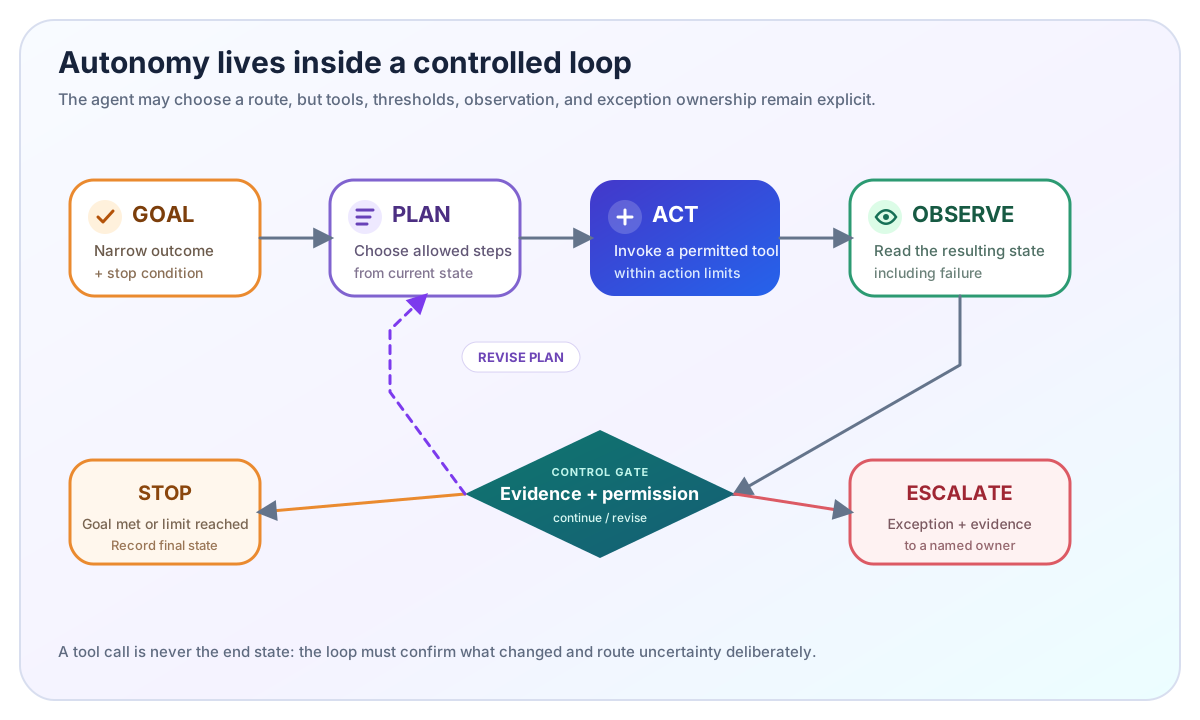
Agentic sales is best understood as bounded delegation: software interprets a sales goal, forms or revises a plan, uses permitted tools, observes results, and decides whether to continue, stop, or ask for help. The word bounded matters more than the word autonomous. Commercial accountability does not migrate into software merely because the software can select a tool.
Three categories clarify the limit. Rule-based automation follows a route designed in advance: when a record enters state A, perform action B. A copilot produces analysis, a draft, or a recommended next step, but a person chooses and executes the action. An agent can choose among allowed steps and execute them through tools.
Anthropic uses a similar technical distinction between workflows with predefined code paths and agents that dynamically direct their processes and tool use. None of these categories is inherently superior. A deterministic rule is often the safer design for stable, high-volume transitions; a copilot fits ambiguous judgment where the person should remain directly in the loop; an agent is useful only when local variation justifies plan selection and the action space can still be constrained.
Classify the system by authority, not by its conversation style
Fluent language can hide a simple rule, and a quiet background service can make consequential choices. So classification should follow observable authority: Can the system choose a step? Can it write to a record? Can it communicate externally? Can it commit money, a discount, a delivery date, or a legal position?
This lens prevents the common mistake of labeling every AI-assisted sales feature agentic. It also keeps evaluation practical. The team can inspect permissions and action logs instead of debating whether the system appears intelligent. The same feature may act as a copilot in one deployment and as an agent in another because the granted tools and confirmation points differ.
How a bounded agentic sales loop operates
A useful loop begins with a goal narrow enough to test: identify companies matching a stated market hypothesis, prepare a draft for selected accounts, or reconcile records with a defined status conflict. The system decomposes that goal into steps, chooses an approved tool, acts, and reads the resulting state. Observation is not merely collecting more text. It means checking whether the company set fits the criteria, whether a record write succeeded, whether a reviewer rejected a draft, or whether an external action returned a failure. The next move follows from that observed state: continue, revise the plan, stop at a threshold, or escalate. Without those exit choices, repeated tool use is not a controlled operating loop.
Consider account research as a contained example. A user gives OKKI Go a product description, buyer type, target country, and exclusions. The documented output is a candidate-company set with business context. A person reviews that set, selectively unlocks companies, and may correct the search route after seeing the first candidates.
The usable result is therefore a human-approved research set and a refined route, not an automatic declaration that a company will buy. The input, output, confirmation, and result are visible, which makes this a useful pattern for bounded delegation even though it should not be mislabeled as an end-to-end autonomous seller.
Map use cases to a state change
Across the funnel, the relevant unit is not a flashy task name but a controlled state change. Research can turn a hypothesis into a review queue. Qualification can turn observations into a proposed routing state. CRM hygiene can identify stale or conflicting fields and propose a correction. Opportunity monitoring can surface a missing owner or overdue action. Follow-up preparation can turn approved context into a draft. Cross-functional coordination can assemble evidence for an approval request. Each use has a different risk profile. Reading records is not the same as rewriting them; proposing a message is not the same as sending it; creating an approval packet is not the same as approving a concession. Keeping those distinctions explicit prevents a low-risk experiment from silently expanding into broader authority.
Data and integrations define the agent's working world
An agent does not see the business; it sees the context exposed through prompts, retrieval, records, and tool responses. That context needs meaning as well as access. A field labeled status must have allowed values and an owner. A date needs a timezone and freshness rule. A company identity needs a matching key and source history.
Salesforce documentation, for example, treats lead status, assignment, conversion, and history as distinct elements. The point is not that one CRM supplies a universal model. It is that delegated work needs explicit state and traceable handoffs. If a system cannot distinguish an observation from an approved state, its plan may be coherent in language while wrong in operation.
Integration design should expose the smallest useful interface. A research service may need read access to company context but no right to edit an opportunity. A hygiene service may propose a normalized field value but require review before overwriting the record. An outreach workflow may draft without owning send authority.
This principle also reduces diagnostic ambiguity: when the system has fewer tools, reviewers can more easily reconstruct why it selected a step and what changed. Data-quality work remains continuous. The UK Government framework describes definition, measurement, improvement, governance, and ownership as an ongoing practice; that is a sound operating stance here, but it does not prove that any particular commercial dataset is accurate.
Keep preparation separate from external execution
A second product example shows the separation. For an unlocked company, a user supplies company context and product materials to OKKI Go. The system can surface contact clues and produce a context-based draft. The person confirms the recipient, subject, and body before anything is sent.
The usable result is an approved, send-ready message tied to selected context, not an autonomous relationship decision. This four-part trace—provided context, generated output, explicit confirmation, usable artifact—is what a commercial systems owner should demand from any delegated workflow. It makes the handoff inspectable and leaves the consequential act with the named owner.
Set the permission boundary before execution
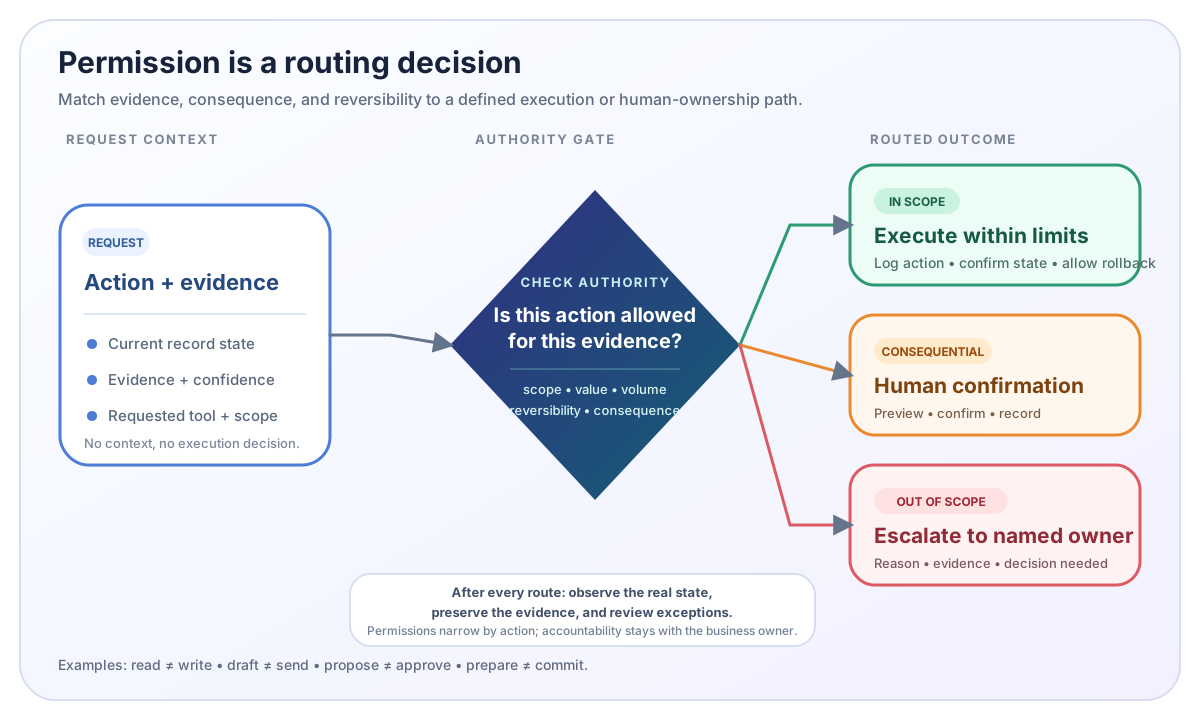
A permission model should distinguish at least reading, drafting, proposing a record change, writing a reversible change, sending externally, approving a commitment, and spending money. It should also limit scope by object, account segment, time window, geography, value, and volume. The decisive question is not whether an agent can technically invoke a tool. It is whether that specific action is authorized under the current evidence and state. Consequential actions deserve confirmation or a stronger approval route. Reversible internal actions can sometimes proceed within a narrow threshold, provided they are logged and can be rolled back. Irreversible, regulated, contractual, financial, or reputational moves should reach a qualified human owner rather than a generic review queue.
Escalation assigns exceptions to an accountable owner
Escalation needs a reason code and a destination. Useful triggers include missing evidence, conflicting records, tool failure, low-confidence identity, a requested action outside scope, repeated unsuccessful revisions, an unusual value, or a human rejection.
The receiving person needs the goal, evidence used, attempted steps, latest observed state, and exact decision requested. Otherwise escalation merely transfers confusion. NIST's GOVERN, MAP, MEASURE, and MANAGE functions offer a vocabulary for assigning oversight, understanding context, evaluating risk, and responding to it. They do not certify the system, ensure compliance, or make autonomous sales action safe by declaration.
Make outcomes and failures visible to the owner
Confirmation does not end control; the resulting state must be observable. In the documented OKKI Go flow, the input is a message whose recipient, subject, and body a user has confirmed. The output is a visible send status or failure reason.
A person then decides whether the evidence supports retrying, correcting, or stopping. The usable result is a traceable communication state rather than an assumed success. That last step matters across agentic sales: a tool invocation is not the business outcome, and silence from an integration is not proof that the intended state occurred.
Measure control quality before claiming commercial impact
Early measures should test whether the workflow behaves as designed. Track the share of actions supported by required evidence, valid tool calls, successful state confirmation, permission denials, human rejections, escalations by reason, reversals, unresolved failures, and time to human resolution.
Add review effort: how often must a person reconstruct context, correct a draft, or undo a change? These measures reveal whether delegation actually reduces coordination or merely hides it.
Data-state integrity matters too: duplicate writes, stale reads, conflicting owners, and missing histories can make a fast loop operationally worse. Targets must be local because action risk and system architecture vary.
Commercial measures come later and need a comparison that respects selection effects and workflow changes. A team may observe changes in research throughput, accepted drafts, response handling time, opportunity-state freshness, or cycle time, but those observations do not by themselves prove that the agent caused pipeline or revenue movement.
Keep an operating baseline, record human policy changes, and separate attempted actions from completed states. No source in this evidence pack supports a universal ROI, conversion, productivity, or replacement claim. The honest aim is a workflow whose decisions can be inspected and improved, not a headline autonomy score.
Stage adoption by widening one permission at a time
Begin with one workflow whose start state, allowed tools, stop state, reviewer, and recovery path are understood. Run it first in observation mode, then recommendation mode, then limited execution if the evidence supports that move. Review failures by cause, not only by count.
Adopt one closed loop, then widen authority deliberately
Widen one dimension of authority at a time—perhaps account scope, write access, or volume—so a changed result can be traced. Keep high-consequence decisions with people until governance, evidence, and recovery are demonstrably adequate for the specific context. The practical first step is small: choose one sales action and write down its permission limit before delegating it. If the team cannot name the exception owner, the workflow is not ready to act.
Frequently asked questions
What is agentic sales?
Agentic sales is bounded delegation of sales work to software that can interpret a goal, choose steps, use approved tools, observe state, and continue, revise, stop, or escalate within defined authority.
How is a sales agent different from a copilot?
A copilot proposes analysis, content, or a next step while a person executes it. An agent can select and execute permitted steps. The distinction depends on deployed authority, not conversational style.
How is an agent different from rule-based automation?
Rule automation follows a predefined route. An agent can choose among allowed steps based on the goal and observed state. Stable transitions may still be better served by deterministic rules.
Which sales actions should require human review?
Review should rise with consequence and irreversibility. External messages, commitments, pricing, spend, regulated decisions, broad record changes, and unresolved identity or evidence conflicts should reach qualified owners.
How should agentic sales be measured?
Start with required-evidence coverage, valid actions, confirmed states, permission denials, human rejections, escalations, reversals, failures, and review effort. Evaluate local commercial outcomes only after the workflow is controlled and observable.