
Four reviewed provider records show why disclosure completeness must come before a coverage ranking.

Start With the Signal Definition, Not the Coverage Number
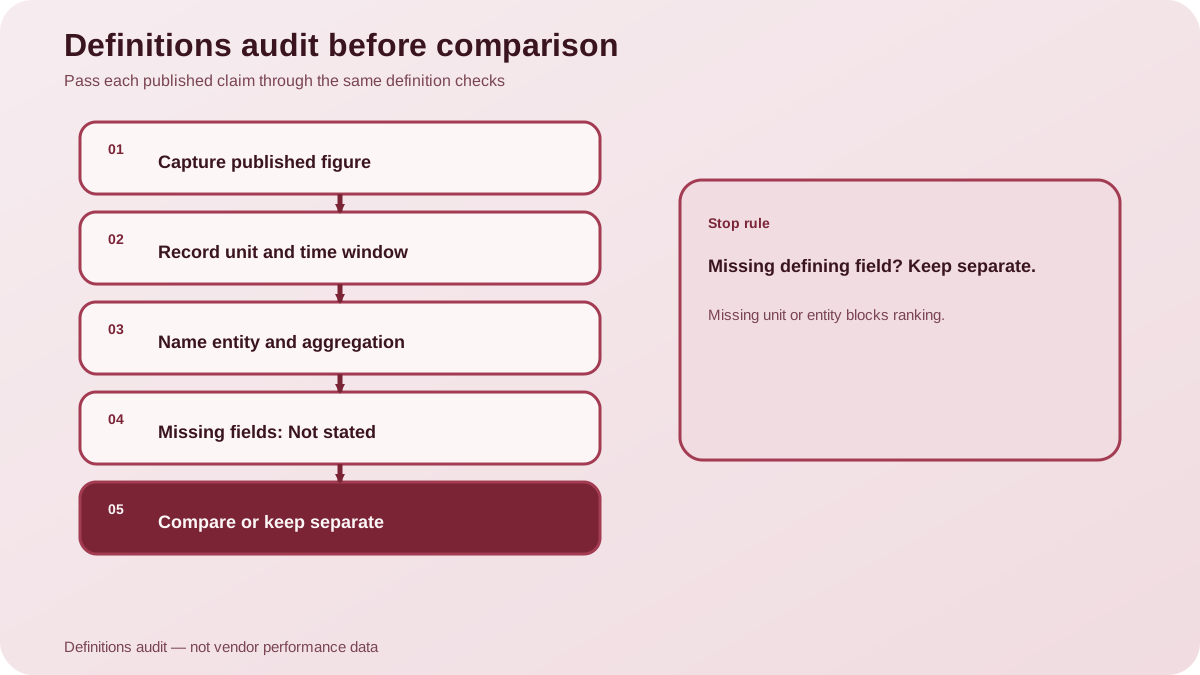
Let's begin with a basic fact: a scale figure becomes comparable only when we know what it counts. For intent data providers, that means naming the source mix, coverage denominator, aggregation level, refresh cadence, and consent or source basis. A website count, a device share, an IP-to-organization pairing, and a topic count are different units. Vendor pages may publish all of them as evidence of scale, but putting them in one ranking column would erase their definitions. In this review, we opened only the approved pages and kept a compact audit note for every assertion we used. We wrote the vendor, the August 2026 check date, the speaker, the subject, and the exact unit before we summarized anything. Then we asked: What is counted? Which universe sits underneath it? At what level is activity returned? Which clock does the page describe? Does it state a consent or collection basis? When a page didn't answer, we kept the field blank instead of borrowing an answer from a different page or vendor. That sequence is why the useful first output isn't a ranking. It's a set of disclosure records. The four records below preserve vendor attribution, do not estimate missing values, and do not rank the providers.
- ZoomInfo. Source mix: ZoomInfo's pages, checked August 2026, describe four sources: content consumption, bidstream signals, IP-based identification, and third-party review-platform integrations. Denominator: Not stated in the reviewed source. The page separately reports sourcing for named pairing claims from more than 90% of accessible United States devices, but it does not define that as the denominator for overall intent coverage. Aggregation level: Not stated in the reviewed source. IP-to-organization and keyword-to-device pairings are named inputs, not a disclosed final output level. Refresh cadence: ZoomInfo says intent data refreshes daily; a separate scale statement says the named pairings are sourced monthly. Consent/source basis: Not stated in the reviewed source.
- Bombora. Source mix: Bombora's pages, checked August 2026, describe a proprietary consent-based data cooperative with more than 5,000 B2B websites. A Demandbase provider comparison, also checked August 2026, characterizes Bombora's contributors as B2B publishers supplying anonymized content-consumption data for aggregated insights. Denominator: Not stated in the reviewed source. Aggregation level: Not stated in the reviewed source. The phrase aggregated insights does not identify a returned entity or measurement level. Refresh cadence: Not stated in the reviewed source. Consent/source basis: Bombora says the data is collected directly, with consent, from its proprietary source rather than siphoned or scraped.
- 6sense. Source mix: The 6sense tutorial, checked August 2026, lets a user filter by another intent source, which establishes that selectable sources can differ, but the complete source mix is Not stated in the reviewed source. Denominator: Not stated in the reviewed source. 6sense separately claims intent tracking in more than 40 languages and coverage ten times that of another provider, but the reviewed page does not supply a denominator that makes that coverage claim comparable. Aggregation level: Not stated in the reviewed source. Refresh cadence: Not stated in the reviewed source. Consent/source basis: Not stated in the reviewed source.
- Demandbase. Source mix: Not stated in the reviewed source. Denominator: Not stated in the reviewed source. Aggregation level: Not stated in the reviewed source. Refresh cadence: Not stated in the reviewed source. Consent/source basis: Not stated in the reviewed source. The reviewed Demandbase guidance, checked August 2026, tells buyers to seek transparency into sourcing and refresh, ideally daily, but that buying advice is not a disclosure of Demandbase's own product definitions. Its reviewed comparison of Bombora is likewise a description of another provider, so it cannot fill the Demandbase record.
Define the Unit Before the Operating Outcome
The records reveal the operating choice. ZoomInfo discloses a named multi-source method and two timing statements, Bombora discloses a consent-based cooperative and taxonomy context, 6sense discloses selectable intent sources while leaving the comparison fields incomplete in the reviewed pages, and the reviewed Demandbase pages provide selection advice rather than Demandbase-specific definitions. That is uneven disclosure, not a league table. A blank preserves what the evidence can and cannot establish. Once the unit is clear, a buyer can decide whether the signal fits a named-account workflow, a broader research process, or a pilot. Before that point, the largest number answers only the vendor's own framing.
Make each audit record reproducible by preserving seven elements together: the speaker making the claim, the product or provider that is the subject, the exact unit, the denominator or universe, the returned entity and aggregation level, the relevant clock, and any field the reviewed material leaves unstated. I use a simple replay test. Could a second reviewer reopen the dated source, identify the same sentence, and reach the same classification without interpreting a marketing headline? If the answer is no, the record isn't ready for comparison. Suppose a page says a provider covers millions of businesses. I don't copy that figure into a ranking until I can answer what counts as a business, which geography and time window define the universe, whether the delivered object is an account or another entity, and who made the statement. If the denominator is absent, I write Not stated in the reviewed source. I don't infer it from a different page. That discipline also separates disclosure quality from product quality. A complete record means the claim is ready to test; it doesn't mean the signal is accurate, useful, compliant, or commercially superior. You can therefore keep a well-documented provider in the pilot without declaring it the winner, and you can test a sparsely documented provider while keeping its headline claim outside the ranking. Those questions belong to the fixed-cohort pilot and to legal or operational review, not to the definitions audit.
Audit Source, Denominator, Entity, and Three Clocks
Start with source mix because it defines what activity can enter the system. Next ask for the denominator behind any coverage statement. Then name the aggregation level, since a device, organization, website, publisher, and topic are not interchangeable. Put cadence after those fields and separate source collection from the refresh of the intent output. Finally, record the vendor's stated consent or collection basis without turning it into an independent legal judgment. ZoomInfo's guidance, checked August 2026, says understanding signal origins helps buyers audit coverage and avoid dependence on one source. Demandbase's guidance from the same check month recommends transparency into sourcing and refresh. Together they support questions to ask, not a provider score.
Taxonomy deserves its own dated note. Bombora's current concepts page, checked August 2026, describes tens of thousands of topics across industries, brands, solutions, technologies, capabilities, challenges, and market segments. That is Bombora's taxonomy description, not an account-coverage figure, source-breadth measure, or performance result. In an OKKI Go workflow, preserve the upstream provider name, checked date, and definition beside any transferred intent field so a familiar destination does not make an incomplete source claim look normalized.
Timing needs three separate clocks. Source-event time answers when the underlying activity occurred. Processing or score-refresh time answers when the provider recalculated the delivered signal. Delivery time answers when the customer system received the new value. A page that says data refreshes daily may be describing only one of those clocks; a separate monthly sourcing statement may apply to a named input rather than to the final signal. Ask the supplier to label each clock and provide a sample record that exposes it. Without that separation, two providers can both say daily while delivering materially different recency, and a team can mistake a newly delivered score for newly observed activity.
Turn Every Feature Claim Into a Supplier Question
Turn each feature claim into a supplier question. Ask which activity sources contribute and what is excluded. Ask what exact universe forms the denominator, including geography or account set. Ask at what entity level activity is returned after resolution and aggregation. For timing, ask which event is refreshed on the stated cadence and when the underlying activity occurred. For collection, ask what source and consent basis the vendor states for every category. Answers should fill separate fields, because one detailed answer cannot substitute for silence in another field.
Keep Undefined Provider Claims Out of the Ranking
The first risk is treating absence as equivalence. If two pages omit aggregation level, that does not mean both products aggregate the same way. It means the reviewed sources do not answer the question. The second risk is promoting a partial definition into a complete one. Bombora's own material, checked August 2026, states a proprietary, consent-based cooperative and describes direct collection with consent. That fills the source-basis field. It does not automatically fill the denominator, aggregation level, or refresh cadence. Each field must stand on its own evidence.
The third risk is mixing the speaker with the subject. Demandbase's comparison page, checked August 2026, calls Bombora a consent-based cooperative whose Company Surge product identifies research above an account's normal baseline. That is Demandbase describing Bombora, not Bombora defining Demandbase and not an independent comparison. The same discipline applies to buying advice. Demandbase's recommendation to seek daily refresh transparency is useful as a provider due-diligence question, but it is not evidence that Demandbase itself discloses a daily cadence in the reviewed source. Keeping speaker, subject, and checked date together prevents marketing context from becoming a neutral benchmark.
Test Whether a Blank Changes the Shortlist
A blank should trigger one of two actions. Ask the supplier for a current methodology document, or keep the affected figure outside the comparison. Do not fill the gap from another vendor's page, infer an entity level from an input pairing, or translate a taxonomy total into coverage. The record can still help plan a pilot, because it shows exactly what must be verified. It simply cannot support a rank yet.
Test Comparable Definitions on One Fixed Account Cohort
Suppose a team must choose which feeds deserve a pilot for one fixed account cohort, and reviewer time allows only a consistent sample from each feed. In this review, we treated the four published records above as the team's first audit sheet and read them side by side. Could we name the complete source mix? Did the page disclose a denominator? Could we identify the returned aggregation level? Which refresh clock was actually stated? Did the reviewed source describe its own consent or collection basis? We didn't count a fuller row as a better product, and we didn't turn a blank into a zero. ZoomInfo's reviewed pages provide named source categories and timing statements, while Bombora's provide a consent-based cooperative description but no reviewed refresh cadence. The 6sense record confirms selectable intent sources but leaves the full mix undefined. The reviewed Demandbase pages leave all five Demandbase-specific fields unstated. So we use each blank to draft a supplier question, not a score. We keep any scale figure without an aligned unit outside the initial comparison. That's the practical difference between auditing disclosure and pretending we've measured performance.
Before viewing results, the team writes what counts as a matched account, freezes the cohort, and requires each supplier to return matched, unmatched, and ambiguous records. It also asks when the source activity occurred and when the delivered value changed. A supplier that supplies the missing definitions can move its figure into an aligned pilot comparison. A supplier that does not can still be tested, but its headline scale claim remains contextual rather than ranked. This exercise decides whether claims are defined well enough to test. It does not predict revenue, establish privacy compliance, or prove that the provider with more disclosures will perform better.
- Definition completeness — count how many required fields have supplier-backed answers before testing. Treat Not applicable as an explained answer and Not disclosed as unresolved; do not turn either into a performance score.
- Match disposition — for the frozen account cohort, require matched, unmatched, and ambiguous outcomes whose totals reconcile to the cohort. This tests whether every account receives an explainable disposition, not whether a match is commercially valuable.
- Ambiguity rate — divide ambiguous records by the frozen cohort or returned set, using one denominator for every supplier. Inspect the reasons rather than assuming a lower rate proves better data.
- Lineage retention — sample returned records and check whether source category, observed or processed time, returned entity, and provider definition survive export into the customer workflow. A missing field triggers clarification or a keep-separate decision.
- Definition stability — repeat the audit after the supplier resolves questions and record which definitions changed. A changing definition may be legitimate, but the team must not compare pre-change and post-change results as one unit.
Request Proof That Survives the Handoff
Ask for the current methodology page, a data dictionary, one sample record, and a cadence description that distinguishes collection from delivery. Then require a reviewer to trace a named source category into the returned entity without relying on a sales slide. The checked date and vendor attribution should travel with the definition. If the explanation disappears when data leaves the supplier interface, the handoff is not yet auditable.
Provider Due-Diligence Questions Before the Pilot
Make the definition record part of the provider due-diligence questionnaire and require the supplier to distinguish not disclosed from not applicable. Keep the response attached to the field through evaluation and downstream use. If OKKI Go is part of the broader account-research workflow, carry the provider name, source definition, and timing note with the upstream signal. The destination should not make an undefined input look more precise.
- Name every source category included in the claim and any stated exclusions.
- Define the denominator and geography behind every coverage figure.
- Name the returned entity and the level at which activity is aggregated.
- Separate source collection, score refresh, and delivery timing.
- Record the vendor's stated collection and consent basis, with its checked date.
- Write Not stated in the reviewed source wherever the reviewed material is silent.
- Keep figures outside a ranking until the units and time windows align.
Every provider answer should change the next decision. A complete, reproducible definition can enter the fixed-cohort pilot. A partial answer should generate a named clarification with an owner and due date. A figure whose unit, denominator, returned entity, or time window remains unresolved stays outside cross-provider ranking, even if the provider itself remains in the pilot. A contradiction between the methodology page and sample record triggers reconciliation before results are interpreted. This consequence map stops the checklist from becoming procurement paperwork: each field either admits a claim to comparison, sends it back for clarification, or keeps it separate.

Set the Acceptance Checkpoint Before the Pilot
A figure is ready for cross-provider comparison only when another reviewer can reproduce its source mix, denominator, aggregation level, and time definition. A provider can still enter a pilot with incomplete public disclosure if the supplier supplies those definitions directly and the team preserves them. What cannot enter is an estimate disguised as a fact. The shortlist now has a simple discipline: compare aligned units, test them on the same cohort, and leave every unresolved field visibly blank.
The four records are useful because they preserve uncertainty instead of hiding it. Keep each vendor's words, checked date, and explicit blanks, then compare only the units that truly align.
Frequently asked questions
Which intent data provider metrics can be compared directly?
Compare only claims that share a defined unit, denominator, returned entity, aggregation level, geography, and time window. Website, device, pairing, topic, and coverage figures are not interchangeable simply because each is presented as scale.
How should an intent data provider disclose refresh timing?
Require three labeled clocks: when the source activity occurred, when the provider processed or recalculated the signal, and when the customer system received it. A statement such as daily refresh is incomplete until it names which clock it describes.
What does a fixed-cohort pilot measure before provider performance?
It measures definition completeness, matched, unmatched, and ambiguous dispositions, ambiguity rate on one stated denominator, lineage retention, and definition stability. Those checks establish whether results are interpretable; they do not prove commercial superiority or compliance.
When should a provider claim stay outside the shortlist ranking?
Keep it separate when the unit, denominator, returned entity, aggregation level, or relevant clock remains unresolved, or when the methodology page contradicts the sample record. The provider may still enter a pilot, but the undefined claim should not enter a cross-provider ranking.