
I don't add steps until the first message can survive the mailbox and still produce a classified next conversation.

The live sequence that never lands
The sequence is still running. Step four just fired. The merge field filled. The follow-up timer did its job. And I still don't have a classified next conversation, because the first message never landed as mail the provider would accept. That's the 2026 failure I start with. Not a missing subject-line formula. A live cadence that cannot land.
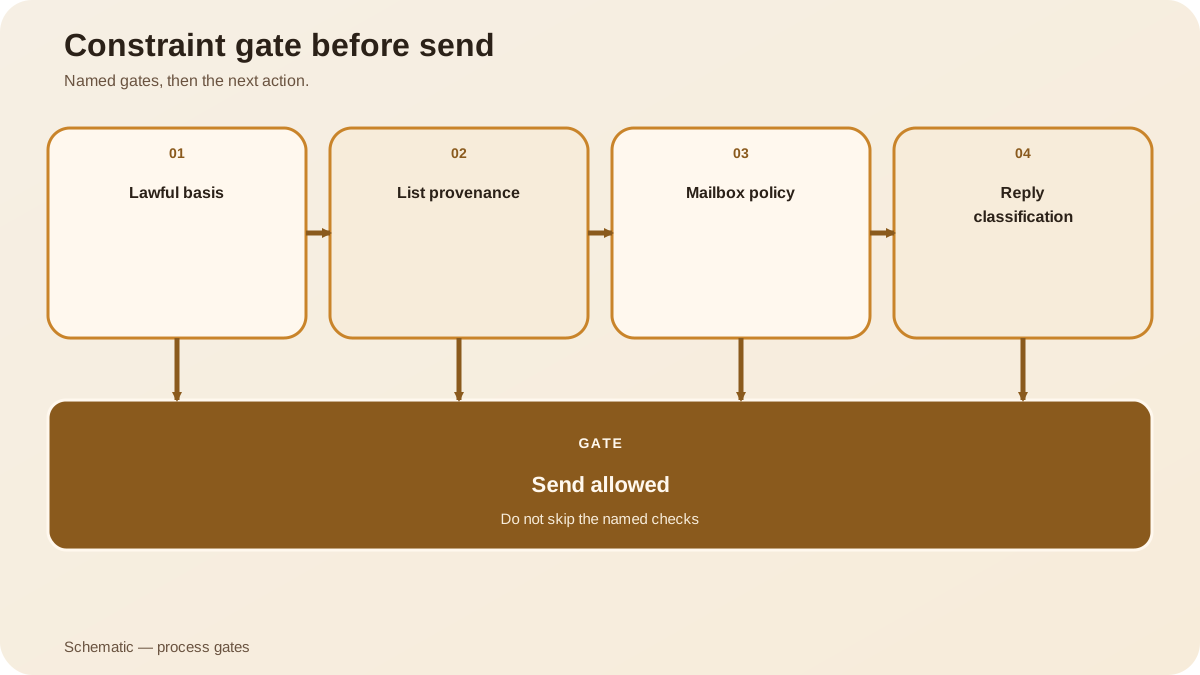
I refuse the default upgrade story for cold email strategies 2026. People treat the year as more AI personalization, more steps, and a fresh subject-line pack. I don't. A cold-email strategy, as I use the phrase here, is the set of controls that decide whether an unsolicited commercial message may leave, how a reply is classified, and what gets suppressed before the next send. Cadence length is not that set. Cadence is a schedule sitting on top of it. Generation got cheaper. Mailbox and recipient tolerance for volume did not get cheaper with it. So the year changes the operating constraints: mailbox filters, lawful basis, list provenance, and reply handling now decide whether a strategy can run at all. If I cannot name those four, I don't have a 2026 strategy. I have a longer tape of messages. A 2026 cold-email strategy is credible only if it can survive provider and recipient constraints while still producing a classified next conversation, not if it ships a longer automated sequence. Classified means I can say what the reply was: interested, not now, unsubscribe, out of office, hard bounce, or a complaint I must stop. A longer sequence that never produces that classification is noise with a calendar. Gmail and Outlook publish sender requirements as systems I inspect, not inbox folklore. I answer the FAQ at the end.
Yahoo's sender guidance is the evidence I use for that definition, not a copy trick. Deliverability, in that official frame, is a system problem of authentication, complaint control, unsubscribe handling, and separating message streams. It is not a single-point repair I can buy by rewriting a subject line. If my 2026 plan starts with subject formulas and ignores authentication, complaint rates, one-click stop, and stream separation, I am not updating a strategy. I am decorating a send that Yahoo already treats as a systems failure. Those requirements apply to mail sent to Yahoo consumer services, and they can change, so I re-read the current Sender Hub before I treat last quarter's checklist as law.
So I don't rank 2026 playbooks by how many touches they add. I rank them by whether they can still send after those systems are in place. Extra steps are theater if they can't.
Authentication is not a subject-line patch
The decision detail I verify is simple. Can this strategy name authentication, complaint control, unsubscribe, and stream separation before it names a follow-up day? If the answer is no, I don't care how clever the third email is. Yahoo's published best practices retrieved 27 July 2026 are the date stamp I attach to that check. I don't invent an effective-date clause the page doesn't give me. I do treat current official sender requirements as the thing that moved, not the copy calendar. That's what changed.
Who the 2026 constraints actually hit
Not every sender is in the same bucket. That's the first strategy error I see. Teams copy a high-volume Gmail rule onto a 400-message week and call it compliance. Or they ignore a high-volume rule because last year's sequence still felt fine.
Who is affected depends on the provider's governing condition, not on my job title. Gmail's sender guidance, as I have to teach it for cold email strategies 2026, splits two groups: requirements that apply to all senders, and additional requirements for senders who send more than 5,000 messages a day to Gmail. I must not write the high-volume threshold as if it were the universal rule for every cold email. If I am under that daily Gmail threshold, I still have all-sender requirements. I don't get a free pass into folklore. If I am over it, I inherit the extra high-volume layer, and copying a simple eight-step cadence from a post that never mentions the split is how I fail quietly. Process and workflow have to encode that split before the sequencer starts. I write who the recipient is, which mailbox provider I think I'm hitting, whether today's Gmail volume crosses 5,000, and what happens if a reply is an objection. That's a strategy, because it chooses what not to send. A longer cadence that skips the split is not a strategy. It's a template with a date stamp. I keep <a href="https://go.okki.ai/">OKKI Go</a> in that workflow only as a review surface before I authorize a send, never as an excuse to add steps. Applies to personal Gmail delivery. I recheck the live help page before I publish the next internal rule.
- Name the mailbox split before you name the follow-up day.
- Record list provenance and lawful basis on the record that would be sent.
- Classify the reply before the next automated step fires.
- Suppress on complaint, unsubscribe, and hard refusal, then stop the cadence.
Split Gmail's all-sender and high-volume rules
The other party who is affected is the recipient under UK marketing rules when that's the relevant guidance. ICO's direct-marketing order is not a copy workshop. I identify that the message is marketing, I plan the data processing, I collect fairly, then I respect objection. I don't start with personalization tricks. If my list provenance can't survive that order, more steps don't help. This is UK regulatory guidance, not universal legal advice. I still use it as the process spine when UK recipients are in the file, because lawful basis and list provenance are the strategy, not the PS line. The Gmail 5,000-a-day split and the ICO order hit different people. I still have to hold both in the same workflow when both apply. That's who is affected. Not everyone who bought a sequencer.
Where volume-first tools stop diagnosing
The old practice holds when volume is low, the list is explainable, and a human reads every reply. It breaks the moment a tool treats landed in spam as a diagnosis and answers with more steps.
It breaks in Outlook the same way it breaks in Gmail. I copied a high-volume rule, or I ignored one, and then I diagnosed with a feeling. Microsoft's published Outlook requirements for high-volume senders tell me to check whether I even fall in that high-volume scope first. Then I check SPF, DKIM, and DMARC. Then I read a specific 550 5.7.515 rejection instead of shrugging that the message went to junk. A sequencer that only reports open rates cannot do that job. Neither can a subject-line tester. Those are tools, not the diagnostic. If my 2026 stack cannot tell me whether I am in the high-volume Outlook.com consumer-domain bucket, I am not running a deliverability program. I'm decorating a bounce. Tools I actually need are authentication inspectors, complaint and unsubscribe handlers, suppression lists, and a reply classifier. Cadence software is optional after those. If the tool's main button is add step, I treat it as a risk until the 550 code is readable. Current mailbox and commercial-email provider policies are the governing condition. The old practice of adding a fifth follow-up because the fourth did not convert does not survive that condition. It only holds while nobody asks for the rejection code.
Reply classification and suppression are strategy controls, not afterthoughts. A safer way to scale personalization, in Microsoft Learn's outreach-simulation guidance, is to run a simulation on representative leads, review the drafts and the research basis, then decide whether to release a real send. That's a tool in the honest sense. It can stop a send. A 2025 habit of pushing the next AI-personalized variant live because the sequence slot is empty is the opposite tool. I keep the simulation in front of the sequencer. Token use and product availability are configuration-specific. I don't treat that Learn page as a universal product promise. I treat it as the order of operations: simulate, review, then maybe send.
Read the 550 code before adding a step
The implication is operational. If the next tool I buy cannot show high-volume scope, SPF, DKIM, DMARC, and a 550 5.7.515 when that's the rejection, I don't buy it to fix cold email strategies 2026. I already have enough sequencers. I need a stack that can fail a send on evidence. That's where it dies.
Controls that beat a longer cadence
I compare strategies by what they suppress, how they classify replies, and what they learn after a send, before I compare sequence length. That's the whole rule. Step count is vanity until those three exist.
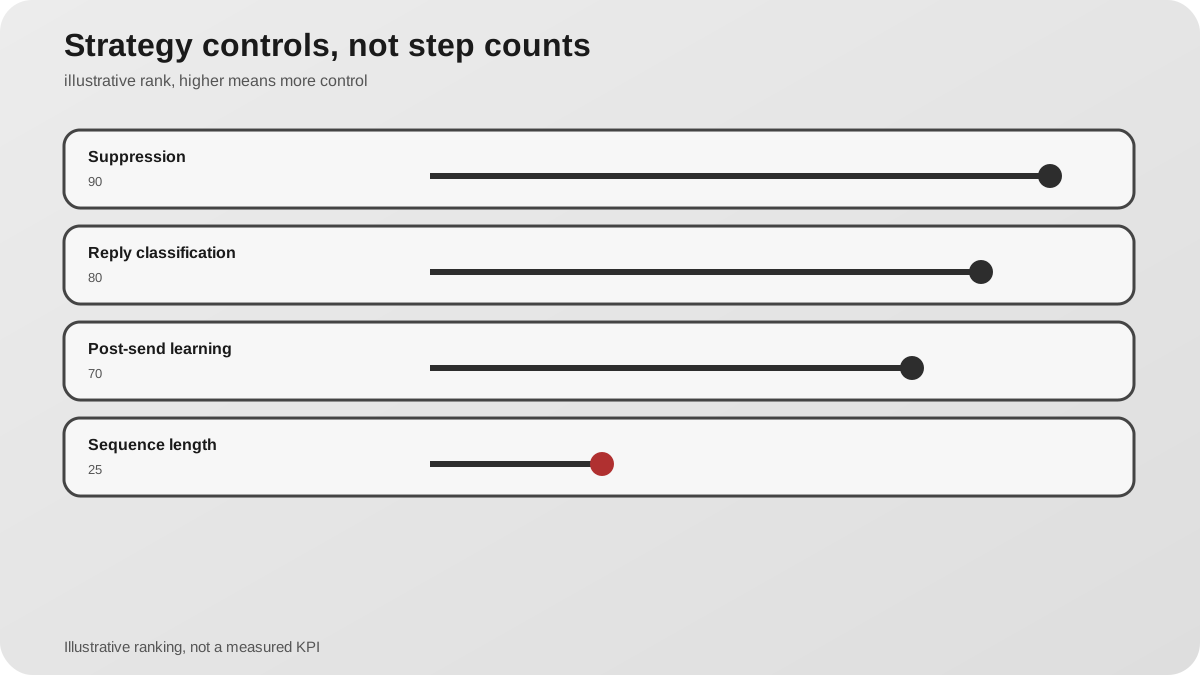
Here's the walkthrough I actually run when a team says they updated cold email strategies 2026 by adding AI personalization, more steps, and new subject lines. Scenario: a UK file of unsolicited commercial mail, a purchased list whose collection story nobody can narrate, and a sequencer already loaded with extra touches. Operating constraints are mailbox filters, lawful basis, list provenance, and reply handling. The parameters I can name are that the message is marketing, the recipients did not request this send, and the data file has no fair-collection story attached. I treat this as a scenario_assumption: the extra steps are already purchased and scheduled, and the team believes subject-line formulas will repair landing. I change the work from drafting first to the ICO order: identify the marketing nature, plan the data processing, collect fairly, then respect objection. What I observe is a halt. I do not get a classified conversation, because I never earned a lawful send. Data and deliverability fail together here. A Yahoo-style systems gap and an unexplained list are the same operational outcome: the message should not leave. The decision that follows is to rank suppression, reply classification, and post-send learning ahead of cadence length, and to park the extra AI variants. That walkthrough is UK guidance, not a global statute, so I recheck the local basis before I copy it. If I need a reviewed company-search path before outreach, I look at <a href="https://go.okki.ai/">OKKI Go</a> the same way I look at any other control: does it stop an unexplained send, or does it just make the next draft cheaper?
- Identify that the outbound message is marketing before you brief the copy.
- Plan the data processing for that send, including who may receive it and why.
- Collect and use contact data fairly, with a provenance story you can narrate.
- Respect objection, unsubscribe, and complaint by suppressing before the next automated step.
Walk the ICO order before personalization
The boundary I keep repeating: this ICO spine is UK regulatory guidance, not universal legal advice. If the file is not a UK marketing file, I still keep the same four questions, because unexplained data is still a deliverability problem. I just don't pretend the ICO page is a world statute. Personalization comes after that spine. Not before.
The release timeline before the first send
I don't date a 2026 strategy by the day the sequencer went live. I date it by the last time a representative sample was simulated, reviewed, and then either released or killed. That's the milestone.
Microsoft Learn's outreach-simulation guidance is the evidence I use for the order, not for a promised lift. The safe scaled-personalization path is to run a simulation on representative leads, review the drafts and the research basis, then decide whether to release a real send. I turn that into a timeline with a threshold. No live send until the sample drafts and their research basis have been reviewed. No next automated step until the prior reply is classified. Metrics follow that threshold. I do not lead with open rate as proof of a 2026 strategy. I lead with: share of sends that passed the constraint gate, share of replies that received a class, share of objections that produced a suppression, and whether a simulation killed a variant before it hit the mailbox. Sequence length is a trailing descriptor. If those four can't be reported, I don't have metrics. I have a dashboard that flatters volume. Token use and product availability on that Learn page are configuration-specific, so I don't copy a vendor screen as a universal SLA. I copy the order. Simulate. Review. Then maybe send. I will mention <a href="https://go.okki.ai/">OKKI Go</a> in that same order only as a place to review companies and drafts before confirmation, not as a metric factory. If the tool cannot show a human confirmation before send, it doesn't belong on this timeline.
- Simulate on representative leads before any live personalization at scale.
- Review drafts and the research basis, then record a release or a kill.
- Classify every reply before the cadence is allowed to continue.
- Report constraint-gate pass, reply class, and suppression before you report step count.
What I measure after a classified reply
After a classified reply, the metric is whether the class changed the next action. Interested becomes a human conversation. Objection becomes suppression. Bounce becomes a list-provenance review. If the class does not change the next action, I don't have a strategy control. I have a tag. That's the threshold. I will not add a 2025 unconstrained follow-up that fires because a timer expired. I kill that step.
I'm killing one unconstrained 2025 step: the automatic follow-up that fires because a timer expired, with no classified reply and no constraint check. If the first message didn't land, the fifth one is not a strategy. Stop that send.
Frequently asked questions
What is the single most important factor in cold email strategies 2026?
Whether the strategy can still send after provider and recipient constraints, and still produce a classified next conversation. Sequence length is not that factor.
What do most buyers get wrong about cold email strategies 2026?
They treat the year as more AI personalization, more steps, and new subject-line formulas. Mailbox filters, lawful basis, list provenance, and reply handling now decide whether a strategy can run at all.
How should you actually decide on cold email strategies 2026?
Compare strategies by what they suppress, how they classify replies, and what they learn after a send, before you compare sequence length.
When does cold email strategies 2026 matter most?
When generation is cheap enough to keep a dead sequence running, and the mailbox or the recipient would already have blocked the first message.