
AI prospecting becomes useful when a team delegates a bounded research or prioritization job, keeps the evidence visible, and reserves consequential actions for an accountable person.

Define AI Prospecting Before You Delegate Work
A prospecting output can be useful and still be unsafe to act on. A model may suggest a company, summarize a page, or draft a note. The category changes when software is allowed to update a record or contact a person without a defined review point.
AI prospecting is the use of AI for bounded work in finding, researching, enriching, and prioritizing potential buyers. Its proper object is a job inside the workflow, not the outcome called pipeline.
That definition makes every output provisional. A generated observation is not verified identity. A score is not buying intent. A draft is not consent to contact. Each remains evidence for a named decision.
Separate AI Prospecting From Automation and AI SDRs
Deterministic automation follows a predefined rule, such as assigning a record after a known state change. AI assistance interprets less structured context and proposes an output. An AI SDR label often bundles research, drafting, routing, and execution. Treat those as separate capabilities, because each needs different evidence and authority.
Name the Bounded Job, Input, and Inspectable Output
A usable job contract is concrete: compare candidate companies with a written ICP, summarize cited account evidence, or flag a stale record for review. State the input, expected output, reviewer, allowed next action, and stop condition. If the result cannot be inspected, the team cannot distinguish assistance from hidden judgment.
Decompose the Prospecting Workflow
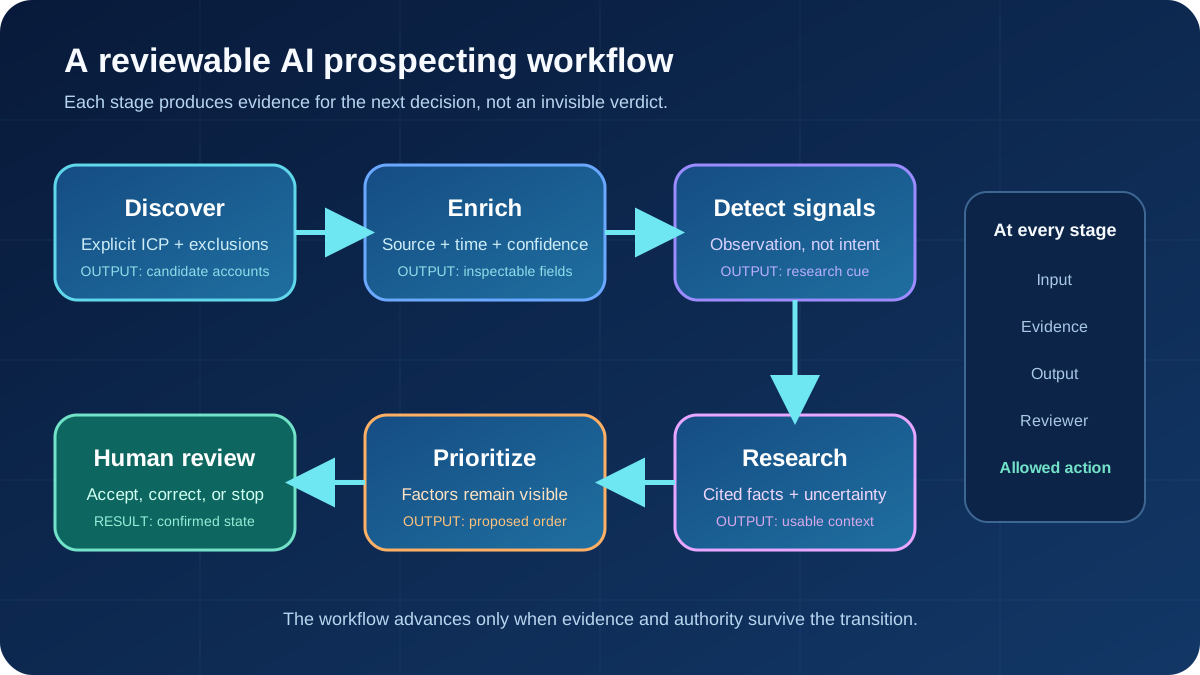
Prospecting is not one task. It is a sequence of transitions: define the market, discover accounts, enrich records, observe signals, research context, prioritize, prepare outreach, and record the approved result.
The implementation question at every transition is identical. What entered? What changed? Which evidence supports the change? Who may accept it? What happens when the evidence is missing or contradictory?
Discover Accounts Against an Explicit ICP
Discovery needs criteria that can be inspected: geography, business model, use case, exclusions, and acceptable uncertainty. Without that contract, a longer list only hides ambiguity. Review the first candidate set against the written ICP, then revise the search route before expanding volume.
Enrich Records and Detect Signals Without Assuming Truth
Enrichment should append an observation with source, collection time, and confidence rather than overwrite a trusted field silently. A detected event may justify research, but it does not prove active demand. Route conflicts, stale values, and uncertain identities to review instead of converting uncertainty into a confident score.
Inspect Research and Personalization Inputs
Research quality depends on provenance. A polished summary without source context is difficult to challenge. Preserve the page, field, date, and uncertainty behind each claim that could change targeting or messaging.
Personalization is a preparation task, not permission to send. The useful output is a compact set of relevant facts, a reason they matter now, and the gaps a person still needs to resolve.
Trace Research Claims to Their Sources
Require a source reference for company facts, a timestamp for changeable fields, and a distinction between observation and inference. Reviewers should be able to remove one weak claim without rebuilding the whole record. This design also makes corrections useful: the team can repair the source transition that failed.
Prepare Context Without Auto-Sending Generic Copy
A preparation output should identify the recipient context, evidence, proposed relevance, and one manageable next step. A person then decides whether the evidence is adequate and the message is appropriate. Generating fluent copy does not establish that the recipient, timing, channel, or claim is correct.
Prioritize Prospects Without Hiding the Evidence
A priority score compresses several judgments. That convenience becomes dangerous when the factors disappear. Show which criteria contributed, which data is missing, and which items are only inferred.
Use separate states for candidate, reviewed, accepted, rejected, and deferred. The CRM should receive an approved result and its reason, not every model guess. This preserves a record of human judgment.
Make Scoring Factors Reviewable
Prefer a small number of named factors tied to the ICP and current workflow. Display the supporting observation beside each factor. Missing data should remain missing rather than receive a convenient average. Review disagreements by factor, because a disputed geography rule needs a different repair from a stale company event.
Write Approved Results Back to the CRM Workflow
Define which fields the workflow may propose, which it may write, and which require confirmation. Record the original value, proposed value, source, reviewer, and time. When an action fails, preserve the attempted transition and reason instead of leaving the record in an ambiguous half-state.
Set the Human Authority Boundary
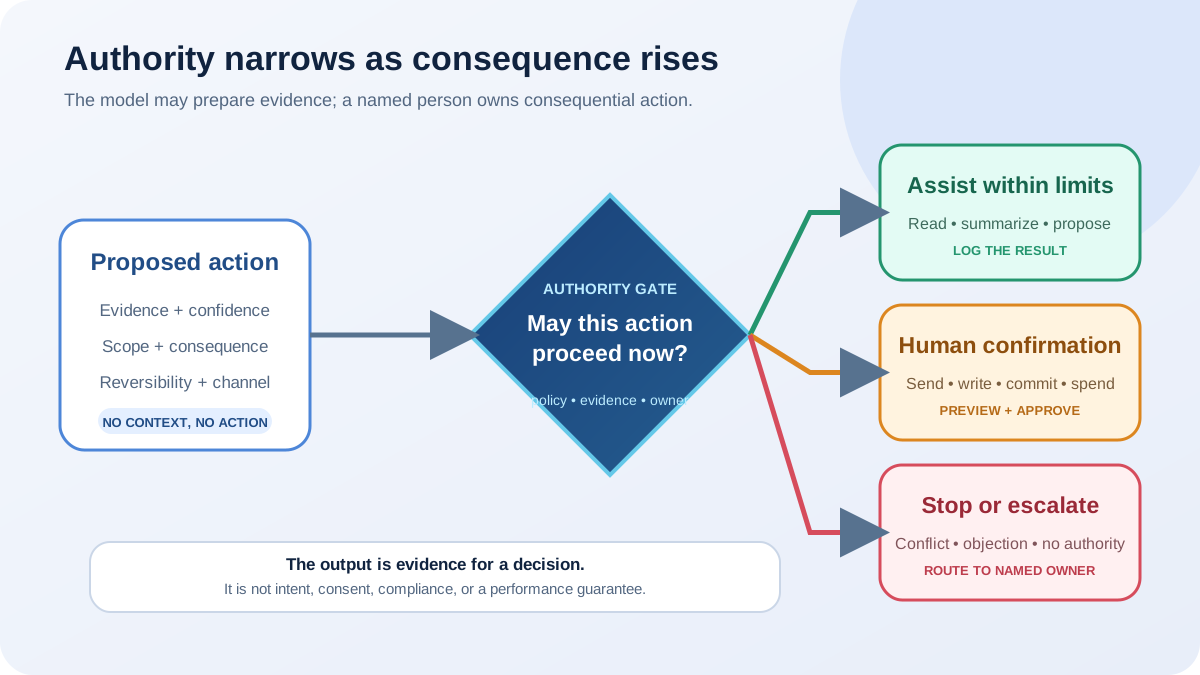
Authority should track consequence and reversibility. Reading a public page differs from overwriting a record. Preparing a draft differs from contacting a person. Approving terms or spend sits farther still.
The permission model should name actions, scopes, limits, and owners. It should also expose a stop route for uncertain identity, weak evidence, objections, channel restrictions, and requested actions outside the system's authority.
Identify Actions That Need Confirmation
Require confirmation for external messages, broad data changes, commitments, spend, and any action based on unresolved identity or evidence. The reviewer needs the proposed action, source context, confidence, affected records, and recovery path. A generic approval button without that context is not meaningful control.
Preserve Privacy, Compliance Review, and Accountability
Applicable direct-marketing duties depend on the data, person, purpose, channel, and jurisdiction. ICO guidance highlights transparency, individual rights, objections, and channel-specific requirements in the UK. That is a review agenda, not a claim that an AI system or vendor makes outreach lawful everywhere.
Run a Controlled Pilot
Choose one bounded job and a small cohort. Keep the ICP, evidence rules, reviewer, and downstream process stable enough to interpret what happened. Avoid testing discovery, scoring, copy, channel, and timing at once.
For discovery, OKKI Go can take a product, buyer type, target country, and exclusions as input and return a contextual candidate-company list. A person reviews that output, selectively unlocks companies, and revises the search conditions when the first candidates reveal a mismatch. The usable result is a reviewed list and a corrected search route—not verified intent, consent, accuracy, or a performance promise.
The pilot should have an owner, start state, expected output, confirmation rule, escalation path, and end date. Freeze material policy changes during the test or record them explicitly.
Choose a Bounded Workflow and Cohort
A useful cohort shares the same decision and review route. Define inclusion and exclusion criteria before the system produces candidates. Keep a baseline produced by the existing process. The comparison should reveal whether the delegated step improves inspection and handoff, not merely whether it creates more activity.
Record Failures, Overrides, and Escalations
Log missing evidence, identity conflicts, rejected candidates, corrected criteria, permission denials, draft revisions, tool failures, and unresolved cases. Capture why a person overrode the output. These records expose whether the problem lies in data, instructions, workflow design, or the authority boundary.
Evaluate Capabilities and Results
Evaluate the workflow before the headline outcome. Check evidence coverage, accepted outputs, reviewer corrections, unresolved exceptions, permission denials, failed transitions, and time required to reach a confirmed state.
Then examine local commercial indicators with care. A change in meetings or pipeline may coincide with different targeting, seasonality, staffing, offers, or channels. The pilot does not isolate causality unless its design does.
For outreach preparation, OKKI Go can use company context and user-provided product material as input to prepare a draft for an unlocked company. The person confirms the recipient, subject, and body before sending; afterward, send status or a failure reason is visible. The usable result is a human-approved message with an observable state, not proof of consent, deliverability, response, or revenue impact.
Measure Decision Quality, Not Activity Alone
Count how often required evidence is present, how often a reviewer accepts or corrects an output, how many exceptions reach the right owner, and whether CRM state remains consistent. Activity volume can rise while decision quality falls. No universal threshold follows from the evidence used here.
Compare Capability Categories Against Selection Criteria
Compare discovery, enrichment, signal detection, research, scoring, drafting, routing, and CRM updates as separate capability categories. For each, inspect input control, source traceability, correction, permissions, human confirmation, logging, failure visibility, integration scope, and exportability. Select the smallest capability set that resolves the pilot job.
Frequently asked questions
What is AI prospecting?
AI prospecting uses AI for bounded parts of finding, researching, enriching, and prioritizing potential buyers. Its outputs remain candidates, observations, drafts, or scores that people and downstream controls must inspect.
Is AI prospecting the same as sales automation?
No. Automation can follow deterministic rules without AI. AI assistance interprets less structured context. An AI SDR label may combine several capabilities, so teams should evaluate each job and permission separately.
Can AI prospecting identify buyer intent?
A system may detect or summarize signals, but those observations do not prove that a person intends to buy. Preserve the evidence and uncertainty, then let a qualified person decide how much weight to give it.
Which AI prospecting actions need human review?
Review should rise with consequence and reversibility. External messages, broad record changes, commitments, spend, and actions based on uncertain identity or evidence should reach a named human owner.
How should an AI prospecting pilot be measured?
Start with evidence coverage, accepted and corrected outputs, exceptions, permission denials, failed transitions, CRM state integrity, and review effort. Evaluate commercial outcomes only after the workflow is controlled and observable.