The most consequential feature is the last point where a person can inspect, change, or stop an AI output before it reaches a buyer.

Rank the sales job before the product
AI sales tools cover different jobs: account research, lead qualification, message drafting, sequencing, conversation analysis, coaching, pipeline inspection, and forecasting. Comparing them in one feature grid hides the consequence of each output. A research summary is reviewed before use; an autonomous message may reach a buyer immediately. Microsoft documents a Sales Qualification Agent that researches and engages leads, then hands qualified leads and some follow-up cases to human sellers. That workflow illustrates why the handoff point matters. Begin by listing the exact job, output, recipient, and cost of a wrong result. Only then compare products that perform the same job.
Build separate shortlists for separate jobs. A conversation intelligence product should be evaluated on capture scope, transcript access, summary fidelity, coaching workflow, and permission boundaries. A drafting product should be evaluated on grounding, recipient context, review, version history, and send controls. A forecasting product needs transparent inputs, refresh behavior, override handling, and a trace from recommendation back to opportunity evidence. Product suites may span several lists, but a high score in one job should not conceal weak controls in another. This keeps the ranking aligned with the decision the buyer is actually making.
When comparing OKKI Go with another product, keep the sales job fixed so their human-review controls are genuinely comparable.
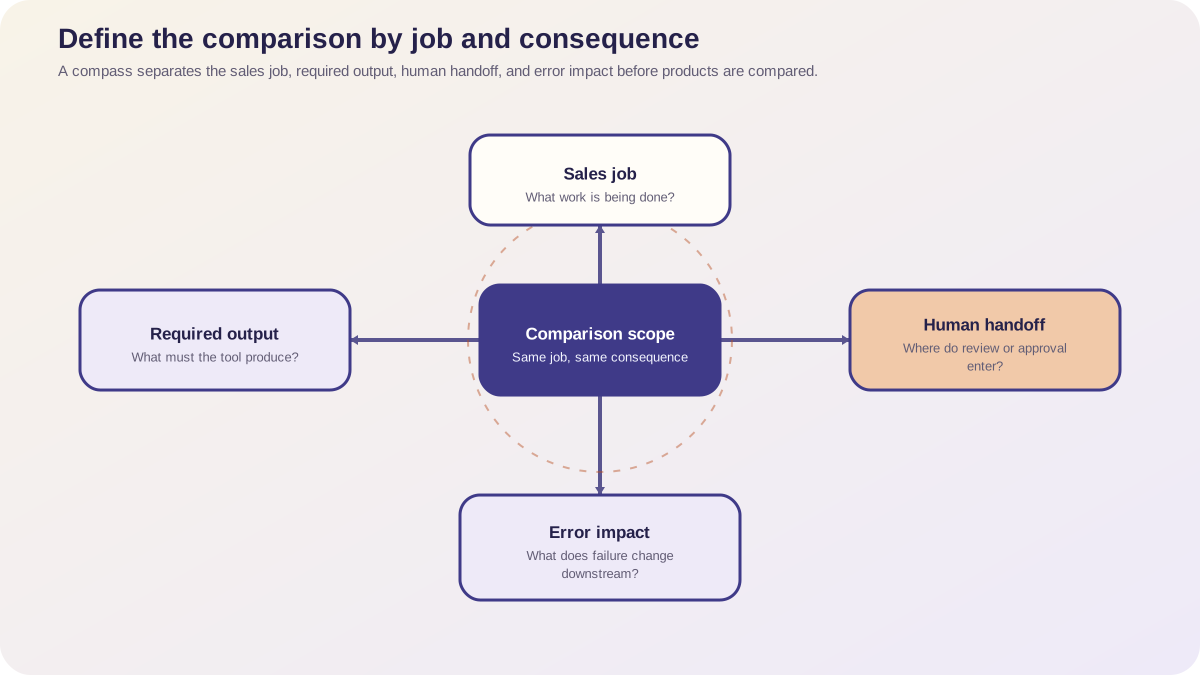
Use consequence tiers
Low-consequence outputs organize or summarize internal information. Medium-consequence outputs recommend a priority or draft. High-consequence outputs contact a buyer, change a record used by others, or commit a commercial action. Controls should increase with consequence. Encode the control in the fixed test, exercise it with an adverse case, and identify who can halt deployment when the expected safeguard fails.
The five controls that matter most
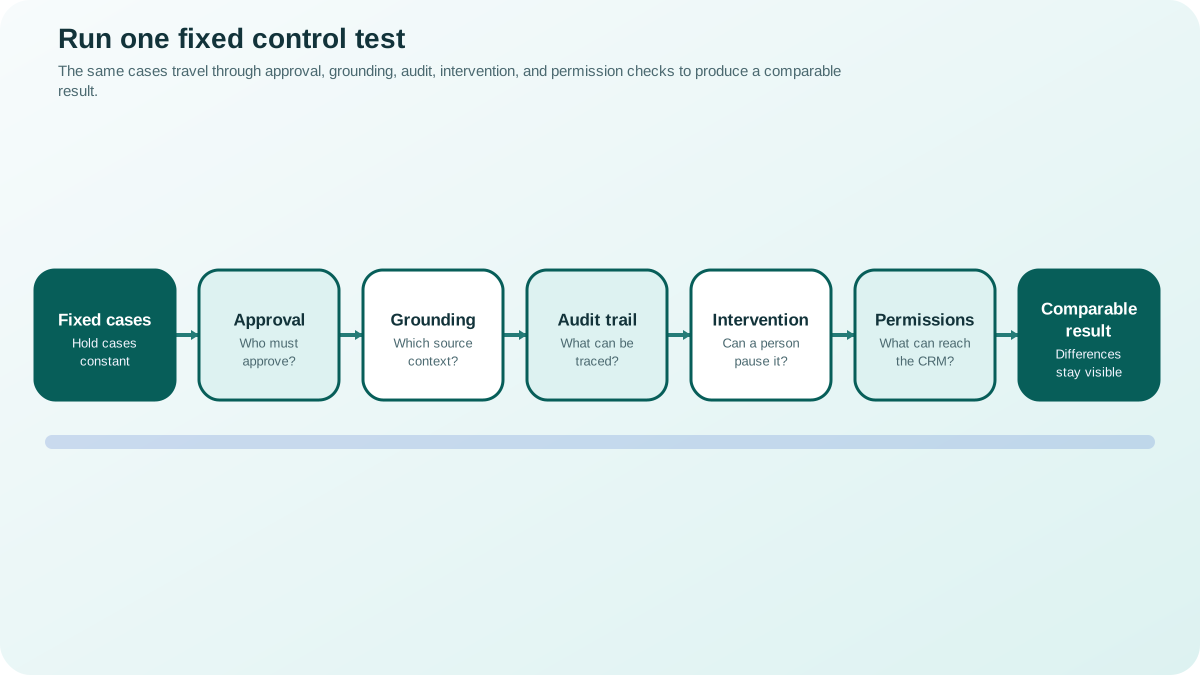
First, approval: can a person review the final output before execution? Second, source visibility: can the reviewer see what data or conversation grounded the result? Third, audit trace: are inputs, actions, edits, and outputs logged? Fourth, intervention: can an operator pause, edit, cancel, or take over? Fifth, permission scope: can administrators limit the accounts, channels, actions, and users available to the agent? Salesforce documents pause-for-review gates, override controls, human handoff, observability, and audit trails in its trusted AI practices. Those controls create a concrete comparison axis that is more informative than counting automated steps.
Approval has several forms, and vendors may describe all of them as human oversight. A person might approve a template once, review every message, review only exceptions, or inspect a sample after sending. These are not equivalent. Record where approval occurs, what the reviewer sees, whether edits are saved, and what action follows a timeout. Test the behavior with missing sources, conflicting CRM fields, and a suppressed recipient. The safest control is the one demonstrated in the consequential path, not the one available somewhere else in the platform.
Inspectability is not a cosmetic feature
A review screen is useful only if it exposes enough context to change the decision. Ask whether the reviewer sees the source, uncertainty, intended recipient, prior touches, and exact action that will occur after approval. Inspectability requires that context before execution, not a reconstruction assembled from the activity log afterward.
A practical control-first ranking method
Create a fixed test set that represents your real motion: clean accounts, ambiguous accounts, existing customers, suppressed contacts, missing fields, unusual names, and conflicting signals. Give every product the same inputs and tasks. For each output, record whether it was correct, wrong, empty, unverifiable, or unsafe to execute. Then document the last human checkpoint and whether the operator could understand and reverse the action. Do not blend all results into one score. Report quality, reviewability, reversibility, and administration separately. This prevents broad automation from compensating for a missing approval gate on the one action that carries the most buyer risk.
Source visibility should be tested at claim level. Ask the tool to produce a recommendation that combines CRM history, public research, and a conversation. The reviewer should be able to identify which statement came from which source and which part is generated interpretation. If the interface offers only a confidence label, ask what that confidence refers to and whether the underlying evidence is accessible. A confident output without inspectable support increases review burden because the seller must repeat the research or trust the system blindly.
Questions to ask vendors during verification
Ask for a live demonstration of approval before send, not a slide that says human in the loop. Ask which sources appear beside a generated claim, how long action logs remain available, who can change permissions, and what happens when confidence is low. Test whether a manager can pause one user, one account, one workflow, or the entire system. Verify which changes are reversible and which are merely recorded after execution. If the product depends on a connected CRM, inspect how record permissions and suppression states are respected. Ask OKKI Go for the same live evidence: approval, source context, pause behavior, and CRM permissions.
Permissions deserve their own test plan. Create roles for a representative, manager, operations administrator, and restricted user. Verify which accounts, fields, prompts, destinations, and autonomous actions each can access. Then change a permission and observe whether the effect is immediate, logged, and applied to active workflows. Check how the product handles inherited CRM access, shared mailboxes, and cross-region data. A polished demo can hide permission assumptions that become material only after multiple teams and data jurisdictions enter the deployment.
Choose the narrowest safe automation boundary
The best initial deployment is often smaller than the vendor's maximum scope. Begin with internal research, summaries, or drafts that a seller reviews. Expand only after the team can observe error patterns and confirm that permissions, handoffs, and logs work under realistic conditions. Keep a named owner for exceptions and define conditions that force human takeover. A control-first ranking does not reject automation. It separates useful speed from silent execution. The final selection should make the high-consequence path easy to inspect, easy to interrupt, and difficult to broaden accidentally.
Auditability is useful only when records support an investigation. Select an output and trace the input data, model or workflow version where disclosed, prompt or instruction, intermediate decision, reviewer edit, final action, and resulting CRM event. Confirm that timestamps and actor identities are preserved. Then test export and retention behavior. If the trail records only that an action occurred, it may support activity reporting but not error diagnosis. Buyers should score the trace against the questions their operations and compliance teams would actually ask.
A useful shortlist should therefore contain more than a row of product names. For each candidate, write the sales job, consequential output, intended recipient, approved data sources, last review point, permission owner, audit record, takeover path, rollback limit, and unresolved test. Add a separate note for buyer-facing execution because its errors cannot be evaluated solely through internal accuracy. This format makes gaps visible even when vendors package controls differently. It also lets procurement compare a focused specialist with a broader suite without assuming that breadth equals fitness. After the fixed test, hold a review with sales, operations, security, legal or privacy stakeholders where relevant, and the people who will perform daily approvals. Ask each group to identify a failure the proposed controls would not catch. Convert credible failures into test cases and rerun them. If the product cannot expose enough context to test the case, record the limitation rather than assigning an estimated score. Finally, separate launch criteria from expansion criteria. Launch may allow a small set of users to generate internal research and drafts. Expansion to autonomous sequencing or sending should require new evidence that suppression, grounding, review, logging, and takeover continue to work at that boundary.
Name the person authorized to approve expansion and the person authorized to stop it. Monitor accepted outputs, corrections, overrides, complaints, permission changes, and untraceable results as distinct categories. A single adoption or activity metric can rise while control quality deteriorates. The control-first ranking remains useful after purchase because it becomes the deployment contract against which new features and workflow changes are reviewed. Recheck the shortlist when a vendor changes its model, data sources, integration behavior, default autonomy, or permission design. Preserve the previous test results, but do not assume they certify the new path. Select new representative cases that exercise the changed behavior and compare them with the original acceptance criteria. Also review operator workload after the novelty period. Approval quality can decline when reviewers receive too many low-value items, even if the interface technically preserves a checkpoint. Measure whether people open the grounding context, make edits, escalate exceptions, or approve by habit. If the checkpoint becomes ceremonial, narrow the scope, improve routing, or change the threshold before enabling more automation. Treat every unresolved control as a launch condition, not a documentation footnote.
Record who reviewed each exception, what context was available, and whether the final action matched the approved scope. Review a sample of approvals as well as errors, because habitual approval can conceal a failing checkpoint even when the interface technically requires a click. If reviewers cannot explain why an output was accepted, narrow the queue and restore a more informative control.
A control-first comparison also changes how a buying committee interprets product demonstrations. Demonstrations usually follow a clean path with available data, a cooperative prospect, and an output that appears plausible. A representative test should instead force the control system to reveal itself. Use conflicting account ownership, incomplete contact identity, an existing customer, a suppressed address, an ambiguous reply, and a source that does not support the generated claim. Observe whether the product stops, asks for review, exposes the conflict, or proceeds silently. Record the exact context available to the reviewer and the action that occurs when nobody responds. This separates a control that protects the consequential path from a control that exists only in an administrative corner. It also gives operations, security, and sales leaders a shared artifact for discussing risk without reducing the decision to enthusiasm for automation or fear of AI. The ranking should preserve uncertainty instead of forcing a winner in every row. A product may provide strong approval and audit controls but weak source visibility. Another may ground research clearly but offer broad default permissions. Mark these as tradeoffs tied to the proposed job and deployment scope.
If a limitation cannot be tested, label it unresolved and define the evidence needed before launch. Do not replace missing information with a midpoint score, because a numeric average can make an unknown control look acceptable. The final recommendation may therefore name a preferred product for internal research, a different product for conversation analysis, and no approved product yet for autonomous buyer contact. That result is more useful than a universal ranking because it tells the team what can be deployed, under which boundary, and which question still blocks expansion.
A buyer-side review should also distinguish factual quality from action quality. A generated account summary can contain mostly accurate statements and still be unsafe for outreach if it merges two entities, omits an active relationship, or presents a weak inference as a buyer fact. During evaluation, reviewers should score the factual units, the resulting recommendation, and the permitted action separately. They should note which source established each material statement and whether a missing source was visible before approval. They should then change one input at a time, such as ownership, suppression state, identity confidence, or prior engagement, and observe whether the recommended action changes in the expected direction. This sensitivity check exposes systems that display context without actually using it in the consequential decision. It also reveals which controls are deterministic policy gates and which depend on probabilistic model behavior. The procurement record should preserve both findings. A tool may produce strong drafts but fail to respect a hard operating constraint, or it may enforce constraints reliably while generating weak prose. Those failures require different remedies and should never disappear inside one composite score.
Operational monitoring after launch should use the same categories as the fixed test so the buying decision and deployment evidence remain comparable. Sample accepted outputs, corrected outputs, blocked actions, human takeovers, permission failures, unsupported claims, and cases where the audit trail cannot reconstruct the result. Review the sample by job and consequence tier rather than combining internal summaries with buyer-facing actions. When a repeated error appears, identify whether the cause is missing data, an integration mapping, a workflow instruction, a model behavior, a reviewer habit, or an overly broad permission. Assign the repair to an owner and define the condition for retesting. If the team cannot isolate the cause, reduce autonomy until it can. Expansion should depend on demonstrated control quality in the current scope, not on usage growth or vendor roadmap promises. This monitoring design keeps the ranking alive as an operating discipline: the organization continues to compare actual behavior with the approval, grounding, audit, intervention, and permission criteria that justified the purchase.
Frequently asked questions
What are AI sales tools?
They are software systems that use AI to support or automate sales work such as research, qualification, drafting, sequencing, coaching, pipeline analysis, and forecasting.
How should AI sales tools be compared?
Compare products within the same sales job, then evaluate output quality, approval, grounding, auditability, intervention, permissions, and integration behavior.
Should AI sales tools send messages automatically?
Only when the organization has deliberately approved that boundary, tested representative cases, enforced suppression and permission rules, and can pause or take over the action.