A lead score orders attention, but qualification policy decides whether and how a record moves.

What a Lead Score Measures Before Any Qualification Decision
What does a lead score tell you? Picture the queue you open at the start of the day. Several records contain different combinations of company attributes and observed activity, and you need to decide where to look first. A lead score compresses those observations into relative priority. That's useful, but it is narrower than the familiar claim that a high score means a lead is ready for sales. The score can move a record upward without proving that the account is eligible, the contact is appropriate, the timing is right, or a seller should act now. If you let the number make those decisions too, you lose the ability to see which judgment failed. Was the record ranked badly? Did it fail an agreed qualification condition? Did it reach the wrong owner? Or did the workflow authorize the wrong action? Keep those questions separate. When you review a high-scoring record, don't begin with, Is this number high enough? Begin with, What observations raised this record, and what decision is the score actually allowed to influence? That shift gives you a usable definition: lead scoring orders attention under selected observations and weights; it does not, by itself, award a qualification status or permission to contact a buyer.
Want a concrete example? Dynamics 365 documentation, checked August 31, 2026, describes a predictive score from 0 to 100 for comparing and prioritizing leads, then places administrator-defined score ranges beside it to produce grades. You can see two choices, not one verdict: a calculated measure and the organization's interpretation of that measure. It's product-specific, not a universal standard.
Now follow the record beyond the number. What should your tool expose if you want to understand why the record moved? You need the observations that fed the score, the resulting score or band, the criteria that interpreted it, the status assigned after that interpretation, and the workflow that followed. Microsoft Dynamics 365 Customer Insights documentation, also checked on August 31, 2026, separates qualification criteria from post-qualification actions. After a lead qualifies, configured actions can update qualification fields, trigger a journey, assign the lead, or start a sales sequence. Notice the order. The system first evaluates criteria, then changes state, then performs an action. The documentation doesn't make every implementation identical, and you shouldn't read it as a universal process standard. It does give you an inspectable example of the boundary. If your own workflow shows only a final grade and a sales task, ask what disappeared between them. Which input moved the score? Which rule interpreted the score? Which status was assigned? Who accepted ownership? What action became permitted? When those answers remain visible, you can test each layer. When they're collapsed into one field, a disappointing result sends you back to guessing about weights even when the actual problem sits in qualification or routing.
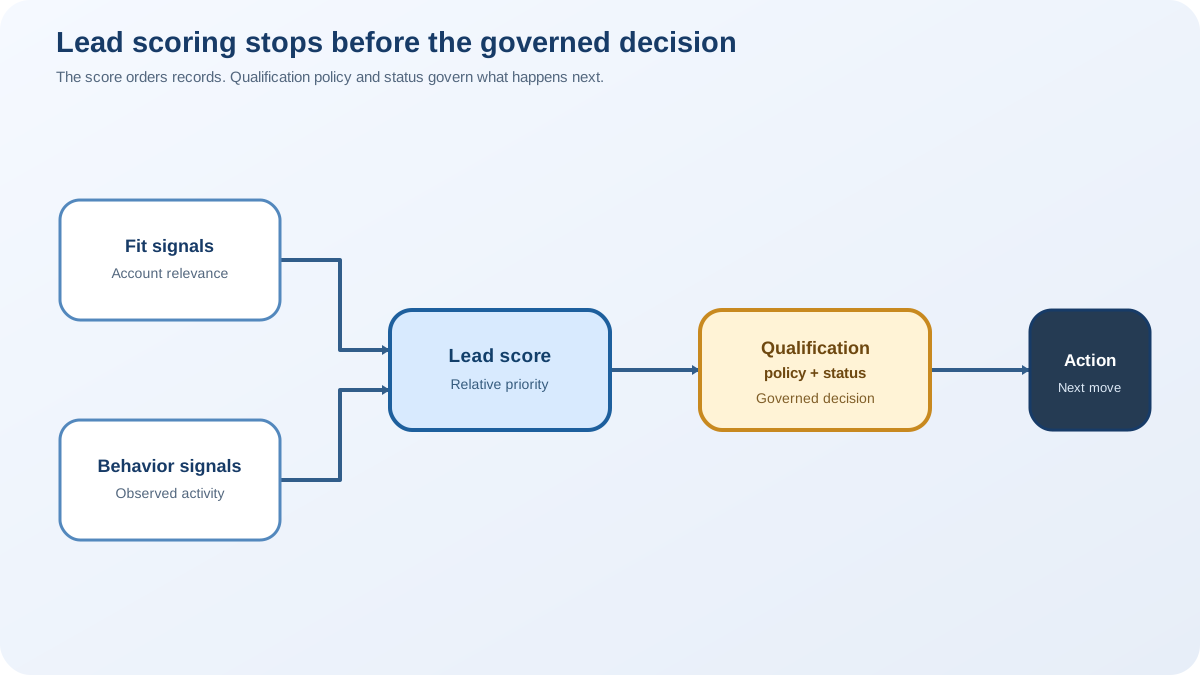
The Score Belongs to the Ordering Layer
Where should the definition stop? Stop before the governed change in state. Your ranking layer asks which records deserve earlier review. Your qualification layer asks which records meet agreed conditions for a named status. Your routing layer asks who owns the record and what action is permitted. A raw score, grade, band, or queue position can serve the first question; it can't silently answer all three.
Where Lead Scoring Ends and Qualification Policy Begins
When does a score become part of a qualification decision? Only when your policy says how to interpret it alongside the other conditions the team requires. Suppose you draw a threshold at one point in the ranking. That line can split the queue, but it can't tell you what state the records above it have earned. To do that, you need to name the state, list the conditions that must hold, identify the owner who accepts the change, and define the action the new state permits. The score may be one condition, yet it is not the policy itself. Try reading the policy without the threshold. Can you still explain what qualifies, who owns the transition, and what happens next? If you can't, the process is leaning on the number to hide an undefined decision. Now try the reverse: keep the policy and change the threshold because seller capacity changed. The definition of the state should survive. What changes is which records receive review under today's operating constraint. This is why you should document the score and policy separately even when automation evaluates them together. You'll be able to change capacity rules without pretending the underlying evidence changed, and you'll be able to revise qualification conditions without disguising the revision as a scoring update.
What breaks when you ignore the boundary? You start treating high relative priority as absolute readiness. A record can rank near the top of a weak pool and still fail your qualification policy; another can meet the policy while more urgent work sits ahead of it. The score allocates attention. The status records a decision. The policy explains that decision. The action is its consequence, not the score's hidden meaning.
A Threshold Is a Policy Choice, Not a New Observation
Why does this distinction matter when you change a threshold? Because the observations about the record can remain exactly the same while the business decision changes. Imagine that the team has room to review fifty records this week and only twenty next week. Tightening the threshold doesn't create stronger evidence about the accounts that remain above it. It changes which records the organization is willing to classify or route under present capacity and risk. Loosening the threshold doesn't make the newly included records more interested. It changes the operating rule. If you store only the resulting status, you won't be able to reconstruct that choice later. Keep the score, threshold, assigned status, and transition reason in separate fields whenever your system allows it. If the system doesn't, preserve the distinction in the review record. Then ask four questions during the next audit. Did the observations change? Did the scoring logic change? Did the qualification policy change? Or did capacity change the action rule? You may reach the same final status through different paths, and those paths call for different fixes. Preserving them is the minimum needed to tell whether a future problem belongs to scoring, qualification, or workflow.
How Fit and Behavior Become a Relative Priority
What goes into your lead score? Start with two broad input types. Fit observations describe whether an account or contact resembles the market you've chosen to serve. Behavior observations describe activity you can observe or record. Neither proves qualification: fit doesn't prove interest, and activity doesn't prove authority, timing, or need. Weights or a model combine the observations into relative priority, so keep the underlying signals available when you review the result.
- Fit observations describe relevance to the market the team has chosen.
- Behavior observations describe activity the team can observe or record.
- Weights or a model combine those observations into relative priority.
- A separate policy interprets that priority for a named qualification state.
Fit and Behavior Answer Different Questions
Should you collapse fit and behavior into one explanation because the model combines them? No. The two inputs answer different questions. Fit asks whether the record belongs in the field of attention your team has chosen. Behavior asks whether something happened that may deserve timely review. Now imagine three records with the same displayed band. The first is a strong fit with little activity. The second shows intense activity but is a poor fit. The third has moderate evidence across both categories. The ranking may place them together, yet you wouldn't research them in the same way. For the first, you'd check whether the lack of activity reflects timing or missing observation. For the second, you'd verify whether the activity came from a relevant account or contact. For the third, you'd inspect which combination of signals cleared the band. This is why a reviewer needs more than the final position. Ask your system to show which kind of evidence moved the record and how much context was compressed. A scoring model can combine observations for priority without claiming that every combination has the same meaning. If you preserve that distinction, the score becomes a starting point for review rather than a story you have to invent after the fact.
Why Score, Status, and Sales Action Must Stay Separate
Which adjacent term causes the most confusion? Qualification. Your scoring strategy ranks records. Your qualification strategy assigns a business state under explicit criteria. Routing decides where that state goes, and outreach rules decide what a person may do next. Automation can connect all four, but it doesn't make them synonymous. Change a weight and you've changed prioritization; change the state criteria and you've changed policy; change the owner or permitted action and you've changed workflow.
Can the same score lead to different actions without contradicting itself? Yes, because the score isn't an action instruction. Take three records that sit in the same band. You send the first to research because ownership is unclear. You send the second to sales review because it meets the qualification conditions and an owner accepts the change. You take no action on the third because policy blocks the transition. The ranking can remain stable across all three outcomes; the decision context changes. If that sounds uncomfortable, ask what you expect the score to contain. Does it know whether an owner accepted the record? Does it know whether the current policy permits contact? Does it know whether a required field is unresolved? Unless those conditions are scoring inputs, the answer is no. And if they are inputs, you still need to see how they were interpreted. Preserve a status and reason code outside the score. Then a seller can see not only that a record ranked highly, but why the organization allowed this particular move. You also gain a cleaner review path: investigate the model when ranking looks wrong, the policy when status looks wrong, and routing when the accepted record reaches the wrong place.
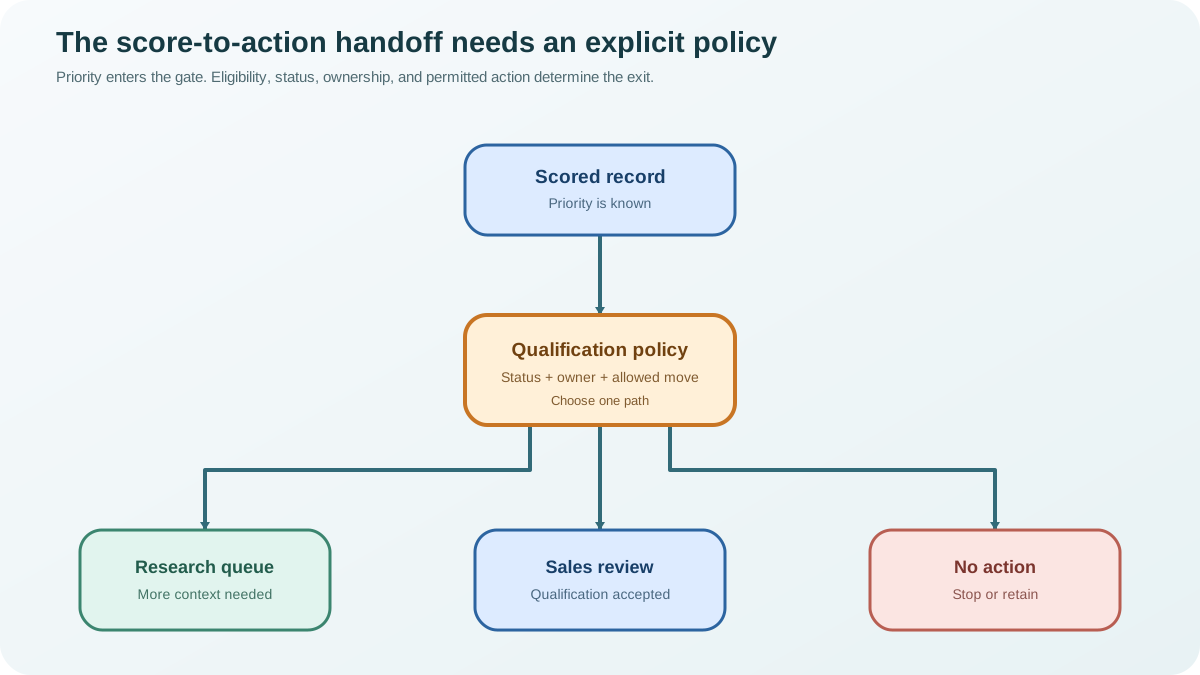
The Same Score Can Produce Different Legitimate Outcomes
How should you choose among those outcomes? Name a qualification state the business can defend, define the evidence and ownership needed to enter it, and specify its possible exits. Only then ask whether the score gives that policy a useful ordering signal. Don't tune weights merely to push more records across a line. When you evaluate a prospecting platform such as OKKI Go, check whether the surrounding process keeps this handoff inspectable; a product label can't resolve an undefined decision for you.
How to Audit the Handoff from Score to Action
What does the boundary change in a real workflow? Walk one hypothetical record through it. The record appears near the top of your scoring queue because it has a strong fit pattern and recent observed behavior. Your team has limited seller capacity and requires an accepted qualification status before contact. Keep six items in view: the fit observations, behavior observations, resulting score band, current status, assigned owner, and allowed action. At the first step, the score changes only review priority. It doesn't change the status or authorize contact. You open the record sooner, inspect the evidence behind its position, and ask whether the qualification conditions are actually present. That constraint is deliberate. It gives you a transition you can test instead of treating queue position as permission. If the behavior signal turns out to be ambiguous, the high score can remain while the record returns to research. If the evidence holds but ownership is unresolved, the score can still remain while the status waits. Neither outcome means the ranking contradicted itself. It means the next layer did its own job. By recording each result separately, you'll know whether to revisit an input, adjust a weight, clarify a policy condition, or resolve ownership before anyone acts.
What happens at the deciding moment? Your policy checks the named conditions and whether an owner accepts the state change. If either is unresolved, the record stays in research despite its high score. If both hold, the status changes and routing assigns the permitted action. You're not proving conversion. You're preserving a traceable decision. If high-priority records keep failing qualification, inspect inputs against policy; if qualified records reach the wrong owner, inspect routing instead of weights.
- Inspect the observations that moved the score before changing their weights.
- Inspect the qualification policy when priority and accepted status diverge.
- Inspect ownership and permitted action when accepted records take the wrong path.
- Keep the outcome attached to the transition so the next review can locate the failing layer.
Run One Record Through the Whole Chain
Where should your audit stop? Stop when you can trace one record from observed signals to score, from score to qualification policy, from policy to status, and from status to an owned action, while the reason for every transition remains visible. Run the trace in order. First, point to the fit and behavior observations that raised attention. Next, show how the scoring logic combined them. Then identify the policy that interpreted the result, the status it assigned, the owner who accepted it, and the action that became permitted. Can a reviewer challenge each step without reconstructing the whole workflow from memory? If yes, the handoff is inspectable. This test doesn't prove your scoring model is optimal; it proves the team can tell which layer made the decision. If your team uses OKKI Go in the surrounding prospecting workflow, keep its records and actions inside the same explicit handoff rather than treating product activity as qualification by itself. The boundary has a practical limit too. A simple queue may not need elaborate automation, but you still need a shared distinction between what raised attention and what authorized action. Carry one question into the next review: when a record moves today, can you show which layer actually decided that it should?
Keep the lead score's job narrow: order attention, preserve the observations behind that order, and hand the record to an explicit qualification and routing policy. Then ask your team one final question: can you show where the score stopped and the decision began?
Frequently asked questions
Does a high lead score mean a lead is qualified for sales?
No. A high score places a record higher under the chosen scoring logic. A separate qualification policy must assign a status and define whether a sales action is allowed.
Which lead-scoring inputs describe fit, and which describe behavior?
Fit inputs describe relevance to the market the team serves. Behavior inputs describe observed activity. A score can combine both, but reviewers should retain the distinction because the same priority can arise from different evidence patterns.
What should stay attached when a lead score enters a workflow?
Keep the underlying observations, score or band, qualification status, applicable policy, owner, permitted action, and transition reason together. That record lets the team locate whether a failure belongs to scoring, qualification, or routing.
When may lead scoring change the next action?
Only after an explicit policy interprets the score and assigns an accepted status, owner, and permitted move. A score can change review priority on its own, but it should not silently become permission for buyer contact.
Explore OKKI Go
- Explore OKKI GoReview the official OKKI Go overview while assessing how prospecting activity fits around a separate qualification policy.Official OKKI Go resource ↗
- Review OKKI Go use casesSee the current first-party use-case pages and keep product workflow separate from qualification status.Official OKKI Go resource ↗