A GTM strategy becomes executable when the team can tell who stays out, what starts the motion, who acts next, and when the plan changes.

Define the market and the motion
A go-to-market strategy is the cross-functional plan for reaching target customers and delivering a product or service into a market. Stripe's guide includes target customer definition, value proposition, channels, pricing, distribution, support, and milestones. Start by naming the specific product, geography, segment, use case, and time horizon. Then state the commercial motion: self-serve, sales-led, partner-led, product-led, or a deliberate combination. A broad ambition such as grow mid-market revenue is not yet a motion. The plan must specify who encounters the offer, how they evaluate it, and which team owns each transition.
Write the strategy at the level of a decision another operator can make. For a real account, the document should reveal whether it is in scope, which evidence established that status, what event starts work, and which team receives it. If the answer depends on asking the strategy author, the plan still contains private context. Convert that context into observable criteria, examples, and exception ownership. This is especially important when product, marketing, sales, and service use different language for the same customer state.
Assess OKKI Go or another platform only after the operating motion is explicit, because software cannot decide which market boundary the company intends to enforce.
Separate GTM strategy from marketing strategy
Marketing creates and captures demand, but the GTM plan also coordinates product, sales, distribution, pricing, onboarding, service, and launch operations. The distinction makes ownership visible. This wider scope matters because a market message can attract attention while pricing, delivery, or support constraints still make the commercial motion unworkable.
Write inclusion and exclusion rules
An ideal customer description needs edges. Define the characteristics that qualify an account and the conditions that make it a poor fit. Salesforce's customer-profile guidance explicitly recommends exclusions for businesses that are not a good fit, alongside buying triggers. Exclusions may involve unsupported geography, incompatible operating model, unavailable integration, buying complexity, regulatory constraint, or economics that the offer cannot serve. Keep them observable. Avoid labels such as innovative or high intent unless the team can identify the evidence. Clear exclusions protect resources and prevent different teams from quietly expanding the target whenever a difficult account appears.
Avoid turning the ideal customer profile into a long collection of attractive attributes. Separate required conditions, prioritization factors, and exclusions. Required conditions establish eligibility. Prioritization factors help order eligible accounts. Exclusions stop the motion even when some attractive traits are present. Then define the evidence source for each rule. A company description, verified technology dependency, contract state, or operating event is more usable than a subjective label. This structure makes tradeoffs visible and prevents a score from quietly overriding a hard boundary.
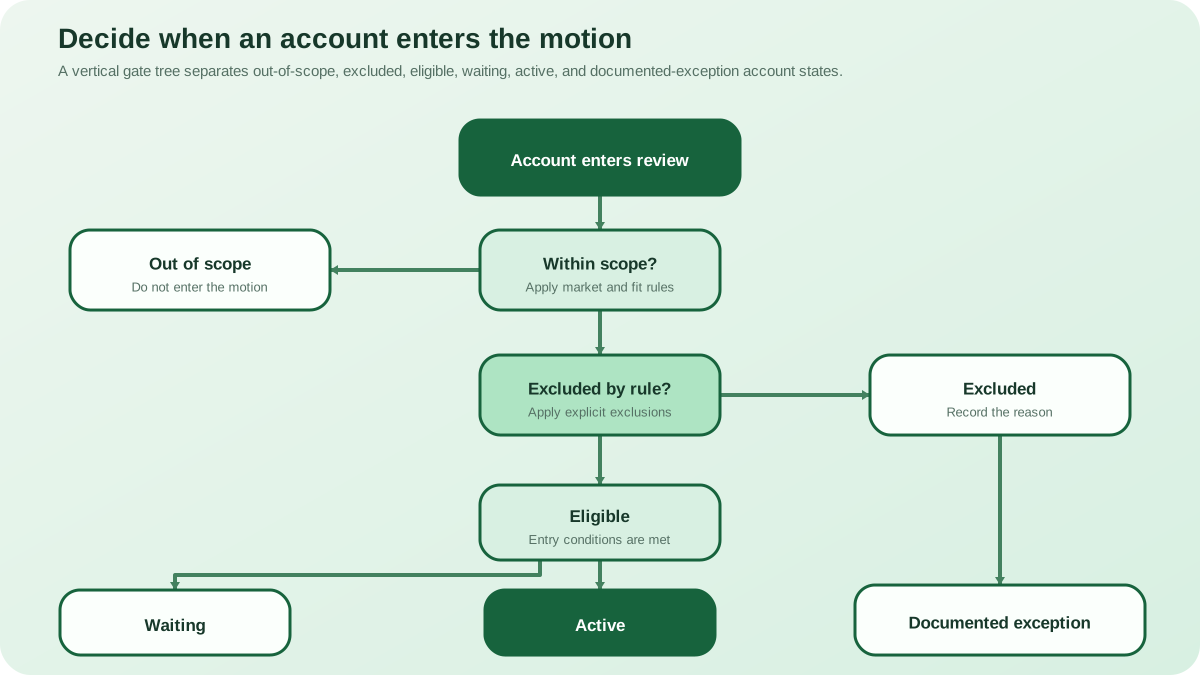
Define the account entry condition
Name the documented event or state that moves an eligible account into the motion: a qualified inbound request, verified operational trigger, product threshold, partner referral, or another observable condition. Interest alone may be too vague. Separating eligibility from entry prevents every suitable account from entering permanent pursuit and makes the motion begin only when the named trigger is present.
Design value, channel, ownership, and handoffs
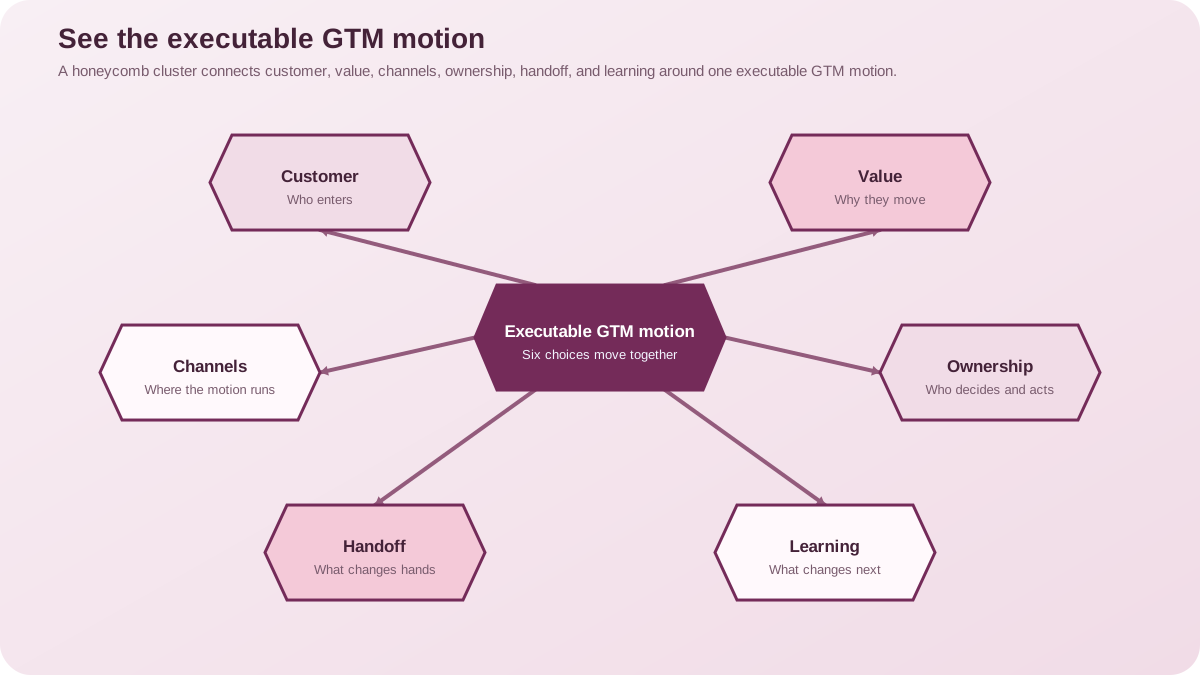
For the selected customer and buying situation, state the problem, promised outcome, proof required, objections, and why the offer is preferable to the status quo. Map the channels that create awareness, evaluation, purchase, delivery, and support. Assign an owner to every transition and specify the artifact that crosses the handoff: account context, qualification result, required fields, next action, due time, and stop rule. Stripe describes GTM as time-bound and cross-functional, covering launch and post-launch operations. A handoff contract converts that broad plan into work another team can perform without relying on the original author's memory.
Handoffs should include an acceptance action. The receiving team confirms that the account meets the rule, required context is present, and ownership is understood. If it rejects the handoff, it selects a reason that returns to the originating team. Common reasons might include missing evidence, duplicate motion, unsupported region, existing relationship, or incorrect buying situation. Review these reasons as strategy feedback. Repeated rejection is not merely an execution problem; it may show that the target, entry condition, or upstream interpretation is poorly specified.
Test the strategy with real account decisions
Before launch, run representative accounts through the rules. Include clear fits, clear exclusions, ambiguous cases, existing customers, and accounts that meet the profile but lack an entry condition. Ask two teams to apply the plan independently. Differences reveal undefined language, missing evidence, or unclear ownership. Record decisions and revise the contract before scaling activity. OKKI Go can support execution only after these target and transition rules are explicit; software cannot resolve a strategic ambiguity that the team has not decided. The test succeeds when the same evidence produces the same inclusion, owner, and next action.
Run the test across different weeks and owners so the result does not depend on one launch workshop. Compare decisions, not just activity totals. Investigate cases where teams disagree about eligibility, trigger status, or next owner. Revise the smallest rule that resolves the ambiguity and rerun the cases. After launch, preserve a version history so changes in conversion or cycle behavior can be interpreted against the strategy that was active at the time. This creates a learning loop without pretending that correlation proves a single cause.
The launch review should end with explicit decisions: continue unchanged, narrow the target, revise the entry condition, change a handoff, or stop the motion. Assign each revision an owner and effective date. Keep accounts evaluated under the old rule distinguishable from those evaluated under the new one. That record prevents a team from explaining every result with the latest version of the strategy and gives the next review a stable basis for comparison. Review excluded accounts as deliberately as included ones. If exclusions repeatedly remove accounts that later show strong fit, inspect the rule and evidence source. If exceptions are routinely granted without recorded reasons, the written boundary is not controlling execution. A small exception log can reveal whether the strategy needs revision or whether teams need clearer authority to apply it.
Publish the current rule set where every execution owner can find it, and retire superseded versions so local copies do not create conflicting motions. At each review, ask owners to apply the rules to one ambiguous account in the room. A disagreement found during review is cheaper and more informative than a disagreement discovered after parallel teams contact the same account.
One team may argue that a broad target preserves opportunity: if an account might buy, why exclude it? The opposing view is operational: if every plausible account enters, your channels, message, and owners cannot specialize. Which side wins? Keep broad market awareness, but make the executable motion narrow enough that an owner can apply it consistently. You are not declaring excluded accounts worthless. You are deciding that this particular offer, channel, and time horizon will not spend resources on them until the evidence or strategy changes.
A second debate concerns triggers. One side says your ideal customer profile is enough; once an account fits, sales should act. The other side asks what changed now. Your plan needs both answers. Fit tells you whether the account belongs in the addressable set. The entry condition tells you when this motion begins. Without fit, you chase noise. Without a trigger, you create permanent pursuit of every eligible account. Write the two rules separately so your teams can challenge each one with evidence rather than collapsing them into a single opaque score.
Finally, debate exceptions before launch. Should a senior seller override your exclusion? Sometimes, but your plan should state who may decide, what reason must be recorded, and when you review the exception. If your teams can override every boundary informally, your written strategy is descriptive rather than controlling. If no exception is possible, you may ignore learning from unusual but valuable cases. You need a narrow exception path that protects focus while giving your organization a visible way to improve the rule.
What happens when your account fits but your trigger is missing? You wait. What happens when your trigger appears but your account is excluded? You stop. When your evidence conflicts, you escalate to your named owner. You should be able to explain your decision, your source, and your next review date. If you cannot, your plan has left you with an opinion instead of a rule.
You decide. You document. You test. Your team applies your rule, and you review every exception you allow.
Measure the motion, not just the launch
Track entry volume, qualification outcomes, handoff completion, stage movement, conversion, cycle time, retention or expansion where relevant, and reasons for exclusion. Review whether the target or entry rule needs revision rather than merely demanding more activity. The pattern of waiting, exclusion, handoff, and progress shows whether the operating motion works across teams, not merely whether launch activity was high.
Frequently asked questions
What is a go-to-market strategy?
It is the cross-functional plan for bringing a specific product or service to a defined market, including target customer, value proposition, channels, commercial model, ownership, launch, and measurement.
What should a GTM strategy include?
It should include market scope, customer definition, exclusions, entry conditions, positioning, channels, pricing and delivery, owners, handoffs, milestones, risks, and review metrics.
What is the difference between GTM and marketing strategy?
Marketing strategy focuses on demand and communication. GTM coordinates the broader path from market selection through selling, delivery, support, and launch operations.