A control-first shortlist that shows where each platform fits, what its official documentation supports, and what a buyer still needs to prove in a pilot.
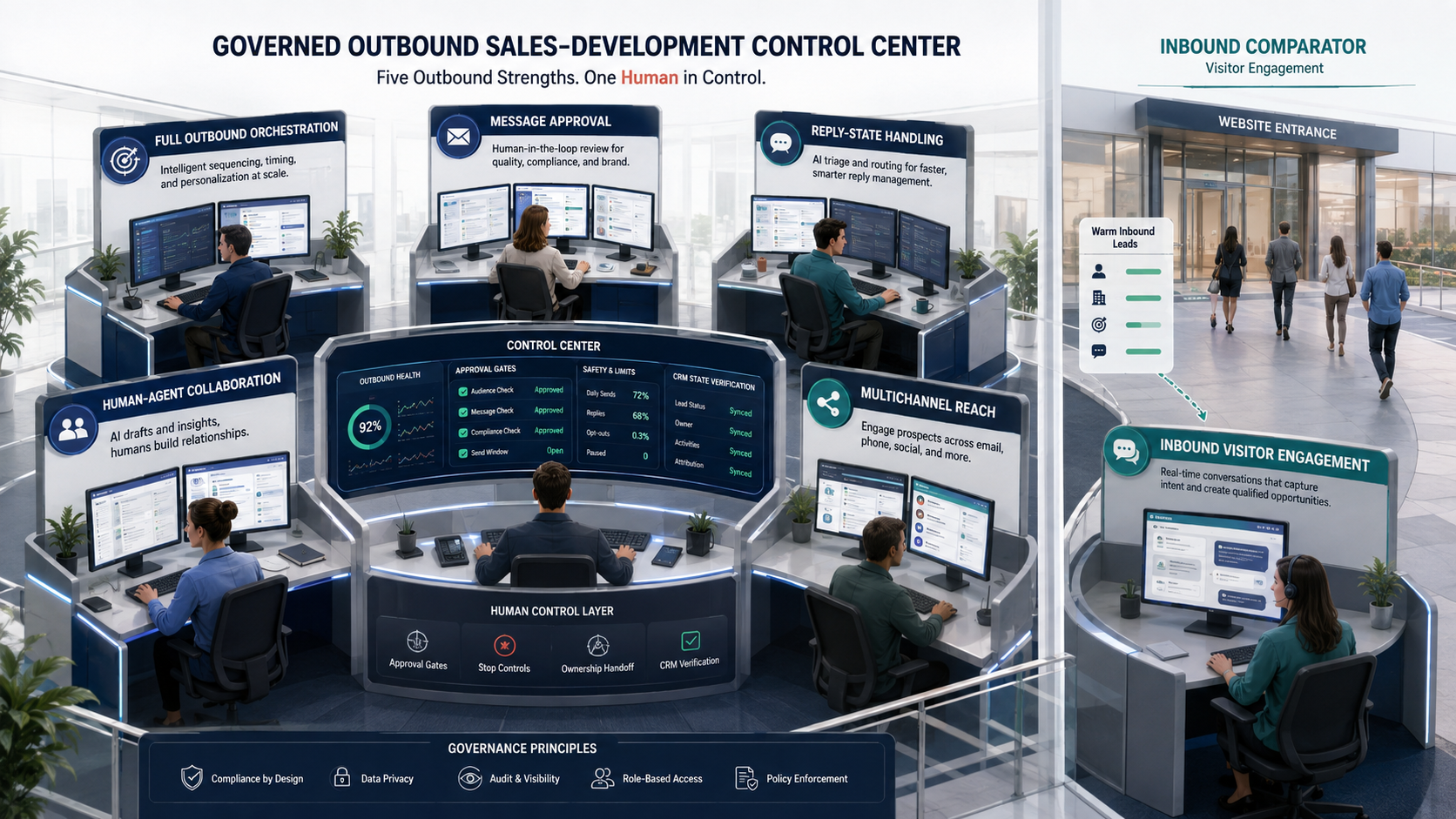
Five outbound platforms ranked, with one inbound comparator
This is a five-platform ranking for a buyer who wants one controlled outbound motion, not a league table for every sales team. Rank 1 has the clearest documented combination of broad job ownership and inspectable controls. Lower placement can still be the better fit when the outbound job changes: AiSDR rises for reply-state operations and Regie.ai for rep-governed execution. Qualified Piper is shown separately as an inbound comparator, not assigned an outbound rank. Every row separates the official evidence boundary from the question that must be answered in a live product demonstration.
| Rank and platform | Best for | SDR job it can carry | Channels and CRM state | Human stop or takeover | Buyer verification question |
|---|---|---|---|---|---|
| 1. Artisan Ava | Broad outbound with configurable control | Identify, research, personalize, sequence, handle replies and book meetings | Email plus dialer call tasks; CRM can remain read-only or export selected fields | Approval gates and escalation rules can interrupt the loop | Show one escalation and the exact CRM fields written before and after it. |
| 2. Reply.io Jason | End-to-end prospecting with message-level review | Source and research prospects, run outreach, handle replies and book meetings | Email, LinkedIn and phone; CRM context may inform personalization, while write behavior needs verification | Copilot mode supports review and approval of every message | Can Copilot approval remain mandatory across every channel, reply type and user role? |
| 3. AiSDR | Teams that need explicit reply and suppression states | Continue positive replies, stop negatives, pause out-of-office threads and support manual response | Email; suppression can sync with HubSpot and Salesforce | A rep can reply manually, stop the sequence, or move the thread to a work mailbox | Replay positive, negative, referral and out-of-office cases and show both mailbox and CRM state. |
| 4. Regie.ai | A governed hybrid of agents and reps | Research, enrich, personalize and activate signals while routing human-touch work | Email and social activation with phone tasks for reps; Salesforce-linked states are documented in the changelog | Read-only drafts, sign-off and audit logs preserve a review point | Show who approved a draft, which source or Salesforce field changed, and how a terminal lead state is protected. |
| 5. 11x Alice | Broad multichannel coverage | Identify, research, personalize and engage prospects | Email, phone, social and SMS; the reviewed overview does not specify CRM write semantics | Detailed approval, exception and takeover behavior was not established by the reviewed page | Trigger a stop on one channel and prove it propagates to every other channel and the CRM. |
| Inbound comparator — Qualified Piper | Inbound website and email conversion | Engage site visitors, nurture warm leads, answer by email and schedule meetings | Website and email; meeting and owner-routing state needs in-product verification | The reviewed product page is less specific about exception handoff than about autonomous engagement | Show a question outside the knowledge boundary and prove how the thread reaches the correct sales owner. |
Ranks 1–2: the broad outbound loop
Artisan and Reply.io both document a long outbound loop. The purchasing difference is where a person can constrain that loop. Artisan exposes staged approvals, escalation and CRM export choices; Jason exposes a Copilot path for approving each message. Neither documentation set proves the quality of the research or replies, so the pilot should compare corrections and exceptions rather than accept an autonomy label.
1. Artisan Ava — best for a controlled full outbound loop
Artisan is the strongest starting point here for a team prepared to treat prospect identification, research, one-to-one email, sequences, reply handling and meeting booking as one delegated job. Ava's official 2.0 announcement describes that full loop, adds dialer call tasks, and—more importantly for this ranking—documents approval gates, escalation rules and CRM access that can stay read-only or export only selected fields. I would begin there, with nonstandard replies sent to people and CRM writes still constrained. The announcement remains vendor evidence, so it says nothing neutral about accuracy, deliverability or outcomes. In the demo, ask the administrator to trace a message back to its research fact, interrupt the next action, route an exception and show the exact CRM fields before and after the handoff.
2. Reply.io Jason — best for end-to-end work with message approval
Reply.io Jason makes more sense when the team wants a long outbound loop but is not ready to surrender message review. Its official page covers sourcing and research, email, LinkedIn and phone execution, CRM-informed personalization, reply handling and meeting booking. Copilot mode is the practical differentiator: it can keep every message in front of a person for approval. I would leave that control on while sampling new outreach and replies across segments, because the reviewed page does not spell out field-level CRM writes or exception routing. A useful demo should show the final rendered message—not an earlier draft—being approved on every channel, then prove that a rep can claim the conversation without Jason continuing through another channel.
Ranks 3–4: reply state or governed rep participation
These platforms move up when the operational question is not who can send the most, but who can make the next state visible. AiSDR exposes detailed reply transitions and mailbox takeover mechanics. Regie.ai makes agent drafts and human work part of a reviewable shared motion. The choice is between an explicit reply-state machine and an intentionally hybrid execution model.
3. AiSDR — best for observable reply and suppression states
AiSDR moves up the list for an email-led team that already thinks of positive, negative and out-of-office replies as different operating states. Its help center is unusually concrete about what follows each one: positive conversations can continue, negative replies trigger suppression, out-of-office threads pause and resume, and a rep can reply manually or move the thread into a normal work mailbox. Suppression can also synchronize with HubSpot and Salesforce. That detail makes a real handoff test possible, although it does not reveal how accurate the classifications are. Seed a referral, an ambiguous objection and a changed return date; then compare the chosen state, booked status, mailbox owner and CRM suppression with the rep's expected decision and require a reconstructable trail.
4. Regie.ai — best for a governed agent-and-rep motion
Regie.ai is the more convincing choice when human participation is part of the operating design rather than an emergency brake. Agents can research, enrich, personalize and activate email or social signals, while the signal trail and suggested message move to a rep for calls and higher-judgment work. Regie's official material also documents read-only drafts for sign-off, audit logs and safeguards around terminal Salesforce lead states. Those controls are useful evidence of product design, not proof that a customer's prompts, permissions or reviewers are well governed. During evaluation, trace one draft to its signal and field inputs, reject it, and let a delayed trigger mature after the lead is closed or disqualified; the terminal CRM state should remain intact.
Rank 5 and the separate inbound comparator
11x and Qualified should not be compared as substitutes. Alice is the breadth candidate for outbound channels; Piper is the inbound candidate for turning existing interest into conversation and meetings. Their lower general-outbound ranks signal different evidence gaps or job boundaries, not an assertion that either product is weak.
5. 11x Alice — best for buyers prioritizing channel breadth
Choose 11x for the shortlist when channel breadth is genuinely part of the job. Its official overview describes Alice identifying, researching and personalizing prospects before engaging them across email, phone, social networks and SMS. The same page gives far less operational detail about approval checkpoints, exception queues, manual takeover and field-level CRM writes, which is why Alice sits below products with a more inspectable control story in this ranking. Breadth alone does not prove that suppression or ownership changes travel cleanly across channels. Test an SMS opt-out and a CRM owner change while other actions are scheduled; every channel should stop when expected, and the interface should preserve the reason.
Inbound comparator: Qualified Piper — not a cold-outbound rank
Qualified Piper belongs in a different buying lane. It is relevant to teams with meaningful website traffic or warm leads that want an inbound agent to engage, continue by email, nurture interest and schedule meetings. Qualified's official page supports that website-to-email-to-meeting workflow; it should not be stretched into evidence for cold outbound. Nor does the page expose reply states, exception routing, owner assignment and CRM writes with the same specificity as AiSDR's help documentation. Put an unsupported pricing or legal question into the demo and watch what happens next. Piper should stop at the knowledge boundary, preserve the conversation and route it to the correct sales owner without quietly continuing nurture.
The five-state takeover drill
Do not ask whether human takeover exists. Seed five conversations and watch the state transition: a clear positive, a clear negative, an out-of-office reply, an ambiguous objection and a sensitive question. For each, record the next scheduled action, suppression status, thread owner, CRM state and visible reason. A usable stop is immediate across channels; a usable takeover preserves context and prevents the agent from resuming behind the rep.
| Seeded state | Expected automated behavior | Required human control | Record to inspect |
|---|---|---|---|
| Positive intent | Continue only within approved booking rules | Rep can claim the thread | Thread owner, next action and meeting state |
| Negative or unsubscribe | Stop and suppress | Admin can confirm global stop | Suppression source and CRM status |
| Out of office | Pause and retain return date | Rep can correct date or contact | Resume trigger and alternative-contact history |
| Ambiguous objection | Route rather than invent | Rep reviews and chooses response | Classification, draft and approval event |
| Sensitive question | Stop at the knowledge boundary | Named owner receives full context | Escalation reason, SLA and final CRM write |
- For a product with multiple enabled channels, a stop applies to email but leaves another enabled channel scheduled; for a single-channel product, mark this check not applicable.
- The rep takes the thread but the agent can resume without a new approval.
- Suppression appears in the sender but not in the system of record.
- The audit trail shows an action but not the source, classifier or approver.
- An unsupported question receives an invented answer instead of escalation.
Reconcile channel activity with CRM ownership
A clean email preview proves almost nothing about system ownership. During the demo, change a lead owner, close a record, add an account to suppression and let a delayed action mature. The product should show whether the CRM or the agent wins each conflict. Capture field-level before-and-after values, not a generic integration badge. Read-only CRM access is a valid first pilot state; a write-enabled agent must prove idempotency, terminal-state protection and an audit path before it earns more scope.
- Name the system of record for owner, stage, suppression and next action.
- List every field the agent may read and write.
- Prove that terminal and suppressed states survive delayed triggers.
- Require one timeline joining research input, outbound action, reply, approval and CRM change.
- Assign a person who can stop all channels and repair the record.
A three-gate procurement pilot
A procurement pilot should increase permission only after the previous state is understood. Shadow evaluation isolates research and classification from sending risk. Gated sending adds a real mailbox and audience while preserving message approval and narrow CRM access. Controlled autonomy is the final step, reserved for states the team can reconstruct, interrupt and reverse. Define the exit criteria before the vendor configures the happy path.
| Gate | Artifact to retain | Predeclared pass rule |
|---|---|---|
| Shadow | Research source, proposed message, predicted reply state and proposed CRM transition | Before the run, define all eligible cases at that gate as the denominator and the minimum correct-state rate required for mailbox access. |
| Gated send | Final approved message, delivery event, reply classification, takeover event and reconciled record | Before the run, define the sent-and-replied denominators, the correction ceiling, and zero uncontained stop or takeover failures. |
| Controlled autonomy | Exception rate, cross-channel stops, owner changes, record mismatches and reversals | Expand one permission only if the fixed eligible-action denominator meets its error ceiling and there are zero uncontained ownership, suppression, or record failures. |
Choose one SDR job, one system of record and one named human owner. The platform earns wider autonomy only after the team can reconstruct and reverse every state change.
Frequently asked questions
What is an AI SDR?
An AI SDR is software designed to execute a connected sales-development job, such as research, outreach, reply handling or meeting booking. The meaningful definition includes its allowed channels, CRM permissions, stop states and human owner.
Which AI SDR is best?
There is no universal winner. Artisan is the first general-outbound candidate in this control-first ranking; AiSDR may fit reply-state operations better, Regie.ai may fit a governed hybrid, and Qualified Piper belongs in an inbound buying lane.
How should a team test human takeover?
Seed positive, negative, out-of-office, ambiguous and sensitive replies. Verify the next action, suppression, owner, CRM state and audit reason for each, then prove that a rep can stop every channel without losing context.
Should an AI SDR write to CRM during the first pilot?
Begin read-only or with a narrow field allowlist. Enable more writes only after delayed triggers, terminal states, suppression and owner changes remain consistent and reversible.
Is an AI prospecting assistant the same as an AI SDR?
No. An assistant may research, shortlist or draft while a person approves the next action. An AI SDR owns a connected execution loop, so its reply, stop, handoff and CRM behavior require a stronger control test.