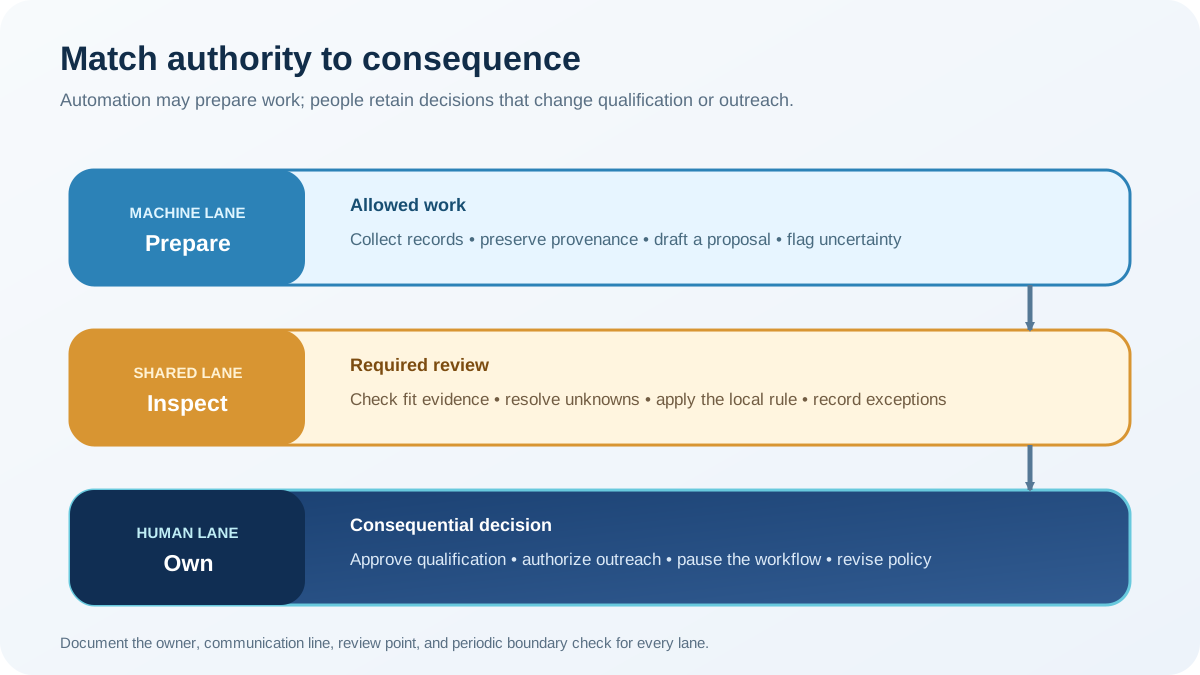
The useful boundary is not manual versus automatic. It is visible work versus hidden judgment: automate the work a team can inspect, and keep a named person responsible for qualification, exceptions, and sending.

Document Roles and Human-AI Oversight
The first screen I open is the exception queue. A long queue doesn't bother me nearly as much as a queue with no owner, because an unowned exception shows that the automation has been given responsibility without accountability.
That is my working definition of automated prospecting: repeatable prospecting work is delegated to a system, while commercial judgment remains assigned to a person. The boundary matters more than the label on the tool.
NIST's voluntary AI Risk Management Framework points to documented roles, communication, human-AI oversight, ongoing monitoring, and periodic review. I use that guidance as an operating discipline, not as certification, legal advice, or proof that a prospecting system performs well.
- Name the person who approves qualification criteria and changes to them.
- Name the person who reviews uncertain outputs and receives exceptions.
- State how operators report a failure and who decides whether the workflow pauses.
- Set a periodic review that revisits roles, communication, oversight, and the automation boundary.
Separate Repeatable Tasks From Sales Judgement
I automate a task when the team can describe what enters, what should come out, and how someone will inspect the change. That makes the work repeatable without pretending the result is automatically correct.
I keep the decision human when the output becomes a judgment about fit, an exception with competing evidence, or permission to send. Automation can prepare the decision. It cannot make the accountable owner disappear.
The split is not permanent. A task can earn more automated scope after tests show that its outputs remain inspectable and its exceptions reach the right person. A task can also lose scope when monitoring reveals that review has become guesswork.
Name the Inputs That Automation Depends On
A role chart is incomplete without an input contract. I write down the selection criteria, permitted fields, unknown state, expected output, reviewer, allowed next action, and route for a conflict. Then the system's authority can be inspected.
The common mistake is to document the happy path and leave silence around missing or contradictory information. Silence isn't a usable default. It is a decision that nobody has agreed to own.
I also keep the communication line concrete. The operator needs to know where to send a questionable output, the reviewer needs the context behind it, and the owner needs a way to change the rule that created it. Otherwise periodic review has nothing usable to examine.
Test Before Deployment and Monitor in Operation
Once the roles are visible, the next question is whether the workflow behaves as described. A tidy configuration page isn't evidence of that. I want documented tests before deployment and documented monitoring after the system meets live work.
The NIST AI RMF describes testing before deployment, regular testing while a system operates, documented results, and production monitoring. It doesn't give prospecting teams a universal pass mark. The team must choose tests that match its own task and risk.
So I split measurement in two. First, did the workflow preserve the intended state and reach the right reviewer? Second, what did reviewers accept, correct, reject, or escalate? Activity belongs after those control questions, not before them.
- Before deployment, test expected cases, missing information, contradictory information, and denied actions.
- During operation, monitor outputs, corrections, exceptions, failed transitions, and whether the assigned reviewer actually receives the work.
- Document the test set, the metric being observed, the result, the reviewer, and any change to the workflow boundary.
Automate Discovery and Enrichment With Checks
Discovery and enrichment are tempting places to chase volume. I test them as transformations instead. Did the system apply the stated selection rule? Did it preserve uncertainty? Did it route a missing or conflicting value to the agreed review path?
A tool is easier to govern when its intermediate output can be inspected and corrected before the next action. If a team can only see the final record, it cannot tell where the workflow introduced the error.
My pre-deployment note pairs each test with the decision it protects. A selection test protects the candidate boundary. A missing-value test protects the unknown state. A routing test protects the reviewer handoff. That makes a failed test actionable instead of merely red.
Require Review Before Qualification and Outreach
Qualification and sending are where a provisional output becomes a consequential decision. I put a named reviewer there, define what evidence the reviewer sees, and prevent an unresolved exception from advancing simply because the workflow has another step available.
Test the refusal path as carefully as the approval path. Can the reviewer correct the record, reject the result, ask for more evidence, or stop the action? A review button without those usable outcomes is ceremony.
Production monitoring should preserve the same distinction. A completed task tells me the route ran. A reviewer correction tells me the output needed work. An escalation tells me the boundary met an unresolved case. I don't collapse those different states into one success count.
Control Third-Party Data and Failure Handoffs
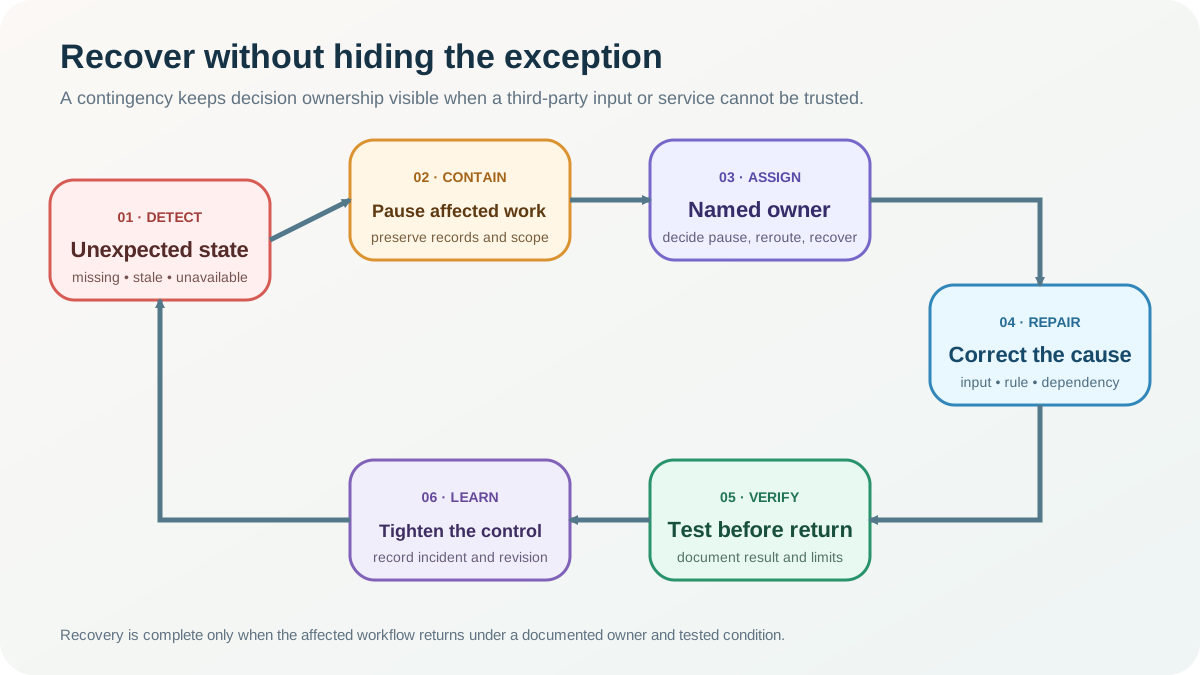
A controlled internal workflow can still inherit an uncontrolled external dependency. Prospecting systems may rely on third-party AI or data, so the handoff needs its own control record and a contingency for failure or incident.
NIST's voluntary framework calls for third-party risk controls, monitoring, and contingency processes. I translate that into plain operating questions: what dependency changed, which records or actions may be affected, who can pause the route, and how will the team recover?
This is also a limit on automation. A system cannot verify truth, intent, consent, or compliance merely by passing a value downstream. Unknown information must stay unknown until an accountable review resolves it.
- Document each third-party dependency and the workflow step that consumes its output.
- Preserve an unknown state instead of silently converting missing information into a positive or negative decision.
- Define the event that pauses the workflow, the owner who investigates, and the contingency that keeps affected actions from continuing.
- Record the incident and use the result to revise the control or narrow the delegated scope.
Track Freshness, Provenance, and Unknown Values
I want a reviewer to know where a value came from, when the workflow obtained it, and whether the system transformed it. Without that context, a polished field can look more certain than the dependency behind it.
Freshness and provenance are not proof of fit. They are controls that make review possible. The practical win is modest but important: the reviewer can see what is known, what is stale, and what still needs a decision.
Do not let a new value silently erase the old one when the two disagree. Preserve the conflict for review. The point is not to keep every field forever; it is to prevent the workflow from presenting an unresolved third-party difference as settled truth.
Route Exceptions to a Named Owner
An exception route needs a person, not a department name. I record who receives it, what evidence arrives with it, which actions are blocked, and who may restart the workflow after the issue is understood.
Then I watch the queue for a different signal: repeated exceptions. They don't automatically condemn the tool. They show where an input rule, third-party dependency, handoff, or authority limit deserves another look.
The contingency must be usable before the incident arrives. The owner needs authority to pause the affected route, keep unresolved work from advancing, document what happened, and decide whether recovery means correcting a record, changing a control, or narrowing the automated scope.
Bound the Documented OKKI Go Workflow
A product page is useful here only if I keep its claim inside the documented workflow. The official OKKI Go pages describe company search, selected contact access, outreach drafting, confirmation before sending, and locked email-status visibility.
The sequence matters. A clear prospect profile leads to candidate companies. The team can review which companies to unlock, access selected contacts, inspect an outreach draft, confirm before send, and see task status or a failure reason.
That scope does not prove that a candidate has buying intent or qualifies as an opportunity. It does not establish consent, compliance, fixed accuracy, deliverability, response, pipeline, or revenue. Those are separate decisions and outcomes.
Connect Activity to Qualified Progress
The visible states can support an operating review: candidate set, selected unlock, contact access, draft, confirmation, send status, and failure reason. I would track those states as workflow evidence, not translate them into qualified progress without a human decision.
This keeps metrics honest. Activity measures what the workflow did. Qualification records what an accountable person decided. Commercial outcomes arrive later and are not promised by the first-party pages in this evidence pack.
For a tool review, I would therefore ask whether each state is visible and whether the team controls the transition between them. The product description supports that workflow inspection. It does not support a ranking claim or a prediction about business results.
Use Failure Signals to Tighten the Boundary
An exception closes the loop only when a named owner reviews it. I ask whether the input was unclear, the selected record needed human review, the draft needed correction, or the send action should remain blocked; none of those checks requires a product claim beyond the cited workflow.
That answer should change the next run. Tighten the search context, narrow the permitted transition, add a review point, or keep the action human. Automation earns more scope only after its failures remain visible and manageable.
This is the final audit question I leave with the owner: if the next run produces the same failure, will the system show it, stop the affected action, and put the evidence in front of the person who can change the route? If not, the boundary is still too wide.
Open the prospecting workflow you want to automate. Write down one boundary, the person who owns its exceptions, and the action that stays blocked until that person reviews it. If you cannot name all three, keep the step human.
Frequently asked questions
What is automated prospecting?
Automated prospecting delegates repeatable prospecting work to a system while people remain responsible for qualification, exceptions, and sending. A task is a sound candidate only when its input, output, reviewer, and failure route can be inspected.
Which prospecting tasks should be automated?
Start with repeatable transformations whose intermediate output can be reviewed and corrected. Keep a step human when it decides qualification, resolves conflicting evidence, authorizes sending, or produces an exception with no named owner.
How should an automated prospecting workflow be tested?
Test it before deployment and regularly in operation. Document expected, missing, conflicting, and denied-action cases; then monitor outputs, reviewer corrections, exceptions, failed transitions, and whether work reaches the assigned owner. No universal threshold is established here.
How should a team compare automated prospecting tools?
Compare the work each tool is allowed to perform, whether inputs and intermediate outputs remain visible, where a person confirms consequential actions, how failures are surfaced, and whether third-party dependencies have documented controls and contingencies.
Does OKKI Go autonomously qualify prospects or guarantee outreach results?
No such inference is supported here. The official OKKI Go pages describe a reviewed workflow for candidate-company search, selected contact access, outreach drafting, confirmation before send, and visible email status. They do not prove intent, qualification, consent, compliance, accuracy, deliverability, response, pipeline, or revenue.
Explore OKKI Go
- Explore OKKI GoReview the official overview of company search, contact discovery, outreach drafting, and email tracking.Official OKKI Go resource ↗
- Review OKKI Go use casesInspect the documented candidate review, selected unlock, contact access, drafting, confirmation, and status workflow.Official OKKI Go resource ↗