
Three recurring artifacts look similar in a workflow: recorded activity, an account inference, and a person-level claim.

What does B2B intent data actually observe?
Field note one: a large input count sits beside a compact label. Demandbase says it analyzes trillions of web interactions and reports more than two trillion signals each month, checked August 2026, to identify accounts showing early buying signals. Its separate guidance treats a spike as a reason for research or a priority change, not an automatic outreach trigger. What can you safely read from that scale? You can see how much the system processes. You can't see which person decided anything.
Field note two: two products can display a similar topic while taking different routes to it. Cognism says keyword-based bidstream data can produce false positives, while co-op data uses historical baselines, engagement depth, and topic relevance to identify stronger signals. If you're building a shortlist, that difference belongs under collection and modeling quality. It doesn't give you permission to promote either account-level result into a person-level fact.
The evidence chain becomes clearer when you name every transformation. A source first records an activity. An identity or resolution process associates that activity with an account. A baseline or model then decides whether the activity is unusual and assigns a topic, score, segment, or recommendation. The CRM receives that derived object and may place it beside a contact record. Only the final screen changed; the observation underneath did not. If a rep then writes that a named person researched the topic, the workflow has added an attribution that the account-level chain never supplied. Shortlist documentation should therefore show the observed activity, resolved entity, baseline, derived label, and permitted action as separate fields rather than hiding the transitions inside one score.
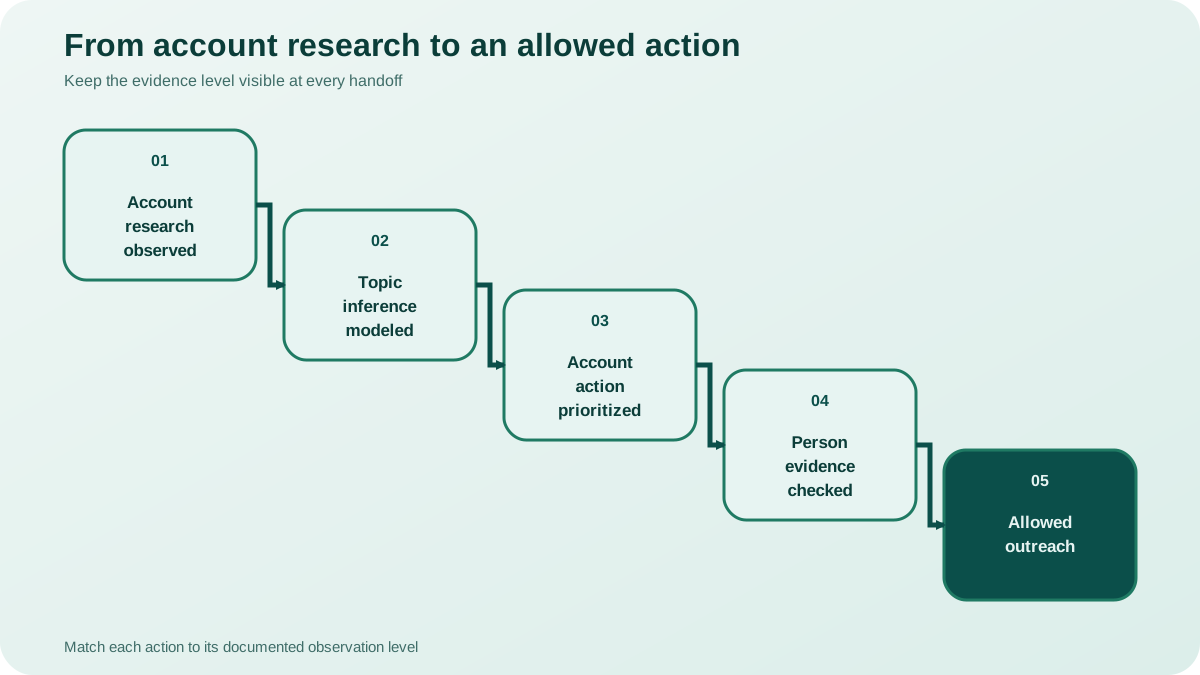
Keep the observation separate from the inference
The useful artifact isn't another score. It's a reading key for your shortlist. For each candidate, write down what the vendor says it records, what it models from that record, and which action the documentation actually supports. You'll keep an account-level third-party topic separate from a known person's first-party action without pretending that either one proves a purchase.
- Observed, account-level third-party: research or content-consumption activity associated with an account. Actionability: use only for account research or priority when the documentation supports that use. Outreach reason: no person-level claim.
- Inferred: a topic surge, account-interest label, score, segment, or recommended action derived from the activity. Actionability: compare and route accounts. Outreach reason: do not state the inference as something a named contact did.
- Observed, first-party and person-level: a disclosed action tied to a known recipient, such as an open or click in your own workflow. Actionability: describe only that engagement. Outreach reason: it still does not prove budget, timing, or commitment.
- Unresolved until confirmed: identity behind third-party research, buying authority, purchase timing, and decision status. Actionability: specify what additional observation would be required before making each narrower claim.
How does an account signal become a workflow action?
Field note three: the inference doesn't stay on a methodology page. Demandbase describes intent feeds inside orchestration, scoring, and segmentation, then surfaces account-level summaries and recommended actions in a rep's workflow. Bombora recommends integrating intent tools with CRM and marketing platforms. You'll gain useful activation from that integration. You won't gain a new evidence type, so the destination field should still say account-level inference rather than observed person action.
A separate Demandbase recommendation adds the missing control: combine intent with fit and engagement, then apply thresholds before acting. That suggests a workflow test for your shortlist. Can the product preserve the source and observation level, combine signals without merging their meanings, and place a threshold before an action? A workflow that answers yes is easier to audit than one that presents a single unexplained priority label.
A usable lineage record needs more than a provider name. Preserve the checked source page and date, the activity or event the provider says it observes, the entity to which that activity is resolved, the aggregation level, the baseline or time window, the derived topic or score, and the action your team permits. Keep any later person-level event in a separate field with its own timestamp and source. Those fields let a reviewer answer two different questions: why did this account enter the queue, and what new evidence justified contacting this person? When the record stores only a final priority value, the reviewer cannot reconstruct which transition came from the provider and which came from the team's workflow.
Read the derivation before the score
Your shortlist can remain vendor-neutral and still be decisive. Ask six questions. Does the option document its observed event and aggregation level? Does it explain how a topic or score is inferred? Does it preserve that inference label after CRM integration? Does it show account summaries without implying person attribution? Does it support fit, engagement, and action thresholds? Can your team define the additional observation required for a person-level claim?
In an OKKI Go workflow, you'd carry the label with the field. An account-level third-party topic can enter account review as an inference. A known recipient's later open or click belongs in a first-party engagement record. When you keep both visible but separate, workflow convenience can't turn an account model into a statement about a person.
Where does the evidence stop?
Start with signal type. This article's caution applies to account-level third-party topic intent. When a vendor documents that level, you can use the signal for an account-priority decision. A disclosed first-party action tied to a known person is narrower evidence and may support saying that the action occurred. You still can't use either category, by itself, to establish budget, purchase timing, or commitment.
Then check the method. Keyword-based bidstream collection may create false positives, while a co-op method can use historical baselines, engagement depth, and topic relevance. Those differences can change which option survives your shortlist. They still don't answer whether a named person researched, holds authority, or entered a buying process.
- Documented account-level third-party topic: compare accounts, investigate fit, or change research priority. Do not turn it into a named person's reason for outreach.
- Documented first-party action by a known recipient: record the specific action and use it under your engagement rules. Do not describe more than the event establishes.
- CRM summary, score, segment, or recommendation: treat it according to its underlying observation level. Integration and presentation do not upgrade the evidence.
- Budget, timing, authority, or commitment: require separate confirmation designed for that exact claim.
This boundary matters in OKKI Go as well. If you observe a known recipient's open or click in the first-party outreach workflow, classify it as delivery or engagement evidence. That's more person-specific than an anonymous account topic, yet it still doesn't prove authority, budget, timing, or a buying decision. Keep your action conditional on that documented meaning.
What should you reject on a shortlist?
A fourth note comes from shortlist meetings: teams often compare the size of a signal before they compare its definition. You may hear a tempting chain: a topic surge means an account is in-market, so a contact wants a conversation. Can you see the extra meaning added at each step? Demandbase's own guidance leaves room for a narrower response, more research or changed priority without automatic outreach.
Your qualification should begin with the vendor document, not the score. Mark the observation level, collection method, inference step, and recommended action. Then write the claim your team wants to make. Is the documented signal broader than that claim? If so, you need another evidence step in your workflow. That's a selection criterion, not a universal ban on activation.
That test gives you a more useful shortlist than a provider ranking. One candidate may be stronger on transparent collection. Another may preserve lineage better through CRM integration. A third may make thresholds easier to govern. You can't use the evidence here to settle which vendor wins for every team. You can use it to decide what must remain inspectable before a topic label influences a person-facing action.
How would you apply the evidence rule?
Now put the rule to work in one bounded scenario. You're looking at an account that matches the team's ICP. The topic alert is documented as account-level third-party intent, and no known person has taken a separately observed action. You may compare and investigate the account. You can't attribute the topic to a contact.
Before activation, you check the shortlist artifact. The observed column contains account-associated research activity. The inferred column contains the topic label. The permitted-action column allows account research because the source guidance supports priority changes without automatic outreach. You check fit and visible company context. If you find no credible reason for contact, the alert remains a monitoring input rather than forcing a sequence.
What changes if an OKKI Go outreach later records an open or click from a known recipient? You now have a first-party observation, so the evidence row changes from account-only inference to person-level engagement. You can say that the message was delivered or engaged with, according to the recorded event. You still can't say the person has budget, purchase timing, or commitment.
You can now trace the change in action without reaching for a stronger adjective. The account alert justified research. The known-recipient event justified an engagement record. Any later claim still needs evidence at its own level. If a vendor documents a different observation model, this example stops applying. You'll need to reread that documentation instead of carrying this account-level rule across every intent product.
Now test the counterfactual. Remove the known-recipient event and leave the account surge unchanged. The account can remain prioritized for research, but the person-facing reason disappears; it is not merely a lower-confidence version of the same claim. Restore a documented click from a known recipient and the team may follow up on that engagement, while still avoiding claims about budget or timing. If the record cannot show which message, recipient, and event produced the engagement field, the workflow must fall back to account context. This stop rule prevents a stale topic label from inheriting certainty from a later contact record simply because both sit on the same CRM page.
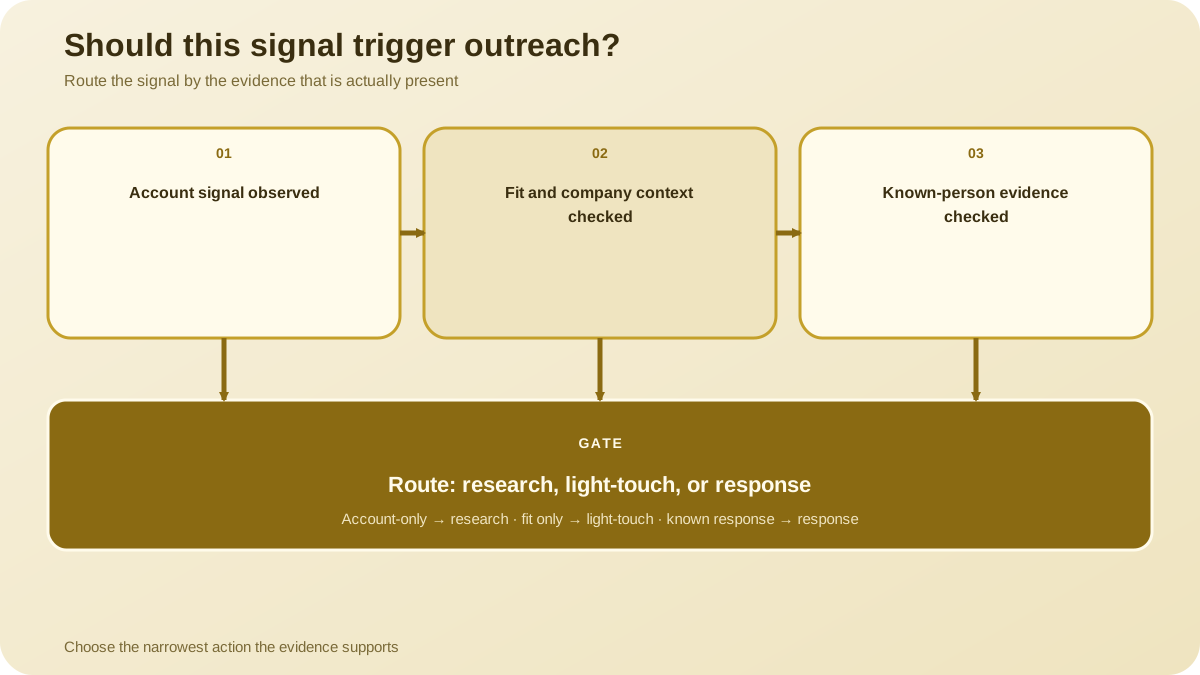
The notes do not produce a universal winner. They produce a shortlist discipline: preserve what was observed, name what was inferred, and limit each action to that evidence level. The unresolved work is local to your team, deciding which additional observation is strong enough for the next claim you intend to make.
Frequently asked questions
What does a third-party B2B intent spike actually tell you?
It indicates that research activity associated with an account differs from the provider's baseline for a topic. It supports an account-level inference and a reason to investigate; it does not establish that a named person has decided to buy.
Can B2B intent data identify the individual buyer?
Account-level third-party topic intent does not identify the individual decision-maker. A first-party action tied to a known recipient can document that person's specific interaction, but it still does not prove authority, budget, timing, or commitment.
When should an account-level intent signal change outreach?
Use it to change account priority or trigger additional research when the source, aggregation level, baseline, and timing are documented. Person-level outreach requires separate evidence tied to a known recipient; without that evidence, keep the action at account context rather than individual certainty.
Which fields should survive when B2B intent data enters the CRM?
Preserve the collection method, observed entity, aggregation level, baseline window, derived topic label or score, observation and processing times, and the action the evidence permits. If the CRM cannot retain that lineage, the workflow should fall back to account research instead of presenting the field as person-level fact.