When B2B sales prospecting in a new market produces many convincing lookalikes, the list is mixing companies that play different commercial roles. Familiar industry language can hide direct buyers, distributors, integrators, specifiers, peers, and exclusions that require different next actions. Map the possible route to purchase, require observable evidence for each role, keep ambiguous firms in investigation, and search for contacts only after the company classification is defensible.
Similar company descriptions can hide incompatible commercial roles
Consider a hypothetical Chinese manufacturer of end-of-line packaging machinery preparing to enter Poland. At home, the company often sells through regional equipment distributors, but larger projects may involve line integrators and direct factory relationships. The export team searches for packaging companies, automation providers, food-processing suppliers, and machinery distributors. Within hours, it has hundreds of plausible businesses.
The websites create a false sense of familiarity. One company manufactures cardboard packaging. Another distributes consumables. A third integrates complete production lines. A fourth provides maintenance without selling machinery. A fifth owns factories and might be an end user. A sixth manufactures equipment that overlaps with the exporter. They all discuss packaging, automation, efficiency, and food production.
If the team calls all six prospects, its list is large but its motion is undefined. A distributor conversation concerns portfolio fit and territory. An integrator conversation concerns project compatibility and technical cooperation. An end-user conversation concerns a production problem. A specifier may never buy but can influence a shortlist. The first research task is therefore classification.

B2B sales prospecting begins with a route-to-purchase hypothesis
A route hypothesis is a provisional answer to three questions: who experiences or represents the problem, who can evaluate the product, and how the purchase normally reaches the customer. The word provisional matters. In a new country, the team should expect the hypothesis to change as company evidence and conversations reveal local structure.
For the packaging-machinery example, the first hypothesis might be: independent distributors with adjacent equipment and service capability can introduce mid-sized food factories; line integrators matter for larger projects; direct outreach to factories can test demand and expose incumbent routes. Each part points to a different company type and different contact responsibility.
Do not import a home-market ICP as if it were a universal company description. The same function may be performed by a distributor in one country, a systems integrator in another, or a manufacturer's direct office elsewhere. Ownership structures, service expectations, procurement practices, and channel concentration can change the route without changing the product.
- Direct route: the operating company evaluates and buys for its own site
- Channel route: a distributor resells and may support a territory
- Integration route: a project or line integrator includes the product in a broader solution
- Specification route: an adviser, engineer, or technical body shapes requirements
- Learning route: an industry participant may not buy but can explain language, alternatives, and access
Classify each company by the next action it makes possible
Classification should be based on what a company visibly does, not on a label copied from a database. Company descriptions are often broad. “Solutions provider” could mean distributor, integrator, consultant, contractor, software vendor, or manufacturer. Look for operational evidence: portfolio pages, represented brands, project descriptions, service capabilities, customer industries, locations, and the way the company describes revenue-generating work.
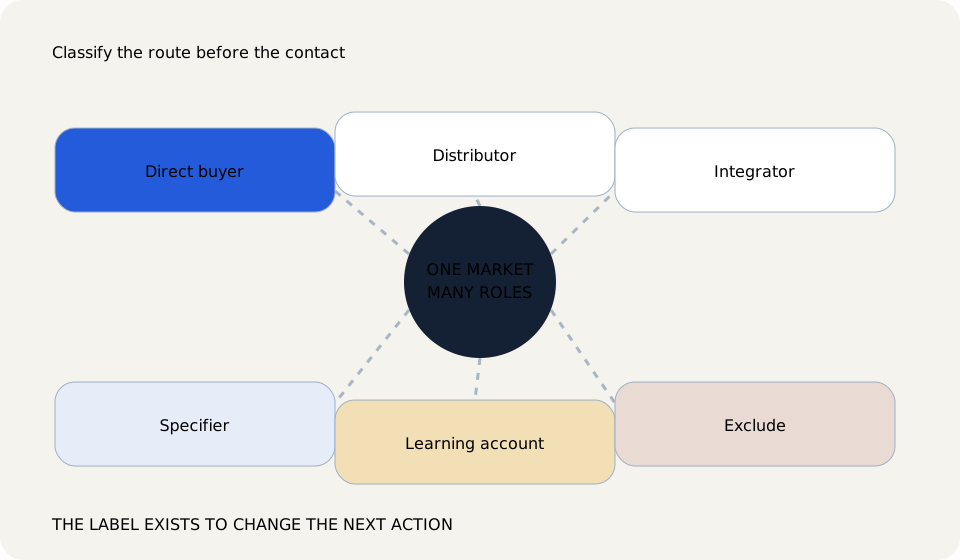
Classify the role before choosing the action
| Company signal | Possible role | Question before action |
|---|---|---|
| Owns production sites and discusses capacity | Direct buyer | Does the product solve a visible process constraint? |
| Carries multiple machinery brands and offers local service | Distributor | Is the product complementary to the current portfolio? |
| Designs or installs complete lines | Integrator | Where could the product fit technically and commercially? |
| Writes specifications or advises projects | Specifier | Can it influence requirements, and is outreach appropriate? |
| Makes adjacent equipment | Partner or peer | Is there a real non-competing cooperation route? |
| Uses category terms but sells packaging material | Lookalike | Is the apparent relevance purely linguistic? |
A classification is not a verdict about willingness to buy. It is a working model of commercial position. Record the supporting fact and a confidence note. “Distributor—represents three adjacent brands and lists a nationwide service team” is usable. “Good fit—90 score” hides the reasoning a salesperson needs.
Separate inclusion evidence from lookalike exclusions
The export team now creates a one-page card for each route. This is more precise than one giant ICP because a direct factory and a distributor should not be forced into the same definition. Each card contains the role, why it matters, observable evidence, common lookalikes, exclusions, missing facts, and the likely first-contact responsibility.
A distributor card must state evidence and exclusions
Role: independent machinery distributor serving food and beverage plants. Include when: the company represents several complementary brands, covers the target geography, and shows sales or service activity. Investigate when: it sells relevant equipment but the resale model or territory is unclear. Exclude when: it manufactures the same core category, sells only packaging consumables, or is an end user. First role cues: owner, commercial director, portfolio or product manager, business development. First question: does this category complement the current portfolio and customer base?
Exclusions deserve equal attention. A competitor is not the only costly mismatch. A technically relevant company may serve pharmaceutical plants while the exporter is prepared only for food applications. A distributor may have no local service capacity for a product that requires commissioning. A multinational may appear ideal but route all purchasing through a country outside the target seller's coverage.
Seven fields make a route hypothesis testable
- ✓Commercial role and reason it matters
- ✓Visible positive evidence
- ✓Common lookalikes
- ✓Explicit exclusions
- ✓Facts that remain unknown
- ✓Likely first-contact responsibilities
- ✓A modest first-conversation objective
Build a route-balanced portfolio before collecting contacts
A portfolio keeps different kinds of uncertainty separate. Direct buyers can be grouped by use case. Potential distributors can be compared by portfolio and coverage. Integrators can be mapped to project types. Specifiers and learning accounts can be kept outside the immediate outreach queue. Exclusions remain visible so the same convincing lookalikes do not return in every search.
The mix matters. If the list contains only large end users because their websites are rich in data, the team may falsely conclude that a direct-sales route is best. If contact availability determines selection, smaller private distributors may disappear. Review company roles before considering whether a convenient email address exists.
Five steps from route hypothesis to balanced portfolio
- HypothesizeName the possible direct, channel, integration, and influence routes
- SearchFind companies using role-specific evidence and exclusions
- ClassifyAssign role, supporting fact, ambiguity, and next research action
- BalanceInspect whether the portfolio over-represents the easiest data
- LearnUse research and conversations to revise route cards
This structure also prevents premature personalization. A message to a distributor should not sound like one to a factory engineering manager. By the time contact work begins, the route card already supplies the business question that makes the communication relevant.

Review company logic in OKKI Go before searching for people
The team can enter the product category, country, candidate buyer routes, positive clues, and exclusions into OKKI Go in natural language. One search can focus on independent distributors with adjacent brands; another can examine line integrators; a third can explore direct end users. The initial output is a candidate company set for review rather than a mandate to contact everyone.
A salesperson classifies the candidates using the route cards. Strong evidence earns selection. Missing evidence creates an investigation task. Repeated lookalikes improve the exclusion language. If the first distributor search returns mostly material suppliers, the correction is commercial: require represented machinery brands, installation work, or service capability—not merely more packaging keywords.
After selected companies are unlocked, OKKI Go can support contact discovery using role or name cues within those accounts. The team chooses the responsibility implied by the route. For a direct factory, it may be plant engineering, operations, maintenance, procurement, or a technical owner of the process. For a distributor, it may be commercial leadership, portfolio management, or business development.
If the team later prepares outreach, company context and supplied product material can support a draft. A person confirms the recipient, factual basis, subject, and body before sending. The usable output is therefore not a raw list. It is a company-role hypothesis, a relevant person to test it with, and a reviewable reason for the conversation.
Choose a contact who can validate the route
New-market teams often search for “the decision-maker” as though one universal title exists. Industrial purchases distribute responsibility. An engineering manager may understand technical fit, procurement may control process, operations may own the pain, and a managing director may sponsor a small company relationship. In a distributor, the person who manages a category may be more useful than the most senior executive.
The first contact does not need unilateral buying authority. The person needs enough responsibility to recognize the business question and redirect it accurately. This changes the research objective from “find the boss” to “find the role that can validate this route.” It also makes a modest first ask possible.
The first contact should validate the route
| Route | Useful responsibility cues | First conversation |
|---|---|---|
| Direct factory | Operations, plant engineering, maintenance, process owner | Does the problem exist, and how is it handled now? |
| Distributor | Commercial director, portfolio manager, product manager, owner | Does the category complement the portfolio and territory? |
| Integrator | Projects, engineering, partnerships, technical director | Where could the product fit into current line designs? |
| Specifier | Consulting engineer, technical adviser, standards or project lead | Which requirements shape selection, if contact is appropriate? |
Use public role evidence cautiously. Titles vary by language and company size, and a profile may be outdated. Treat responsibility as a hypothesis to verify, not as permission to make personal claims. If uncertain, ask whether the recipient owns the topic or can point to the right colleague.
Review what the market model learned each week
At the end of the week, do not report only how many companies or contacts were added. Review how the market model changed. Which role produced the clearest evidence? Which lookalike recurred? Which exclusion removed too much? Which company type had no obvious contact responsibility? Which conversation contradicted the initial route?
Review how the market model changed
- ✓One route hypothesis strengthened by evidence
- ✓One route hypothesis weakened or reframed
- ✓The most common lookalike and its new exclusion rule
- ✓A missing data point worth investigating
- ✓A contact responsibility that proved useful or misleading
- ✓A message assumption that needs evidence
- ✓The single market question for next week
Keep illustrative and observed information separate. The packaging-machinery scenario in this article is hypothetical; your market record should identify which statements come from public company sources, which came from conversations, and which remain team assumptions. That discipline prevents a confident internal story from hardening into invented market fact.
A useful portfolio becomes more selective as knowledge grows, yet it should preserve learning accounts and alternative routes. New-market entry is not a linear funnel from database to deal. It is a series of decisions under uncertainty. The portfolio shows what the team currently believes and what evidence could change that belief.
Treat role labels as hypotheses, not qualification proof
- Calling every end user a qualified buyer without confirming the process problem
- Calling every reseller a distributor without checking portfolio, territory, or service model
- Treating a specifier as a buyer and asking for a purchasing conversation
- Excluding every adjacent manufacturer even when a legitimate integration route may exist
- Promoting an account because a senior contact is easy to find
- Using engagement data as proof that the route hypothesis is correct
The remedy is not more categories for their own sake. Keep only distinctions that change the next action. If two labels lead to the same research, contact responsibility, and business question, combine them. If one label hides two incompatible motions, split it. Classification is a tool for allocating attention.
Finally, respect the boundary between commercial research and compliance. Before outreach, consider the recipient's jurisdiction, your lawful basis and transparency obligations, accurate sender identification, suppression handling, and the rules governing the chosen channel. A company classification can support relevance; it does not erase those responsibilities.
B2B sales prospecting in a new market becomes reliable when the team stops asking only, “Is this company in our industry?” and starts asking, “What commercial role could it play, what evidence supports that role, and what should happen next?” A route-aware portfolio lets direct buyers, distributors, integrators, specifiers, learning accounts, and exclusions coexist without turning uncertainty into noise.
Choose one country and one product line. Write separate route cards for the direct buyer, channel partner, and integrator you currently believe matter. Ask OKKI Go for a small candidate set for each route, classify the companies before looking for contacts, and note which route produces the clearest evidence. That is a practical first week of market learning.
Questions readers often ask
What is B2B sales prospecting?B2B sales prospecting is the work of identifying companies and people that may have a relevant business reason to engage, then researching and testing that reason. It includes target definition, company classification, contact selection, outreach, and learning from results.
How do you prospect for international B2B customers?Begin with the product's use context and several possible routes to market. Search for observable company evidence, classify candidates by commercial role, investigate ambiguity, then choose contacts and messages appropriate to each route. Revise the model as local evidence accumulates.
Should I target distributors or end users first?It depends on product complexity, service needs, market structure, account concentration, and your own coverage. Treat both as testable route hypotheses. Compare the quality of company evidence and early conversations before committing most resources.
What makes a B2B prospect qualified?Qualification is contextual. A company should match a plausible commercial role, show evidence connected to the product's use or route, fit explicit boundaries, and offer a responsible next research or conversation step. A contact record alone is not qualification.
How do I identify decision-makers in a new market?Map the responsibilities involved in recognizing, evaluating, approving, purchasing, or implementing the product. Search by those responsibilities within selected companies. The best first contact is often the person who can validate the business question, not necessarily the most senior title.
Sources and further reading
- OKKI Go prospecting use cases — OKKI Go
- B2B Sales Prospecting — Salesforce
- Question for teams struggling with outbound — Reddit community discussion
- Is enterprise prospecting supposed to take this long? — Reddit community discussion
- OKKI Go FAQ — OKKI Go