The best AI SDR is the product whose bounded job, evidence trail, escalation rules, and human controls match an already-defined sales development process.
Draw the boundary of an AI SDR job
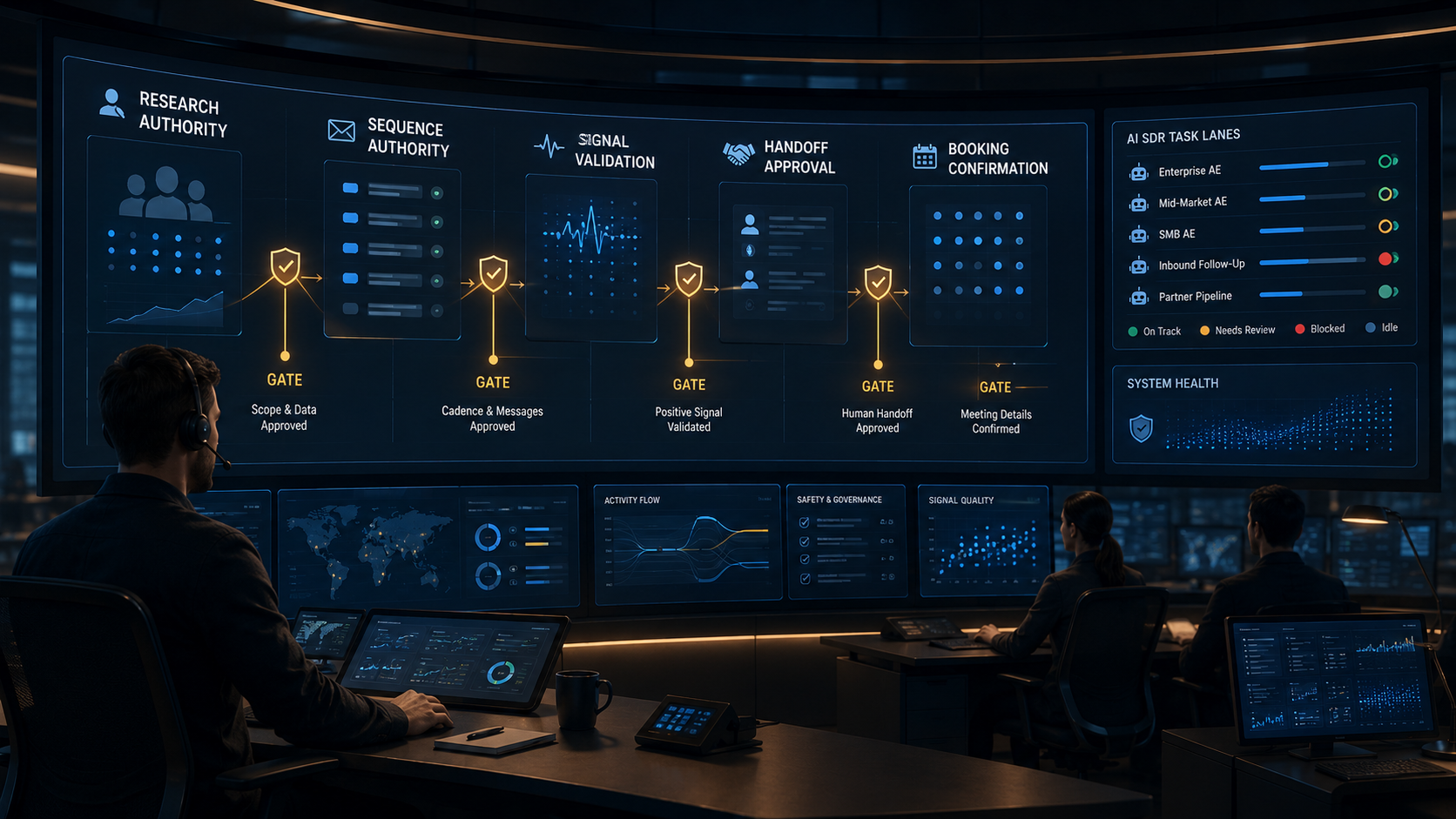
A fluent email is the tempting admission ticket to this category. It should fail: can you trace the prospect decision, permitted action, reply disposition, CRM change, and human exception owner? If not, the product is assistance around an SDR, not an AI system owning a bounded SDR job. Before approving an autonomous outbound pilot, I would strike ordinary writing assistants from the shortlist. Drafting an email is a content task, not ownership of an SDR job. A qualifying AI SDR must connect several stages of work: selecting or researching prospects, applying targeting rules, creating or executing outreach, recording actions, interpreting replies, and handing exceptions to people. It need not perform every stage, but its boundary must be explicit. OKKI Go belongs in the discussion only in its bounded documented role; it should not be promoted into autonomous SDR status without evidence that it owns the wider workflow, controls, and trace required here. If you call it autonomous, I ask you to show your exception path and tell me who owns your irreversible mistake. Would you grant your agent authority we couldn't interrupt?
The category boundary also excludes a loose collection of automations presented as one agent. If enrichment happens in one system, messages are copied into another, replies enter an unmanaged inbox, and CRM updates depend on a rep remembering them, nobody can reconstruct the decision chain. The procurement decision is therefore binary before it becomes comparative: can the platform own a coherent job with inputs, permitted actions, evidence, escalation, and an accountable human? If not, buy it as a supporting tool and retain human ownership of the SDR job. Calling fragmented assistance autonomous merely hides the handoffs where errors and compliance failures accumulate. You define the category before your demo; I expect you to show me which operator can stop each consequential action and why. Can you show your reviewer why we'd allow that transition?
The admission test
Ask the vendor to demonstrate one prospect from trigger to disposition. The record should show the source data, targeting rule, research used, approved claim, channel action, reply classification, CRM write, and responsible human. A polished generated email proves almost none of this. If an operator cannot pause the flow, explain the contact decision, or identify who owns an exception, the product has failed the category test regardless of how fluent its output appears.
Rank documented scope without mistaking it for proof
No official page in this comparison proves safe operation. The order is therefore a provisional procurement hypothesis: evaluate documented job coverage and visible human participation first, then attempt to falsify the assumed controls in an identical pilot. A failed control reverses the rank. This ranking uses safely owned SDR job, not feature count, activity volume, or vendor-reported revenue. I score the fit between documented scope and an already-defined process: whether research and data remain attributable; personalization stays inside approved claims; channels have distinct permissions; replies reach controlled categories; CRM writes are inspectable; and humans can approve, pause, correct, or escalate. Rank 1 therefore means the strongest decision-specific fit for coordinated human-plus-agent execution among these five documented offerings. It does not mean Regie.ai is universally safer or better. A narrower team with different systems may rationally select a lower-ranked platform because its operating boundary is easier to govern. You may prefer another weighting; give me your criteria, your evidence, and the condition that makes you reverse your choice.
The process must be drawn before demonstrations begin. Define who supplies the account list, which signals qualify a prospect, what data sources are permitted, what personalization claims may be inferred, and which email, call, or social actions can execute. Then define reply classes such as interested, objection, unsubscribe, legal concern, wrong person, and ambiguous. Assign each class an owner and CRM disposition. Finally, separate reversible actions, such as drafting a task, from consequential actions, such as sending, booking, or overwriting a field. Vendors should be assessed against this map rather than allowed to redesign the process around their most impressive demo path. You can challenge my weighting by publishing your own; I would accept your reranking when you preserve the same evidence limits and reversal rule.
Context is not proof of performance
Salesforce Research surveyed 4,050 sales professionals across 22 countries in August and September 2025. That self-reported, cross-sectional sample can frame how teams describe AI and data practices, but it cannot show that an AI SDR caused better results; country and role composition also matter. Use such research to shape diligence questions, never to convert adoption sentiment into a performance promise or to excuse missing platform-level evidence.
Test the human-plus-agent operating model
Regie.ai ranks above AiSDR because Regie's official scope explicitly places prospecting agents alongside representatives across lead work, email, calls, LinkedIn tasks, and CRM logging. That is the closest documented match to this article's human-plus-agent operating model; it does not prove approval gates, reliable logs, or safe execution, which the pilot must demonstrate. Regie.ai Prospecting Agents ranks first for teams that want agents and named representatives to coordinate discovery, multichannel tasks, and system-of-record logging. Regie.ai documents lead discovery, enrichment, prioritization, email, calls, LinkedIn tasks, and CRM logging alongside reps. That breadth maps well to a governed SDR job because the work can be divided without pretending people have disappeared. The concrete decision is to use Regie.ai when representatives will remain responsible for audiences, messaging boundaries, reply ownership, and exceptions, while the platform coordinates approved prospecting work. The rank reflects that operating fit. Vendor statements about outcomes or scale are excluded because documented capability does not independently establish safe execution or commercial impact. I would let you keep Regie.ai first only after your rep can explain your approvals and your complete change history.
The demonstration must distinguish an action executed by the platform from a task suggested to a representative. Ask which email, call, and LinkedIn steps run automatically, which pause for approval, and whether every audience, message, status, and routing change receives a timestamped log. A safe configuration approves audiences and claim libraries before launch, gives named reps ownership of replies, and prevents the agent from improvising around objections or sensitive questions. CRM logging must preserve the source event rather than merely posting a generic activity. If a rep changes priority or suppresses an account, that intervention should remain visible instead of being overwritten by the next automated cycle. Show me your Regie.ai configuration, and I will ask you where your rep approves, corrects, pauses, and reconstructs the record.
Procurement cross-examination
Present a deliberately difficult record: the account matches the profile, but the contact has objected through another channel and the CRM contains conflicting ownership. Ask what stops, what logs, and who is alerted. The answer should identify precedence rules and a human owner, not merely promise that the agent is intelligent. Regie.ai remains first only if the live configuration exposes these controls and the team can reconstruct every consequential change.
Inspect the signal-to-booking chain
AiSDR ranks above Artisan Ava because its documented scope connects targeting and research to outreach, reply handling, booking, and CRM synchronization in one candidate flow. Artisan documents strong data-to-sequence work, but its cited page gives this comparison less detail about the reply-to-CRM chain. This is an editorial inference from scope, not comparative performance evidence. AiSDR ranks second for teams testing one contained flow that begins with signals and may extend through research, outreach, replies, booking, and CRM synchronization. AiSDR documents signal-based targeting, research, email and social outreach, reply handling, meeting booking, and CRM synchronization. This makes it a plausible fit when one team wants fewer unmanaged handoffs across the funnel. The safe ownership boundary, however, is not simply from signal to meeting. It is from an approved signal rule to an approved disposition, with each intermediate decision recoverable. Choose AiSDR when that bounded flow matches the process; do not choose it merely because an integrated demonstration appears more autonomous than a collection of point tools. You should let me pause your AiSDR flow mid-action, then show your reason, your route, and your corrected CRM state.
A live test must establish integration depth and regional behavior. Review target rules, prospect research, reply categories, calendar policy, and every CRM field the system may create or change. Then pause a campaign during execution and require the operator to reconstruct why each prospect was contacted. Test duplicate records, stale signals, existing opportunities, absent calendar capacity, unsubscribes, and replies that combine interest with a legal or procurement question. Social outreach also needs its own permission and retention review rather than inheriting the email policy. AiSDR holds second place only where the organization can stop the campaign immediately, inspect the trace, and route ambiguous messages without an automated guess becoming customer-facing fact. When you test AiSDR, keep your signal rule beside every contact; I want you to explain your pause, reply, booking, and CRM decisions.
Minimum fields for a defensible decision
Field | Question | Failure signal |
|---|---|---|
Evidence | What did the team observe? | Source or observation date is missing |
Owner | Who can approve the next action? | Responsibility is shared but unnamed |
Boundary | What would stop or reverse the action? | No exception path exists |
Review | When will the rule be recalibrated? | The metric persists without a decision use |
Market-specific control
Requirements vary by market and need local review. The Information Commissioner's Office explains, as a UK example only, that obligations can differ by channel, recipient type, personal-data use, transparency, and objections. That guidance is not global legal advice. The pilot must apply market-and-channel rules before contact selection, retain the basis used, honor suppression consistently, and send unresolved cases to qualified local reviewers rather than asking the agent to interpret law.
Grant research and sequence authority in stages
Artisan Ava ranks above 11x Alice because this procurement scenario starts with a narrower, more reviewable data, signal, research, and sequence-preparation job before granting broader execution. 11x documents more autonomous stages, but every additional stage creates another unverified transition. A buyer prioritizing breadth over staged authority could reverse these two positions. Artisan Ava ranks third for teams evaluating an AI BDR around data, enrichment, buying signals, research, personalized sequences, and meeting workflows. Artisan documents those functions, giving buyers a potentially coherent route from account information to sequence construction and booking activity. Its best fit is a team prepared to govern source policy and claim formation closely. The decision should turn on whether Ava can show where a datum came from, when it was obtained, and how it affected targeting or personalization. The official page does not independently establish data accuracy or revenue impact. Consequently, the platform should not be allowed to transform an uncertain enrichment field into a confident message simply because the sequence reads naturally. I ask you to challenge your Artisan source when your data is stale, your inference is personal, or your permission is unclear.
Approve data sources and permissions market by market, then classify fields by allowable use. A company-level technology signal might support prioritization without supporting a personal claim about an individual. A job title may be usable for routing yet too stale to justify role-specific language. Sequence rules should specify approved product claims, prohibited inferences, evidence freshness, and handoff thresholds. Meeting workflows must also reject false availability and preserve the message that prompted the booking. Artisan Ava remains third if its trace makes these distinctions reviewable. If source lineage, permissions, or correction behavior cannot be demonstrated, narrow its job to research and draft preparation while a human controls selection and sending. For Artisan Ava, you should separate your sourced datum from your inference; I would return any message your reviewer cannot trace.
A data-error test
Seed the pilot with a known stale title, a duplicated contact, and an account signal that has expired. Observe whether the records are flagged, silently merged, or converted into personalization. The acceptable mechanism is not perfect data; it is visible provenance, confidence handling, suppression, and correction. Ask which data sources and permissions apply in every target market, then verify the answer in the actual configuration rather than accepting a general policy statement.
Stress-test autonomous transitions
11x Alice ranks above Salesforge Agent Frank because 11x documents a broader candidate SDR job from market tracking and account research through replies and scheduling. Salesforge's explicit Co-Pilot mode may be the better first pilot for a team prioritizing reviewability over job breadth, so this pair should reverse when controlled assistance is weighted more heavily than end-to-end coverage. 11x Alice ranks fourth for teams exploring broad autonomous account research and outbound execution. According to 11x, Alice covers market tracking, account research, targeting, personalized multi-touch outreach, reply handling, and scheduling. That documented span is relevant to buyers seeking a larger delegated job, but greater span increases the number of assumptions that can become external actions. Scale and performance statements remain vendor marketing, so they do not raise the rank. The appropriate decision is a tightly limited pilot with a small account set, named channels, approved claims, and restricted reply authority. Broad autonomy should be treated as a hypothesis to test, not a property established by the product description. You show me your Alice transition log, and I will ask your operator why your reply became your scheduled action.
Inspect the trace at every transition: market event to target selection, research to personalization, personalization to channel choice, reply to classification, and classification to scheduling or escalation. Operators need visible evidence, immediate stop rules, and a named escalation path. The agent should not schedule after an ambiguous reply, continue another channel after an objection, or reinterpret a sensitive response to keep a sequence active. Compare the generated record with CRM history and suppression lists, including what happens when they conflict. Alice remains fourth when the organization values broad exploration but is prepared to constrain it. If the trace is incomplete, reduce authority until humans review each consequential step. With 11x Alice, you grant more transitions, so I ask you to narrow your cohort and show me your evidence at every handoff.
Let stop rules decide the finalist
Fifth is not a product-quality verdict. It records the narrow fit of Agent Frank's documented email, LinkedIn, multilingual, knowledge-base, and mode-based scope against this particular end-to-end job. Would your team prefer an explicit Co-Pilot boundary? If so, write that weighting down and rerank it. Salesforge Agent Frank ranks fifth, but it may be the most practical choice for teams specifically wanting visible Auto-Pilot and Co-Pilot modes for email and LinkedIn. Salesforge documents these modes, email and LinkedIn senders, multilingual work, and use of a customer-supplied knowledge base. The lower rank reflects a narrower decision fit and unresolved pilot questions, not a judgment of universal quality. Start in Co-Pilot so reviewers can inspect research, messages, and reply classes before execution. Approve the knowledge base as controlled source material, with owners and update dates. Do not assume that a supplied document makes every generated claim current, suitable for every market, or safe in every language. Your Co-Pilot preference is defensible when you state it; I want your team to show your review record before Auto-Pilot.
The pilot must test sender controls, channel suppression, language review, knowledge updates, and CRM fit. Sample every reply class rather than reviewing only positive responses. For multilingual campaigns, use qualified reviewers to assess meaning, tone, claims, and local requirements; fluent output is not evidence of equivalent policy compliance. Change a knowledge-base fact during the test and confirm when the update reaches active work, whether prior messages remain attributable to the old version, and how operators roll back errors. Deliverability and language quality are unproven until observed in the buyer's configuration. Auto-Pilot should unlock only after Co-Pilot evidence meets preset thresholds and exception handling is dependable.
The shortlist now becomes a controlled experiment, not a vendor beauty contest. Give each finalist the same bounded SDR job, approved account cohort, source policy, claim library, channel permissions, reply taxonomy, CRM field map, and escalation owners. Record denominators rather than celebrating raw activity. For example, calculate accepted meetings divided by meetings booked, qualified opportunities divided by accepted meetings, and wins divided by closed opportunities. The Bridge Group reports medians and averages from 351 surveyed B2B companies, including activity and pipeline measures, but its sample is heavily North American B2B SaaS and observational. Raw pipeline is neither forecast nor closed-won revenue, so external figures should provide context, not universal pass marks.
Write stop rules before connecting live senders. Stop on a suppression failure, an unapproved claim, contact without reconstructable basis, unauthorized CRM overwrite, misrouted sensitive reply, calendar action outside policy, or repeated channel conflict. Also define rate-based review triggers with explicit denominators and minimum samples chosen for the pilot; a single clean example cannot validate a workflow. Assign one person authority to halt execution and another to investigate, then require documented approval before restart. The winning platform is the one whose bounded job produces an adequate evidence trail under these tests while humans retain meaningful control. If none passes, keep the job human-owned and deploy only the components that did. If you prefer Agent Frank's Co-Pilot mode, write your weighting down; I would let your reviewability criterion change your order openly.
Provisional order: documented scope is evidence; every control remains unverified until piloted
Rank | Platform | Why it is evaluated here | Evidence status |
|---|---|---|---|
1 | Regie.ai Prospecting Agents | Closest documented fit to the human-plus-agent model across lead work, three channel types, and CRM logging | documented scope; pilot validation required |
2 | AiSDR | Documented signal-to-reply-to-booking flow includes CRM synchronization, but human approval and exception controls remain unspecified | documented scope; pilot validation required |
3 | Artisan Ava | A narrower data-to-sequence job can be staged before broader authority, with source accuracy and CRM behavior still requiring validation | documented scope; pilot validation required |
4 | 11x Alice | Broad documented coverage makes it an end-to-end candidate, while the number of autonomous transitions increases the pilot burden | documented scope; pilot validation required |
5 | Salesforge Agent Frank | Explicit Auto-Pilot and Co-Pilot modes offer a useful alternate weighting, but its documented job is narrower for this end-to-end scenario | documented scope; pilot validation required |
The approval record
The final decision memo should name the delegated job, excluded actions, allowed markets and channels, approved sources, claim policy, reply owners, CRM permissions, monitoring cadence, stop authority, and restart procedure. Attach failed cases as well as successful ones. Procurement can then compare Regie.ai, AiSDR, Artisan Ava, 11x Alice, and Salesforge Agent Frank on observed control performance rather than presentation quality, feature breadth, or unsupported outcome claims.
An AI SDR earns a wider job only after surviving a narrower one. Begin with a small account set, force ambiguous replies and ownership conflicts into the test, and watch whether a named person can stop, explain, and repair each transition. Breadth matters after control is visible; before that, breadth is simply a larger unknown.
Frequently asked questions
What is the most important AI SDR selection criterion?
Select for fit between a bounded SDR job and the platform's demonstrable controls. The decisive evidence is whether operators can reconstruct why a prospect was selected, what sources and claims were used, which action occurred, how the reply was classified, what changed in CRM, and who owned the exception. Feature breadth without that trace increases exposure rather than proving useful autonomy.
Should an AI SDR be allowed to reply without human review?
Only for narrowly defined reply classes that have approved language, reliable routing, visible logs, and tested escalation. Unsubscribes should trigger suppression; ambiguous interest, legal questions, complaints, sensitive data, and unusual objections should reach named people. Begin with review of every class, then expand authority only when observed evidence supports the change. Never treat fluent interpretation as proof that escalation is unnecessary.
How should buyers evaluate AI SDR personalization?
Trace each personalized statement to an approved, sufficiently fresh source and a permitted inference rule. Separate company-level signals from claims about individuals, and prohibit unsupported familiarity, sensitive inference, or invented business problems. Test stale and conflicting records deliberately. Good personalization is not merely specific wording; it is wording whose factual basis, permission, version, and reviewer can be recovered after the message is sent.
Can one compliance policy govern every market and channel?
No. Requirements vary by market, recipient, data use, and channel, and need local review. ICO guidance is useful for understanding the UK context, but it is only a UK example and not global legal advice. Encode reviewed rules by market and channel, preserve the basis applied to each contact, and escalate uncertainty instead of letting a general agent policy make legal judgments.
When is an AI SDR pilot ready for Auto-Pilot?
Auto-Pilot is appropriate only after the bounded workflow has passed prewritten tests for data lineage, claim control, suppression, reply routing, CRM writes, pause behavior, and audit reconstruction. The team also needs explicit stop authority and restart approval. Moving from Co-Pilot because several messages looked good is insufficient; reviewers need representative evidence across normal, adverse, ambiguous, and conflicting cases.