
You have a live alert queue. Separate observed buyer actions, company/personnel events, technology changes, and account-level research inferences before you act. Digital interactions stay in the buyer-action lane even when the actor is unknown.

Five alerts are waiting: do not score them yet
You open your queue and see a demo request, a funding announcement, a job change, a technology install, and a web visit. Why not rank them as interchangeable and move faster? That's the strongest case for one score: your rep gets one answer. Yet ZoomInfo's buying-signals guide, checked in August 2026, publishes those examples within one broad category, and its guide maps eight high-value types to meanings and suggested actions. The list helps you discover signals, but its rows don't observe the same thing. Your ruling is narrower: name the observed object before you assign urgency.
You could answer that a label is only shorthand, so the differences don't matter. Test that claim against the evidence. A demo request is an observed buyer action; a website interaction stays in that lane, with the actor marked unknown when the reviewed source doesn't identify one. Funding is a company event, while a job change is a personnel event in the same company/personnel lane. A technology install is a technology change. A topic-research surge is an account-level research inference. Cognism's guide, checked in August 2026, rates mergers and acquisitions as medium strength because leadership changes often follow. ZoomInfo's help documentation, checked in the same month, defines Signal Score as a research spike against the company's historical content-consumption baseline. Would you treat those as one unit? You shouldn't. Keep the label, but route each alert by what it can support.
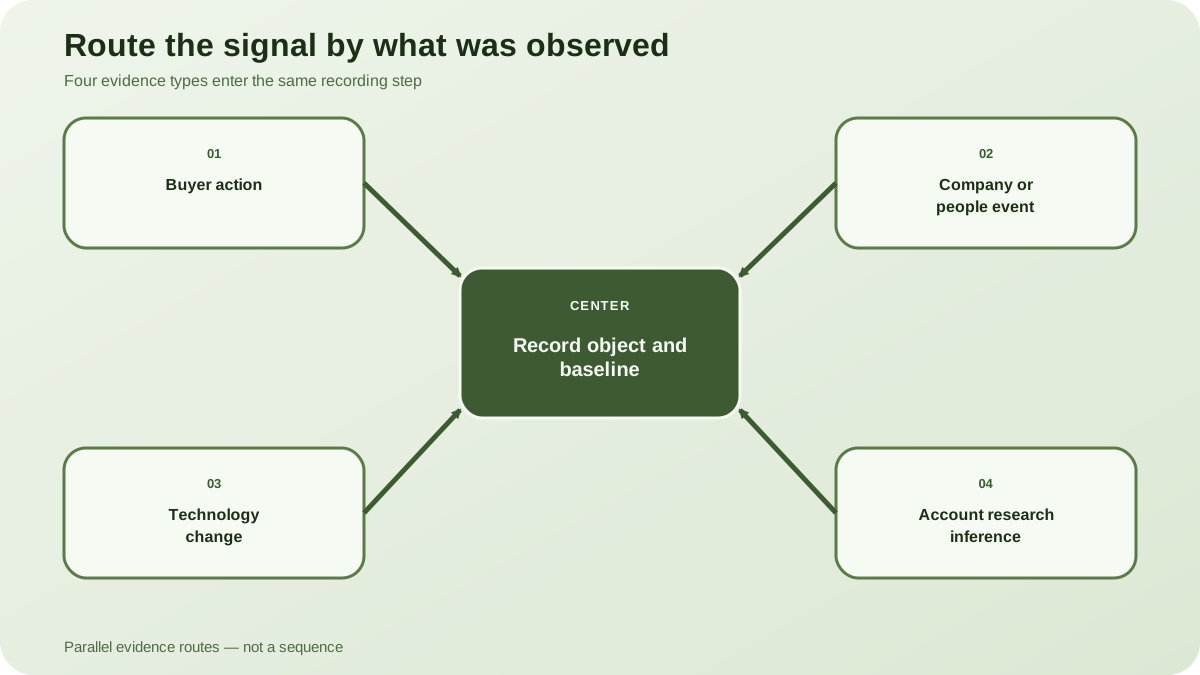
Your first decision is the evidence lane
You are not deciding whether the account will buy. You are deciding what the current record permits you to do next. An explicit request can enter a response lane. A web visit remains an observed buyer action, but the reviewed excerpt does not identify the actor in every instance; record actor unknown and use it as context. A company/personnel event or technology change can enter account research. A topic surge can enter an account-level research-inference lane because its published baseline is company history, not an identified person's declared intent.
The alert is already moving faster than your definition
The queue is live. You might argue that speed is the point, so another checkpoint only slows your rep down. Salesloft's definition, checked in August 2026, describes buying signals as buyer behaviors or actions indicating interest, including website interactions and social activity. ZoomInfo's guide, checked in the same month, describes a platform detecting a signal, alerting your rep through a CRM task list, email, or Slack, supplying context, and recommending outreach within 24 hours. The same guide publishes actions for eight signal types. But what happens if detection becomes proof before you've inspected the object? ZoomInfo warns that when every signal triggers the same action, reps can chase accounts nowhere near a buying decision while ready accounts wait. Speed stays; your unchecked inference doesn't.
A single number still sounds simpler, doesn't it? It is simpler to display, but it asks you to forget which evidence produced it. Your tools should carry the four fields with the alert instead. In an OKKI Go workflow, you keep the observed object visible, preserve any source-defined baseline, and route the record to response, research, context, or monitoring. Automation can deliver the item quickly; your evidence lane decides the action. The ruling is practical: don't ask one score to settle unlike observations. This is a routing rule, not a claim that any signal predicts an outcome.
A score can still be useful inside the evidence family that defines it. A topic-spike score may compare an account with its own historical content-consumption baseline. A strength label for a merger may summarize the publisher's view of a possible consequence. Neither scale automatically supplies a common denominator for a demo request, an anonymous web interaction, and a technology install. Normalizing the display does not normalize the observed object. Before combining scores, the team would need a documented unit, population, time window, and outcome relationship for every input. The reviewed material does not provide those comparable values, so routing by evidence type is more defensible than pretending the inputs share one readiness scale.
The checkpoint before quick outreach
You have enough time for one checkpoint before quick outreach. Isn't the alert context already enough? No: it tells you what arrived, not whether unlike evidence belongs in one score. Keep that context visible, then ask what the record observed, what it inferred, which baseline the publisher stated, and which action fits. Your answers stop delivery speed from deciding qualification for you.
- Which of the four lanes is this: observed buyer action, company/personnel event, technology change, or account-level research inference? Treat a digital interaction as an observed buyer action and mark the actor unknown when the source does not identify one.
- What object was actually observed? Copy only what the published evidence states.
- What baseline did the publisher define? If none appears in the reviewed evidence, enter ‘Not stated.’
- What is the narrowest next action justified by that observation? Keep qualification separate from prediction.
Map each published example before choosing the next action
You now need a decision reference, not another ranking. A critic could say that blank fields make your system less decisive. Do they? The entries below use only examples and definitions stated in the reviewed sources. “Not stated” is intentional: it stops a missing baseline, identity, frequency, or outcome from becoming a zero, an average, or an invented score. You haven't lost a fact; you've protected the distinction between known and unknown. Your next action stays narrow and follows from the observed object rather than a promised result.

- Demo request — Type: observed buyer action | Observed object: a demo request | Published baseline: Not stated | Next action: verify the requester and account, then respond to the explicit request; do not convert the request into a generic account score.
- Funding announcement — Type: company/personnel event | Observed object: a funding announcement | Published baseline: Not stated | Next action: research the company's current situation and fit; do not infer that a particular person requested contact.
- Job change — Type: company/personnel event (personnel subtype) | Observed object: a job change | Published baseline: Not stated | Next action: verify the changed role and its relevance before deciding whether outreach is appropriate.
- Technology install — Type: technology change | Observed object: a technology install | Published baseline: Not stated | Next action: verify the installed technology and its account relevance, then route to research rather than assuming buyer intent.
- Web visit — Type: observed buyer action (digital interaction; actor unknown) | Observed object: a web visit or website interaction | Published baseline: Not stated | Next action: use the interaction as engagement context; actor identity, frequency, and outcome are Not stated in the reviewed excerpts.
- Topic-research surge — Type: account-level research inference | Observed object: a research spike in company content consumption | Published baseline: the company's historical content-consumption baseline | Next action: inspect the topic and account context before deciding whether the account merits prioritized research or outreach.
- Merger or acquisition — Type: company/personnel event | Observed object: a merger or acquisition | Published baseline: Not stated | Next action: research possible leadership change; Cognism publishes a medium-strength label, not an observed buyer request.
Several signals can belong to the same account without becoming duplicates. Suppose a target account announces funding on Monday, an unidentified visitor reaches a product page on Tuesday, and a topic-research surge appears on Wednesday. Keep three records. Funding supports company research because it is a company event. The visit supplies digital-interaction context but no named actor in the reviewed evidence. The surge supports account review against its stated historical baseline. If a verified requester submits a demo form on Thursday, that fourth record can move to response because the requester and action are explicit. The later request does not retroactively convert the earlier visit or surge into person-level intent; each record keeps its own observation and route.
A buying signal is evidence to route, not a universal unit
The tempting definition says every buying signal is a comparable measure of purchase readiness. Wouldn't that make your queue easy to explain? It would, if the examples supported the shortcut. They don't. ZoomInfo's category list combines direct requests, company and personnel events, technology installs, and web visits. A web visit remains an observed buyer action, with actor unknown when identity isn't stated. Its separate Signal Score applies to a research spike against one company's content-consumption history. Cognism's medium label for mergers and acquisitions rests on a possible consequence, leadership change, not a buyer action. Your definition must retain one of four evidence lanes: observed buyer action, company/personnel event, technology change, or account-level research inference.
What a label cannot fill in for you
Could a strength label fill the gaps for you? It can't supply a missing observed person. A company/personnel event can't supply an unstated research baseline. A historical-baseline score can't turn account-level consumption into a declared buyer request. Keep those fields separate. If the publisher doesn't state frequency or outcome data, leave the values blank or mark them “Not stated.” You can still take a proportionate next step; you just can't pretend that the unknown has been measured.
Make the routing decision while the evidence is visible
Your CRM alert says “funding,” your email alert says “web visit,” and a third record shows a topic-research spike. You need an answer now. Why not let the platform's ranking decide? Because the reviewed evidence gives only the topic surge a published baseline. You record funding in the company/personnel-event lane and route it to account research. You record the web visit in the observed-buyer-action lane, mark the actor unknown, and use it as context; normal frequency and outcome remain Not stated. You record the topic surge as an account-level research inference and preserve the company's historical baseline. The verdict isn't “ignore the alerts.” It's “don't turn any of them into an observed demo request merely because quick outreach is available.”
Does this leave you with too many routes? It leaves you with four explainable ones: response or context for an observed buyer action, research for a company/personnel event, research for a technology change, and account review for a baseline-relative research inference. A blended score is tidier, but it can't show you which premise failed. This framework doesn't publish conversion rates, signal frequencies, or outcome lift, because the reviewed evidence doesn't supply comparable values. If your verified data later supports a different action, you can update that action without changing what the original signal observed.
Complete the route with ownership and a stop condition. A response lane belongs to the rep responsible for the explicit request and stops when the requester or account cannot be verified. A research lane belongs to the account owner or analyst and stops when the event has no plausible relevance to the team's ICP. A context lane can remain attached to the account without generating outreach when actor identity or frequency is unknown. An account-inference lane escalates only after fit, source definition, and the stated baseline survive review. Recording the owner, next evidence required, and stop condition makes the route operational; otherwise a cautious label can still become an automatic task downstream.
The four fields to keep in the workflow
Before an OKKI Go workflow routes your next record, keep four reader-visible fields: signal type, actual observed object, published baseline, and justified next action. You may prefer a complete-looking row. But if the source is silent, what would you enter without guessing? Use “Not stated.” You can act now without erasing the four evidence lanes: observed buyer actions, company/personnel events, technology changes, and account-level research inferences. That's the decision you can defend when your next alert arrives.
The next alert does not need a universal score. Preserve what was observed, leave unstated fields unstated, and choose the narrowest action the evidence justifies.
Frequently asked questions
Is a website visit the same type of buying signal as a funding event?
No. A website visit is an observed digital interaction, with the actor unknown unless the source identifies one. A funding event is a company event. Keep them in separate evidence lanes because they support different follow-up questions and actions.
Can different buying signals be combined into one score?
Only after every input has a documented unit, population, time window, and relationship to the same outcome. A score valid inside one signal family does not automatically normalize a company event, an anonymous interaction, a technology change, and an account-level research inference.
Which buying signals justify an immediate sales response?
An explicit request from a known person can justify a response. An unidentified digital interaction is context, company and personnel events usually trigger research, and account-level intent should be checked against its stated baseline. Stronger outreach requires stronger identity and engagement evidence.
What should a rep record before acting on a buying-signal alert?
Record the signal type, observed object, actor identity status, published baseline, owner, next evidence to collect, stop condition, and reason the chosen action fits. Missing fields should remain Not stated rather than being supplied by the alert label.