A healthy acquisition system does more than create activity. It protects delivery by defining who the offer can help, how those clients buy, what qualifies them for a handoff, and what a rejection should teach the next search.

Define the Client and the Offer Context
A bad-fit client creates work before delivery even begins. Someone has to reinterpret a vague promise, negotiate an impossible scope, or explain why the team cannot serve the need that acquisition implied it could. More demand does not repair that mismatch. It delivers the mismatch faster to the people whose capacity the system was meant to protect. I therefore start client lead generation with the offer, not the channel. The offer names the problem the service addresses, the conditions under which the team can do sound work, and the situation it should decline. A target becomes useful only when it is related to that operating boundary rather than described as a large pool of possible buyers. The U.S. Small Business Administration's market-research guidance asks businesses to examine demand, audience characteristics, location and reach, market saturation, pricing alternatives, and competitors by service and segment. Those questions are a planning foundation. They do not prove that a chosen segment or tactic will produce leads, and I do not use them as a forecast. This order protects delivery capacity because every later channel decision can be checked against a stated service promise, a reachable buyer, and a boundary the team is prepared to enforce.
- State the client problem and the service condition that makes the offer credible.
- Record evidence about demand, audience characteristics, reach, saturation, alternatives, and competition.
- Write an inclusion rule for likely fit and a rejection rule for work the service should not accept.
- Mark every untested belief as a question for research or qualification rather than a fact about the client.
Describe the Buying Path and Fit Boundary
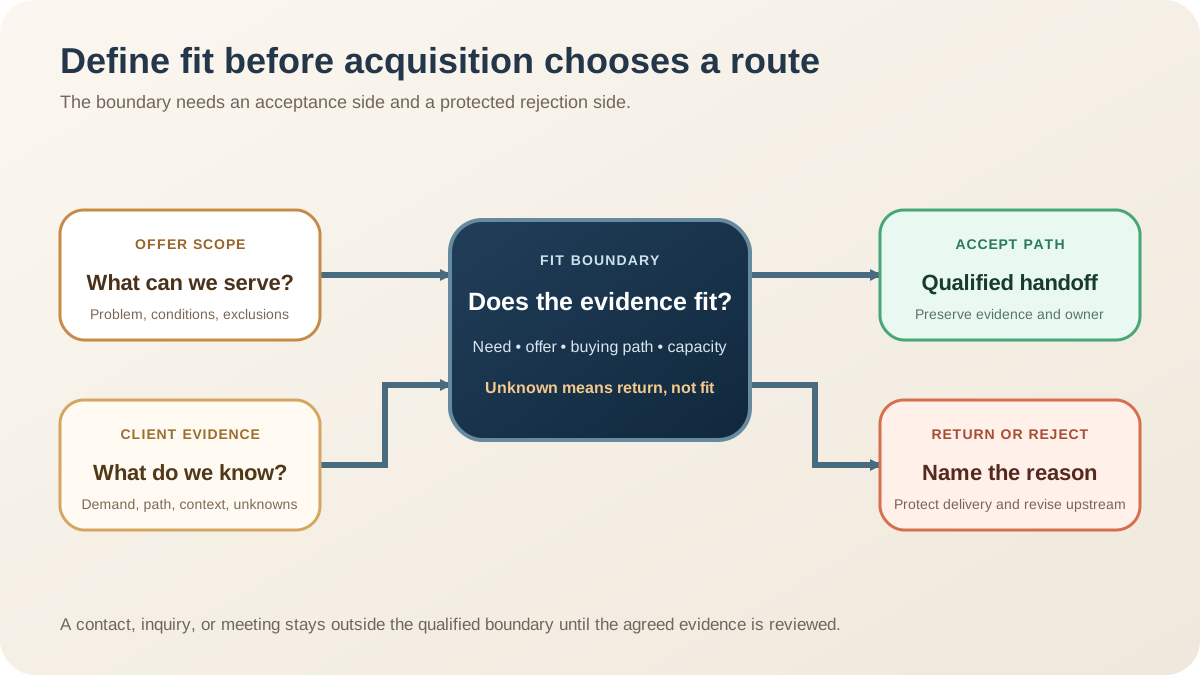
A fit profile should explain how a client reaches a decision, not merely what the client looks like. I want to know what problem creates a search, who must understand the offer, what uncertainty slows the decision, and what evidence a sensible buyer would need before discussing scope. Those questions connect the market description to an acquisition route. The boundary also needs a negative side. A prospect may resemble the target yet need a service the team does not offer, expect a buying process the team cannot support, or present conditions that make responsible delivery unlikely. These are reasons to clarify or decline, not inconveniences to be hidden until a meeting. I write the buying path as a sequence of questions, because that keeps the model portable across advisory work, creative services, professional practices, and other client-service settings. The exact path can differ. The discipline does not: describe the path before selecting a channel, and keep unsupported assumptions open for review. The point is not to predict a universal journey. It is to document enough decision context that the team can choose a route, recognize missing evidence, and return an unsuitable record before delivery absorbs the cost.
Separate Contacts, Leads, and Qualified Client Opportunities
Names become expensive when the system gives them a status they have not earned. I use contact for a person or organization the team can identify, lead for an inquiry or record that merits review, and qualified client opportunity only after the agreed fit evidence has been examined. These are local operating definitions, not a universal taxonomy. That distinction prevents a familiar accounting error: treating a filled field, a reply, or a scheduled conversation as evidence of client fit. Each event can be useful, but none answers whether the need matches the offer, whether the buying path is plausible, or whether delivery should accept the handoff. Qualification has to answer those questions directly. The practical test is simple. For every status change, write the evidence that justifies it and the person allowed to approve it. If the evidence is absent, preserve the earlier state. A large contact pool may support research, but it should not be reported as a pipeline of qualified client work. That evidence rule also preserves reversibility. A reviewer can explain why a record changed state, challenge the decision, and return it without pretending that contact data, a reply, or a meeting proved client fit.
Choose the Acquisition Route
Once fit is visible, the channel question becomes narrower and more honest. The team is no longer asking which channel is best in the abstract. It is asking which route lets this kind of client discover, understand, and evaluate this offer without concealing the friction that belongs in the buying decision. The SBA's marketing and sales guidance supports writing down the target market, literal sales steps, goals, action channels, costs, measurement, and updates. It also directs businesses to use what works for their own situation. I take that as support for an explicit plan, not evidence that referrals, content, events, direct outreach, or any other channel fits every buying path. A usable plan connects each route to a role and a decision. One action may create awareness, another may help a prospective client evaluate fit, and another may prepare a direct conversation. The point is not to force every path into the same funnel. The point is to make the next step and its owner visible. By tying the route to a job, the team can compare actions without treating channel fashion as strategy. Costs, goals, evidence, and review remain attached to the same acquisition decision.
- Name the client context and buying question the route is intended to serve.
- Write the channel action, responsible person, next sales step, and evidence preserved at the transition.
- Assign the cost and goal that belong to the action without inventing a universal benchmark.
- Set a review point for continuing, changing, or stopping the route.
Match Channels to Trust and Buying Friction
Channel choice should reflect what the client needs to believe before taking the next step. When the offer is difficult to understand, explanation may matter before contact. When the problem is already understood but the provider is not, credible proof may matter. When a likely fit can be described precisely, direct outreach may be worth testing. None of these observations makes a channel universal. I map friction beside each action: what the prospective client cannot yet judge, what the team does not yet know, and what must be true before moving forward. This turns channel strategy into a series of bounded questions. It also reveals when an acquisition activity creates attention but does not produce the evidence required for qualification. The review then compares the route with its intended job. Did it reach the described audience? Did the next step preserve enough context to judge fit? Did the cost remain acceptable to the team? The answers can change the plan, but the guidance here supplies no fixed cadence, conversion threshold, or performance promise. The result is a channel hypothesis the team can inspect. Trust and buying friction shape what the next action must establish, while the written review shows whether that action actually reduced uncertainty.
Decide What to Build or Delegate
Tools and outside contributors should be assigned work only after the acquisition plan defines that work. A worksheet, shared system, specialist, or service provider can support a step; none should quietly decide the target, qualification boundary, or acceptance rule merely because the team has not written one. Ownership stays with the business that must deliver the client work. I decide what to build or delegate by inspecting the handoff. Can the task be described in plain language? Does the output preserve the evidence the next person needs? Can the team review cost and results at the planned interval? If not, delegating the activity will distribute ambiguity rather than remove it. This is why a client lead-generation plan is not automatically a software selection or an agency brief. The same operating questions apply whether the work remains with one practitioner, is divided across a team, or receives outside support. Define the route, step, owner, cost, evidence, and review before choosing who or what performs it. Delegation then has a precise limit. The contributor performs a described task and returns an observable output, while the team retains authority over fit, qualification, and the client promise.
Create the Qualification Contract and Run the Feedback Loop
Qualification is the agreement between acquisition and the person who accepts the next conversation or delivery risk. It states what must be known, what may remain unknown, who reviews the evidence, and which state follows. Without that agreement, every handoff becomes a fresh argument and acquisition learns little from the result. The documented OKKI Go use cases describe a reviewed sequence: search for candidate companies from a clear profile, revise inputs when results miss the intended buyer, select companies before accessing contacts, prepare outreach, and confirm before sending. That sequence can support research and outreach preparation; it does not by itself qualify a client. I would place that reviewed work upstream of the qualification decision. Candidate search can help the team find records worth examining. Contact access can help prepare a conversation. Drafting can help express a relevant reason for contact. The qualification contract still has to test the client need, offer fit, buying path, and handoff evidence. This is where reviewed preparation ends and local qualification begins. The contract states what evidence is required, who accepts it, and which uncertainty sends the record back instead of forward, preserving the decision boundary for the receiving owner.
- Define the evidence required to accept a record for the next sales or service step.
- Preserve unknown and conflicting information instead of translating it into fit.
- Name the reviewer who can accept, reject, return, or hold the handoff.
- Keep candidate search and outreach preparation separate from the decision that a client opportunity is qualified.
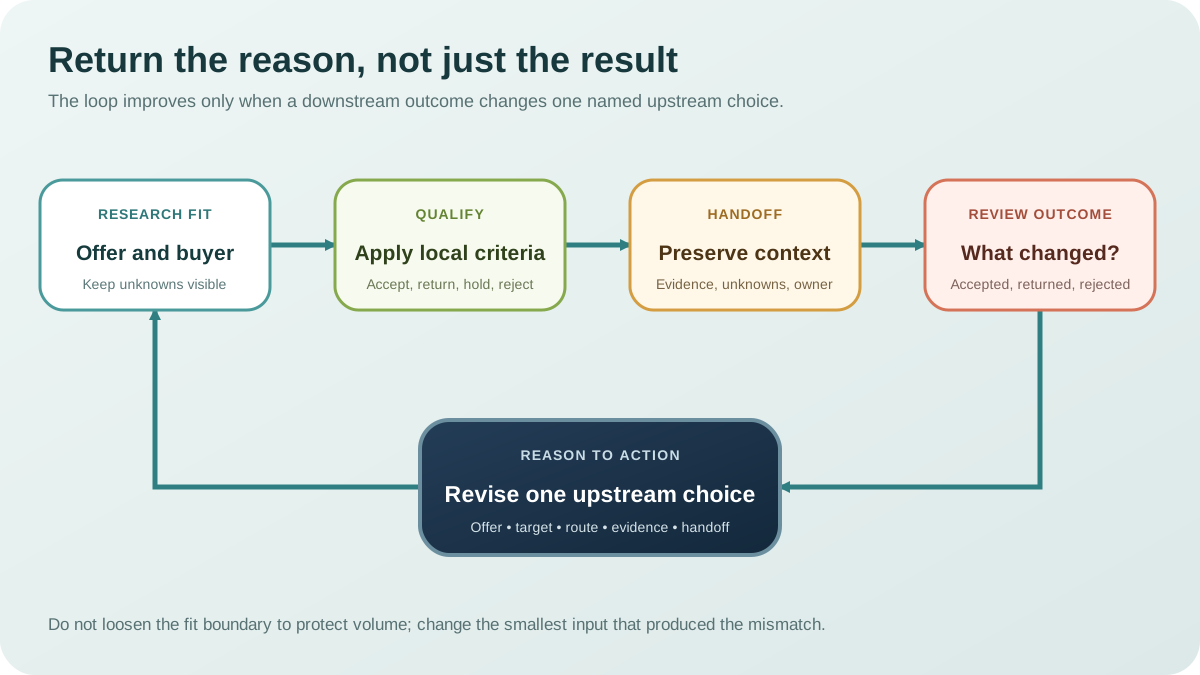
The acquisition plan improves when a rejection changes an upstream decision. If the team records only that a lead was lost, it cannot tell whether the offer boundary was unclear, the target description was loose, the route attracted the wrong context, qualification missed evidence, or the handoff discarded it. The useful unit is the reason. The OKKI Go use cases explicitly describe revising search terms, roles, industries, and country strategy when candidate results miss the intended buyer. That is a bounded form of feedback: review the candidates, change the search inputs, and search again. It does not turn candidate records into qualified opportunities or prove that the revised search will produce an outcome. I extend that logic across the whole client acquisition system. Review fit decisions, handoff outcomes, reasons for return, and search revisions together. Then decide whether to change the offer explanation, client boundary, channel action, qualification question, or handoff context. Volume is informative only after those states remain distinct. A feedback loop is useful only when an outcome changes an upstream choice. The team should record enough context to revise the offer boundary, route, acceptance rule, or handoff without turning one result into a universal conclusion.
- Review candidate, lead, qualified, returned, and rejected states separately.
- Attach a reason to every return or rejection that could change an upstream choice.
- Revise the smallest relevant input: offer context, target rule, search term, channel action, qualification question, or handoff field.
- Recheck the revised path before expanding activity.
Set Evidence-Based Acceptance Criteria
Acceptance criteria should be stated as questions the reviewer can answer, not adjectives that can be stretched after the fact. Does the apparent need belong within the offer? Is there enough context to understand the buying path? Is the next action appropriate? What evidence is missing? This creates a reviewable boundary without claiming a universal qualification score. A candidate-company result from OKKI Go should retain that candidate status until a person reviews it against the local contract. The first-party use cases show user selection and revision, not verified buyer intent. They also make no promise of qualification, meetings, response, pipeline, or revenue. I also include a return state. When evidence is incomplete, the reviewer should be able to send the record back with a precise question rather than force an acceptance or rejection. That question becomes part of the acquisition system: it tells the upstream owner what context must be collected before the handoff can be considered again. Questions make the criteria auditable because each answer can point to evidence. They also expose when a reviewer is substituting enthusiasm, incomplete context, or a convenient activity label for an agreed acceptance rule.
Preserve Context Through the Handoff
A qualified state is less useful than the reasoning behind it. The receiving person needs the offer context, the apparent client need, the observed buying-path evidence, the source of each relevant detail, unresolved questions, and the action already taken. Passing only a name and a positive label transfers work while discarding the basis for the decision. The documented OKKI Go workflow keeps review points around candidate selection, search revision, contact access, drafting, and confirmation. Those points are useful places to preserve context, but the service team must still decide what information its own handoff requires. The product description does not establish a universal qualification threshold or sales process. I ask the receiving person to record one of four outcomes: accept, reject, return for missing evidence, or hold pending a named condition. The labels are less important than the reason attached to them. A reasoned outcome makes the handoff auditable and gives acquisition something concrete to improve. Preserved reasoning lets the receiving person continue the decision instead of restarting it. It also makes rejection useful because the team can trace the mismatch to fit, evidence, route, or handoff quality without reconstructing the decision after the handoff.
Measure Qualified Progress Instead of Volume
Measure the movement that the local contract actually defines. How many records were reviewed? How many remained candidates, were returned for missing evidence, met the acceptance criteria, or were rejected for a stated reason? These are operating questions, not benchmark claims. Their value is that they show where judgment occurs and where the path needs revision. Meetings can be recorded as activity, but they should not replace fit evidence. A meeting with the wrong client context still consumes attention and may pass ambiguity into delivery. The system should preserve what qualified the opportunity, what remained unknown, and what the conversation changed. That protects learning from being flattened into an appointment count. No universal threshold is supplied here. A small practice and a larger service team may set different review intervals and acceptance capacities. Both should be able to trace reported progress back to a reviewed state and a reasoned decision. If they cannot, the metric is describing motion rather than qualified progress. The measure must answer a decision question: whether the right evidence moved, whether the owner acted, and whether the downstream review supported the local fit rule. Volume alone cannot answer those questions.
Use Rejection Reasons to Refine Fit and Channels
Group rejection reasons only far enough to support a decision. Repeated offer mismatch should trigger a review of the target or explanation. Missing buying-path context should change research or qualification. A handoff rejected because essential context vanished should change the fields and ownership at that transition. Each category needs an upstream action, not just a dashboard label. The temptation is to loosen qualification when accepted volume looks small. I would first ask whether the target, route, or evidence collection is wrong. A strict but visible boundary gives the team something to revise. An elastic boundary protects the activity number while allowing bad-fit demand to enter the service system. Scale only after the team can answer three questions in plain language: who do we reject, why do we reject them, and which upstream input changes because of that reason? Those answers join client lead generation to delivery capacity. They also turn rejection from a disappointing endpoint into the evidence that sharpens the next acquisition decision. Grouped reasons should remain specific enough to trigger action. The team can then correct the hypothesis that produced the mismatch before loosening qualification or buying more reach.
Write one rejection criterion that protects delivery capacity. Name the evidence that triggers it, the person who applies it, and the upstream target, route, or qualification input that should change when it appears. If the team cannot write that rule yet, do not scale the acquisition activity.
Frequently asked questions
What is client lead generation?
Client lead generation is the operating work of finding and developing possible client demand. A fit-first system begins with the offer and target boundary, selects routes by the buying path, and requires evidence before a record becomes a qualified client opportunity.
How do you generate leads for a client-service business?
Research demand, audience characteristics, reach, saturation, alternatives, and competition; describe the client buying path; choose channels and sales steps that serve that path; assign costs and owners; define qualification and handoff evidence; then update the plan from reviewed outcomes. No channel or result is assured.
Which client lead-generation channel is best?
There is no universal answer established here. Choose a route according to what a fitting client needs to discover, understand, and evaluate, then write its action, owner, next sales step, cost, goal, and review point into the plan.
What makes a client lead qualified?
Use a local qualification contract. It should state what evidence connects the apparent need to the offer, what buying-path context is required, what may remain unknown, who reviews it, and what state follows. A contact, inquiry, candidate company, or meeting is not automatically qualified.
Where can OKKI Go fit in client lead generation?
OKKI Go's first-party use cases describe candidate-company search, review and revision, selected contact access, drafting, and confirmation before send. These can support reviewed research and outreach preparation, but they do not establish buyer intent, client qualification, meetings, response, pipeline, or revenue.
Should a business buy software or hire an agency for client lead generation?
This article does not prescribe either choice. First define the route, task, owner, cost, evidence, qualification boundary, and review. Then decide whether the work should stay internal, be supported by a tool, or be delegated without transferring ownership of the fit decision.
Explore OKKI Go
- Explore OKKI GoReview the official product overview for company search, contact access, outreach preparation, and reviewed sending.Official OKKI Go resource ↗
- Review OKKI Go use casesInspect the documented candidate search, user revision, selected contact access, drafting, and confirmation workflow.Official OKKI Go resource ↗