
A first-touch email fails when you cannot show why this inbox, now, should consider the offer.

Why does cold email copywriting start with a reason, not a hook?
Read the first line you were about to send: I noticed your company is growing and I thought we could help. What reason did you just prove? None. You proved that you can write a compliment that would fit the next row as easily as this one. That is why cold email copywriting starts with a reason you can show, not a hook you can polish.
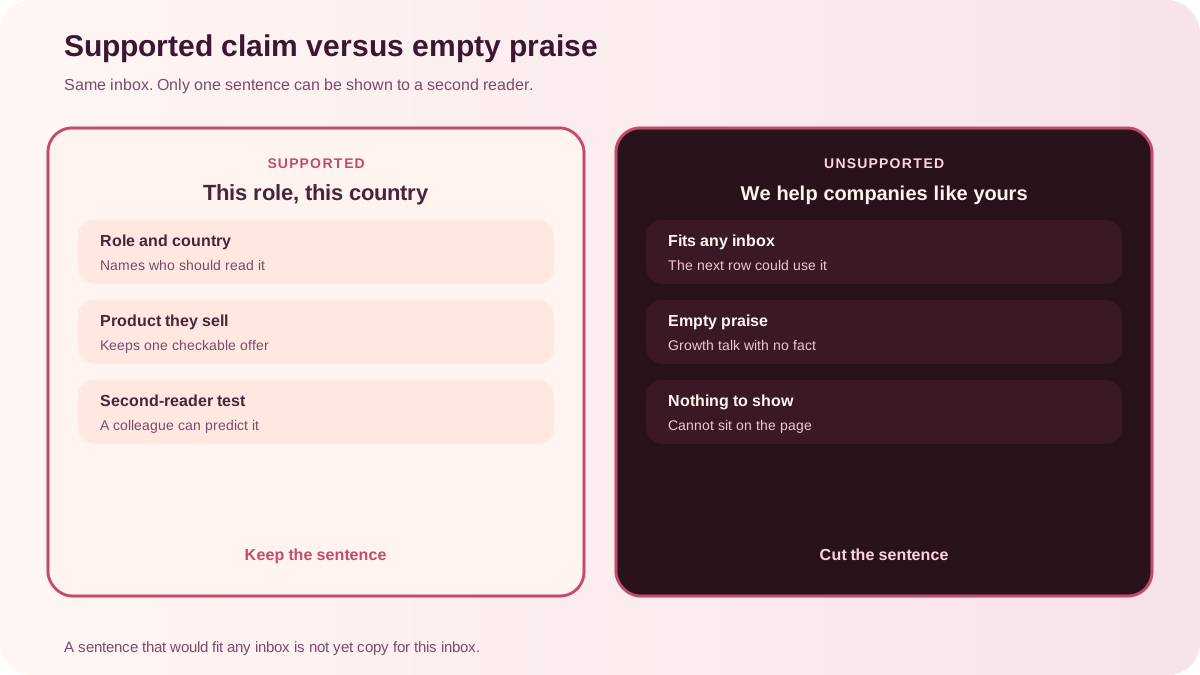
Keep reading past that first line and the rest of the usual draft is just as thin. We help companies like yours save time. Which companies? Teams at similar firms already use us. Which teams? Do you have fifteen minutes next week? You asked for time before you gave a reason to spend it. That is not a copy strategy. A usable strategy starts with a recipient-specific reason you can put on the page: the product, buyer type, country, or exclusion that selected this company. A short subject and body help only when they leave room for that reason. Follow-up helps only when later notes test the same hypothesis. Metrics will argue with you here. Open rate tells you a subject was opened, not that the claim was true. Reply rate tells you someone answered, not that fit was confirmed. Meeting rate tells you a calendar hold appeared, not that the inbox had a credible reason to consider the offer. Google's email sender guidelines add a prior gate: senders have to meet authentication and other delivery requirements, with additional requirements for bulk senders. If the message never arrives, no one judges the metaphor. The definition stops at first-contact commercial email.
- Research-first targeting is a strategy only when it yields a reason this recipient can recognize.
- A short subject and body are a strategy only when they keep that reason visible.
- Open, reply, and meeting rates measure curiosity and tolerance, not whether the claim was true.
Which facts belong inside a usable definition?
A usable definition has three pieces you can inspect. First, the commercial claim you will stand behind for this inbox. Second, the recipient fact that made this address the right one, such as a buyer type, country, or product match you can name. Third, a subject that describes the email you actually sent. The UK ICO explains that direct marketing rules depend on the recipient and the channel, and that organizations must also consider data protection duties and objections to marketing. If you cannot name those three pieces, you are still polishing a hook.
How does a recipient-specific reason become a usable draft?
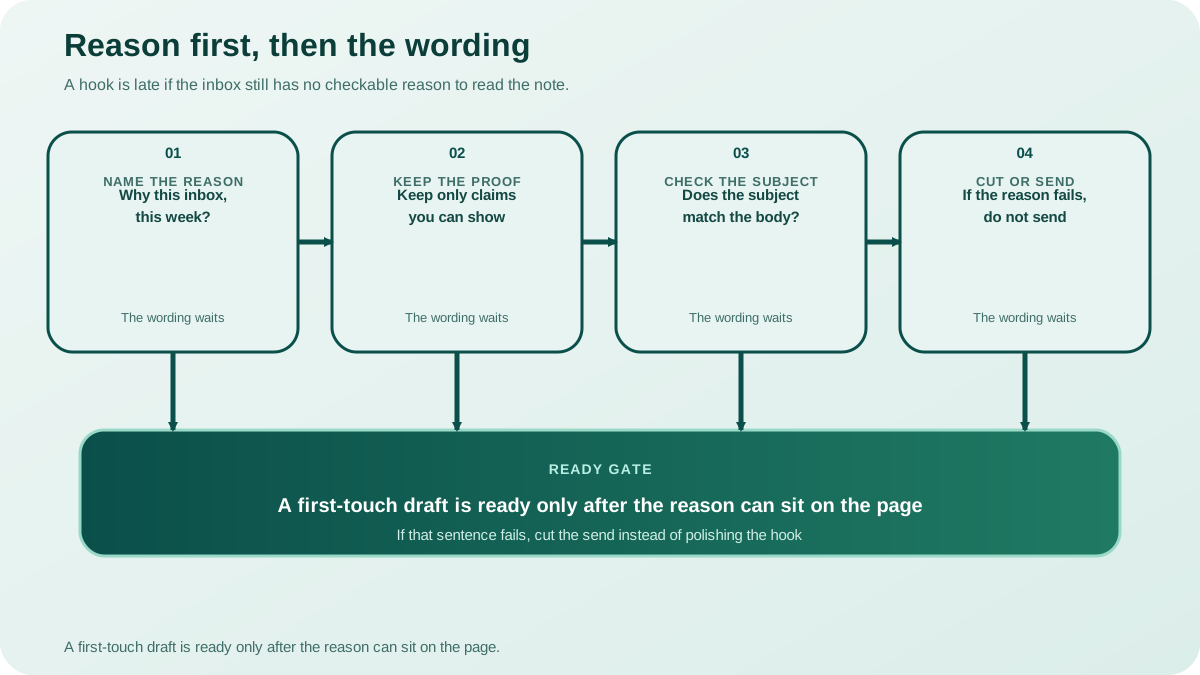
So how does a reason become a draft you can defend? You do not start with a prettier first line. You start by writing the hypothesis in plain language, then you let that sentence decide what the email is allowed to say.
The mechanism is a filter, not a flourish. You name this role, this company, and this reason to consider the offer now. You keep only the sentences that hypothesis can carry. Then you read the From name, the subject, and the first two body lines as a stranger who never asked for the message. Do they tell one story? If the subject promises a research note and the body sells a meeting, you do not have a finished draft. The U.S. FTC's CAN-SPAM compliance guide makes that honesty check concrete. It requires accurate header information, nondeceptive subject lines, a valid postal address, and a clear way to opt out of commercial email. Treat those duties as part of the copy. Data quality sits inside the same filter. A wrong role or a country you never selected makes every relevance sentence false on arrival. Deliverability work, including authentication and the extra bulk-sender requirements, decides whether anyone can even judge the draft. If you skip those checks, you are scoring rhetoric the inbox never saw. A finished draft is the one that still makes sense after those checks, not the one that only sounded ready in the writer's head.
- Treat the subject as a label for the email you sent, not as bait for a different email.
- Treat contact data as part of the copy: a wrong role makes the reason false.
Which honesty check the draft has to survive
Ask yourself one question before you edit for tone. Would a colleague who sees only the company row predict the reason in your first two sentences? If not, the draft is still a pitch looking for a target. Saleshandy's tutorial puts prospect research before the short subject, the short message, the low-friction ask, the follow-up plan, and the deliverability prep. That order is the mechanism. Research inputs come first because they are what make a relevance sentence true.
When is a first-touch draft no longer the job?
The reason-first rule holds when you are writing first-touch commercial email to a person who did not ask for the message. You are asking a stranger to spend attention on an unsolicited claim. Persuasion without a recipient-specific reason is just noise in that inbox.
The rule breaks when the relationship or the channel changes. A reply to an inbound request is not cold. A message the recipient already agreed to receive is not the same job as a first-touch pitch. Direct-marketing rules depend on the recipient and the channel, and organizations must also consider data-protection duties and objections to marketing. That is a threshold. If you cannot say which duties apply here, stop drafting and check the process first. The usual FAQ answers, shorter is better, add social proof, always ask for time, assume the same inbox. They do not travel with the template. The process that does travel is narrower: select a company set you can defend, draft only the claim that set can support, then review subject honesty before anyone approves the send. Copy review is a workflow. One usable front end is a company row you can inspect. OKKI Go can assemble a first-touch note from context you already accepted. It cannot invent the reason that note must carry. If a second reader cannot name the recipient-specific reason without hearing your pitch, the draft is not ready.
- Select a company set you can defend before you write the first sentence.
- Draft only the claim that set can support, then review subject honesty and the size of the ask.
- Approve the send only after a second reader can name the reason without hearing the pitch.
Where a first-touch process stops transferring
Do not lift a consumer promo template into a first-touch B2B inbox and call it personalization. Do not treat every country or buyer type as interchangeable. If someone asks you the FAQ version of this topic, what is the best hook, answer with a process question first: who is the recipient, what channel is this, and which duties apply before any sentence is judged?
Why do writing tools keep you writing the wrong sentence?
Here is the story that keeps getting sold to you: the copy is fine, you just need a better sequencer, a better prompt, or a better template pack. Do you believe that? Tools make fluent language cheap. They do not make a relevance claim true.
The story is wrong because it reverses the order of work. A sending tool can queue follow-ups. A writing assistant can multiply sentences that sound like expertise. Neither one can tell you whether the sentence is true for this inbox. If everyone can generate a confident hook in a few seconds, the remaining question is whether you can show the recipient-specific reason. That is a research and review problem, not a feature gap. Treat a sequencer as logistics. Treat a writing model as a phrasing aid. Treat a research surface as a source of reviewable inputs. Reject any stack that lets you send before a person can name the reason for this exact recipient. A company-search surface such as OKKI Go still only returns candidates for review. It does not write the proof, and it does not replace your judgment. If a tool cannot show you the research input, it is hiding the missing input behind speed. Prospect research, a short subject and message, a low-friction ask, follow-up planning, and deliverability preparation still have to happen in that order. The remaining work is naming the reason this inbox can recognize, then deleting every sentence that reason cannot carry.
- Use a sequencer to time follow-up, not to invent the reason.
- Use a writing model to rephrase a true claim, not to manufacture one.
How do you apply this judgment to one outbound draft?
Take a common scene. You need first-touch emails to buyer-type companies in one target country about one product category. The operating constraint is commercial email with no prior relationship. The usual method is a hook, a benefit stack, a proof line, and an ask for time. That draft can still fail, because persuasive language fails when you cannot show why this recipient, now, has a credible reason to consider the offer.
Label the working assumptions before you rewrite. For this scene, assume the message is commercial email, not a transactional notice (scenario_assumption). For this scene, assume there is no prior relationship (scenario_assumption). For this scene, assume the next step is a short reply, not a booked meeting (scenario_assumption). For this scene, assume you can name product, buyer type, target country, and at least one exclusion used to select the company (scenario_assumption). If any of those is false, do not force this judgment onto the draft.
Start from one defended company row, then write. A line that says we help companies like yours has to become a claim this company can recognize, or it has to go. After that change, a colleague given only the company row should predict the reason in the first two sentences, and the subject should still describe the email you sent. If that colleague cannot do it, the draft is still a pitch looking for a target. Keep a claim only when you can point to a recipient fact that supports it. Cut industry-wide boasts, borrowed proof, and meeting asks the hypothesis cannot carry. If you cannot form the hypothesis, stop the send and return to research. This judgment applies to first-touch commercial copy, not a renewal note or a requested reply. Typical remaining mistakes are treating reply rate as proof of relevance, stuffing unrelated social proof, skipping honesty and opt-out checks, and using a model to multiply the same unsupported claim.
The next checkpoint is a yes or no. Can you state the recipient-specific hypothesis in one sentence and still have an email after you delete unsupported claims? If the answer is no, do not send. Cut one unsupported sentence first. If nothing that remains can be recognized by this recipient, you do not have copy yet.
Write the hypothesis first, then the email. Before you send, cut one unsupported sentence. If a claim cannot be supported in the message, delete it.
Frequently asked questions
What is the single most important factor in cold email copywriting?
A verifiable recipient-specific reason for the offer. Persuasive language matters only after that reason can be shown in the message.
What do most buyers get wrong about cold email copywriting?
They treat hooks, benefits, social proof, and a call to action as sufficient, or they treat tools as the craft.
How should you actually decide on cold email copywriting?
Build the draft from a testable recipient-specific hypothesis and remove every claim the message cannot support. If you cannot name that hypothesis, do not send.
When does cold email copywriting matter most?
On first-contact commercial email, when there is no prior relationship and the inbox still has to accept an unsolicited ask.