
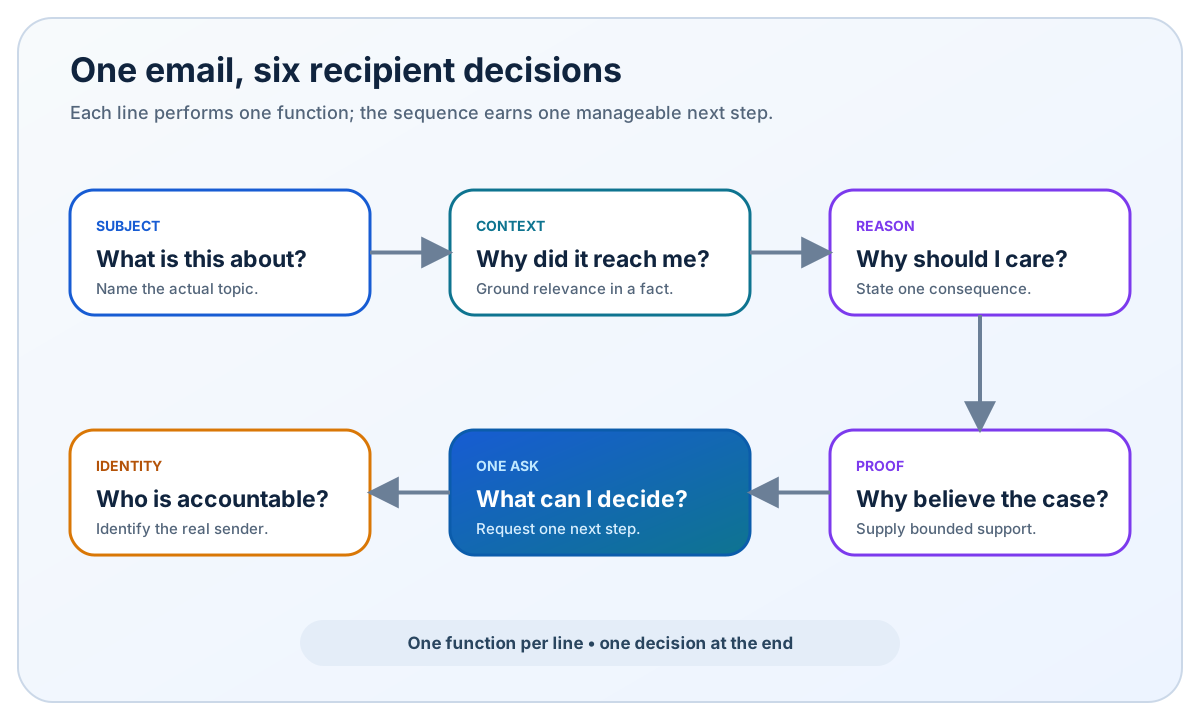
A useful format is not a fixed template. It is a decision sequence in which each line answers one recipient question and prepares one manageable next step.

Define the Format by Recipient Decisions
The draft looks plausible. Its subject says "Quick question." The opener praises the recipient, then the message introduces a product, requests a meeting and a referral, and offers a document. Nothing is grammatically broken, yet it presents five decisions before the recipient understands why one matters. The problem is sequence. A cold email format should arrange information in the order a stranger needs to evaluate it: what this is, why it reached this person, what relevant change is being raised, what supports the claim, and what single response would resolve the next uncertainty. Part names may vary; the decision order is the durable structure.
That distinction matters because a template preserves wording, whereas a format preserves function. Copying a sentence can import another sender's assumptions, proof burden, and desired outcome. Preserving function instead permits a recruiter, supplier, researcher, consultant, or community organizer to use different evidence while keeping the recipient's cognitive path coherent.
Distinguish Format From Templates and Tactics
Tactics operate inside the sequence; they do not define it. A concise subject can orient the reader, but cleverness cannot rescue a body that withholds the contact reason. Personalization can establish relevance, but specificity alone is not useful. Brevity helps only while identity, factual basis, and required commercial-email information remain intact. FTC guidance for United States commercial email treats truthful header and subject information, sender identification, a postal address, and an opt-out mechanism as substantive requirements. ICO guidance likewise emphasizes transparency, recipient and channel distinctions, rights, and objections. Neither source prescribes persuasive copy, but both set boundaries a polished format cannot remove. They are boundaries, not a conclusion that any particular contact is lawful. The sender must still assess recipient type, channel, purpose, applicable rules, and any objection before treating a well-formatted message as ready to send in its context. A sign-off earns its space when it identifies the sender and supports an applicable right; a decorative testimonial does not earn space merely because a template reserves a proof slot. Length should result from complete functions without repetition, not a universal word count.
Give Every Line One Job
The subject identifies the topic without manufactured urgency or disguised commercial intent. The greeting establishes the recipient. The opener explains the contact logic through a verifiable role, situation, or public fact rather than generic praise. The reason-and-value line states what may be relevant and why. Proof narrows uncertainty through a mechanism, example, credential, comparison, or bounded observation; it should not become a second pitch. The call to action requests one decision proportionate to that evidence. The sign-off identifies the sender and supplies what a responsible response or objection requires. Each function should appear once unless clarity requires another sentence.
Reason, Proof, and One CTA
The middle often collapses context, product description, benefits, credentials, and several possible meetings into one paragraph. Separate the logic. The contact reason names the fit hypothesis. The value statement expresses one possible consequence, not every capability. Proof is the smallest defensible support for that consequence. The CTA tests the remaining uncertainty: relevance, ownership, timing, or willingness to inspect a specific item. When context is incomplete, research can precede composition. A user gives OKKI Go a product description, buyer type, target country, and exclusions; the system returns contextual company candidates; the user reviews, revises, and selectively unlocks records; the usable result is an approved research set for writing, not proof of consent, intent, or demand. Editorial judgment remains with a person.
A manageable CTA is not necessarily a meeting request. It may ask whether the issue belongs to this person, whether a short comparison would be useful, whether the timing is wrong, or whether no further contact is wanted. The appropriate request follows from the message's purpose and the evidence available; it does not follow from a universal sales script.
Assemble a Scannable First Email
Consider a supplier writing to an operations director after a public expansion announcement. The message needs a sequence that can be scanned without reconstruction. Subject: "Capacity planning for the new Brno line." Greeting: "Hello Mara." Opener: "Your expansion notice says the Brno line will add two packaging cells this quarter." Reason and value: "We help operations teams compare changeover constraints before committing technician time." Proof: "The comparison separates line-side adjustments from controls work, so each dependency has a visible owner." CTA: "Would a one-page dependency map be useful for the team planning that line?" Sign-off: the sender's real name, role, company, and information required for the context. The request asks the recipient to evaluate one artifact, not accept the entire commercial claim.
Read the assembled email once by function. Check that the subject describes the real topic without false familiarity or disguised urgency. Identify the sentence that explains why this recipient and context belong together, then find one reason to care and the evidence supporting it. Keep a single next decision and delete every secondary request. Finish by confirming sender identity, required information, and an appropriate route for objection or opt-out.
Put Information in Recipient Decision Order
Scanability follows from visible logic more than cosmetic shortness. A recipient should not reach the final sentence to discover why the message arrived or reread the opening to decode the request. Put context before interpretation, interpretation before support, and support before the ask. Break paragraphs when the decision changes: orientation, case, next step. If proof needs dense explanation, offer a compact artifact instead of forcing the analysis into the first email. If the claim cannot survive a plain statement, decoration will not repair it. Read the draft with nouns hidden: could the same praise, claim, and request fit anyone? If so, it is formatted but not grounded. Then highlight every CTA. More than one highlight transfers prioritization work to the stranger.
Repair a Weak Format
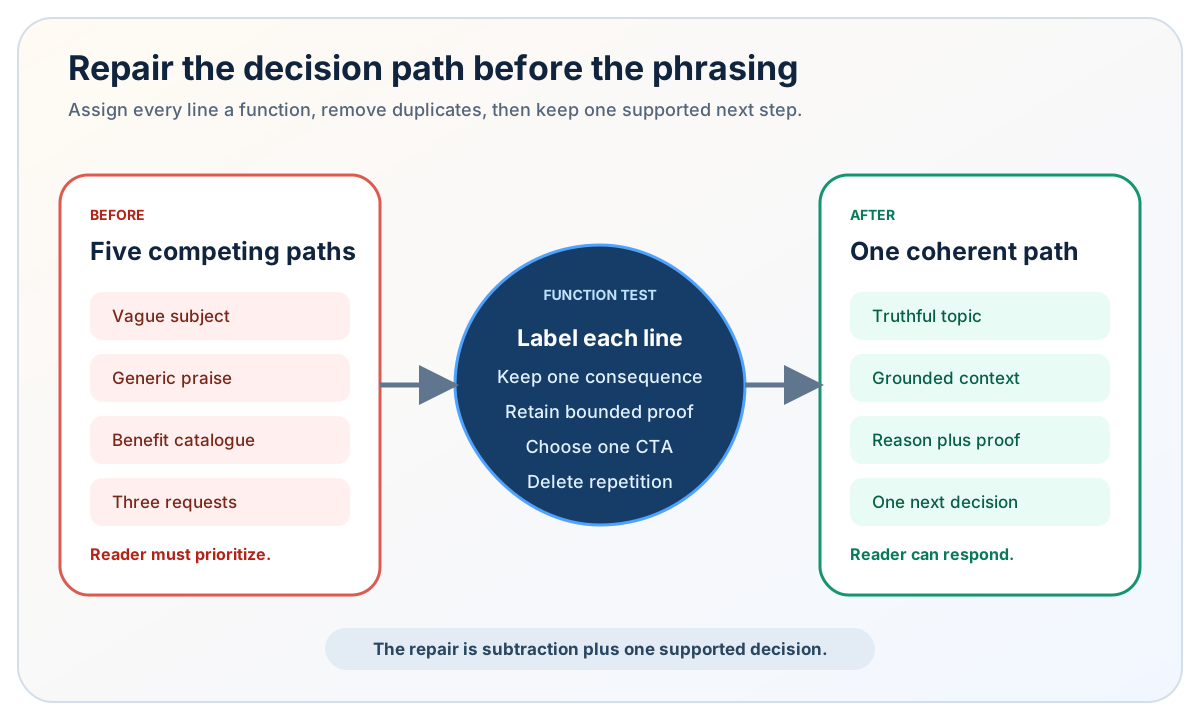
Return to the opening draft. "Quick question" withholds the topic. Praise consumes attention without establishing a contact reason. Capabilities appear before a relevant problem, while meeting, referral, and document requests compete. Repair begins by assigning functions, not polishing adjectives. Use the honest topic as the subject. Replace praise with one observable reason the recipient fits. Reduce the product account to one consequence, retain one bounded proof point, and choose the response that clarifies the next state. Move optional material out of the main path. The revised message may have a similar sentence count, but every sentence now advances the same case.
Remove Competing Claims and Asks
A repair pass uses subtraction tests. Delete the opener: is contact logic lost, or only flattery? Delete each benefit: does one consequence still explain why the message matters? Delete the proof: has the value statement become unsupported? Delete the CTA: can a reader infer the requested decision? These tests reveal which lines carry the argument and which merely decorate it. Then check for an internal-thread subject, unsupported familiarity, sender biography, a benefit catalogue, unrelated proof, a calendar link before relevance, or a postscript with a second offer. Another template cures none of these. Restore the missing function or remove the competing one. The edit is complete when retained evidence supports the retained consequence and the CTA tests its remaining uncertainty. A useful check is directional: context supports the consequence, the consequence sets the proof burden, and the proof makes the requested decision reasonable. Surface polish cannot repair a chain that points toward the wrong next decision. If those elements point in different directions, the draft still has multiple arguments. Finally, verify that brevity has not erased truthful identity, required commercial information, or a clear objection or opt-out route where applicable.
Adapt the Structure Without Multiplying Templates
The same functional format can support different purposes without making every message sell a meeting. A researcher establishes the study context, explains the recipient's relevance and asks whether participation is appropriate. A recruiter names the role and observed experience, supplies employment context, and asks whether to send a brief. A partnership message identifies a shared audience or dependency, presents one credible joint benefit, and checks ownership. A supplier connects a public change to one operational consequence and offers a bounded comparison. Evidence, proof burden, identity, rights handling, and CTA differ. The recipient decision order does not.
Draft assistance belongs after that purpose and evidence are defined. A user can provide OKKI Go with approved company context and product material; the system prepares a contextual draft; the user confirms the recipient, subject, and body before sending; the usable result is a human-approved message with visible send state or failure reasons. The draft still requires a line-function edit, factual checking, and the applicable rights and compliance assessment. It does not establish consent, intent, accuracy, deliverability, or response performance.
Check the Final Message for One Clear Next Step
The final inspection is compact. State the subject's topic. Name the fact that makes the recipient relevant. Summarize one consequence and point to its evidence. Read the CTA aloud and identify its single decision. Confirm sender identity, required information, and the appropriate objection route. Remove any line that repeats a prior function. If the recipient must choose between two next steps, the edit is not finished. This does not guarantee attention or a reply; format cannot manufacture relevance, trust, timing, or permission. It does make the message intelligible and auditable. Take one current cold email, label every line by function, and rewrite until each label advances one coherent recipient decision.
Frequently asked questions
What is the best cold email format?
Use a decision sequence rather than a universal template: truthful subject, greeting, relevant context, one reason to care, proportionate proof, one manageable CTA, and a clear sign-off. Adapt the evidence and request to the purpose.
How long should a cold email be?
No universal word count is established here. The message should be long enough to complete its necessary functions and short enough to avoid repetition, competing claims, and secondary requests.
What should the first line of a cold email say?
After the greeting, establish the contact logic with a verifiable role, event, situation, or public fact. Avoid generic praise or false familiarity; specificity is useful only when it explains relevance.
Should every cold email ask for a meeting?
No. The CTA should test the next unresolved decision. It may ask about relevance, ownership, timing, interest in a bounded artifact, or whether contact should stop.
How do you fix a cold email with too many calls to action?
Choose the one uncertainty the email must resolve, retain the CTA that answers it, and remove or defer every other request. Then ensure the preceding context and proof support that single decision.