
I govern the list before I scale the send, because an unexplained file is not a campaign.

The list you can explain is the campaign
I keep a complaint next to my keyboard, and it is not about subject lines. It is about the mailbox that fills with commercial mail whose sender cannot tell me, in one sentence, how the recipient got onto the list. People still talk about cold email marketing as if it were a faster version of a printed flyer: pick a target, write a pitch, measure the clicks. I do not accept that default. What actually decides cold email marketing is whether the channel can create trust at all, and trust does not start in the copy. It starts in audience selection, lawful basis, sender identity, list provenance, and the way we handle a reply or an objection. If I cannot explain those controls, I am not running a campaign. I am renting a cheaper stamp and hoping the inbox is polite. Automation has made the stamp cheap. Recipient tolerance has not become cheaper with it. So I write the definition the other way around. Cold email marketing is outbound commercial email to people who did not ask for this specific message, and it only stays usable when I can govern the list before I govern the volume.
I define it more tightly because cold is doing too much work in casual talk. A message can be unexpected and still be lawful, or expected and still be sloppy. The qualification I use is not does this company look like a buyer. It is can I name the source of this address, the consent context I am relying on, the identity I will send from, and the suppression path if the person objects. That is the list I can explain. Google's email sender guidelines push the same direction from the delivery side: senders have to meet authentication and other delivery requirements, and bulk senders face additional requirements. I read that as a mailbox operator telling me reputation is not a creative choice. The UK ICO adds the compliance layer I refuse to treat as optional: direct marketing rules depend on the recipient and the channel, and an organization still has data protection duties and must handle objections to marketing. None of that proves a reply rate. It does prove why I will not define cold email marketing as efficient promotion. The edge of this definition is also honest. It does not tell me which sentence will land. It tells me whether I am allowed to send the sentence at all.
What belongs inside a governable list
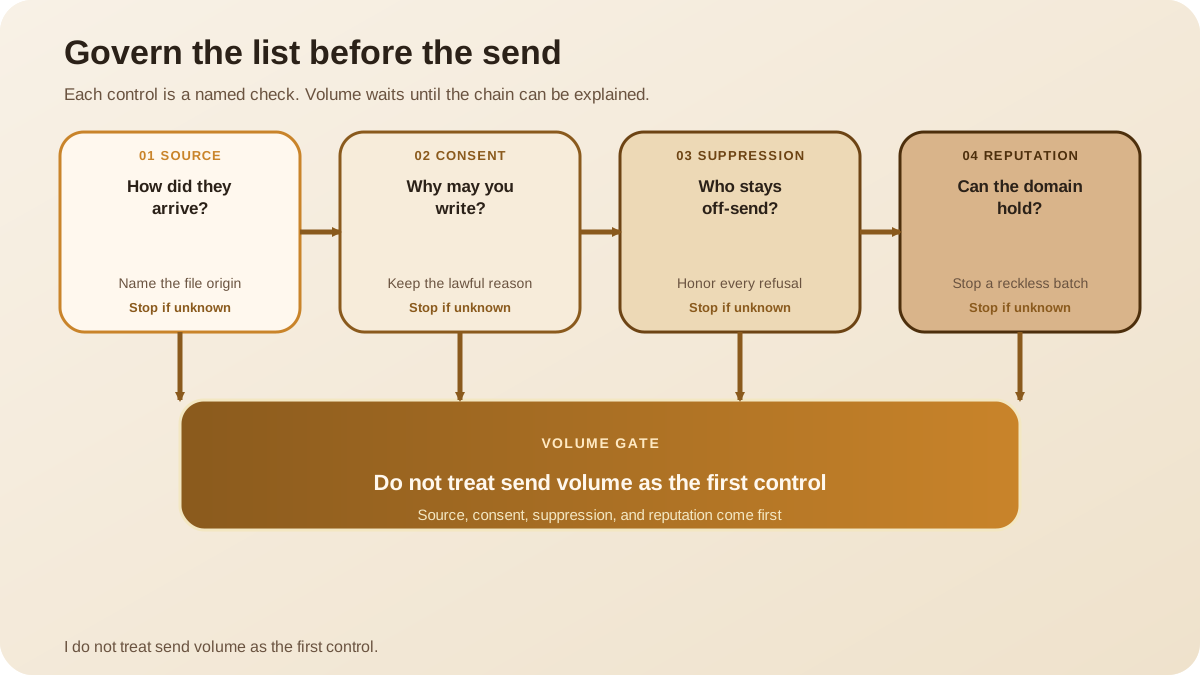
What belongs inside that definition is the boring inventory I actually write down before a sequence is live. I want the source of the names, the date or method of collection if we have it, the role I think I am writing to, the country or mailbox provider context if it changes the rule, and the suppression file I will honor. I do not treat a discovered email as a qualified record just because a search returned it. Qualification, for me, is the moment I can defend the contact as a list entry rather than as a guess. If the record cannot survive those questions, I do not promote it into a send queue. That is why I keep saying the list is the campaign. Copy can be rewritten in an afternoon. A list I cannot explain will keep producing the same mailbox complaint no matter how short I make the first line. So I ask the room a blunt question. Can we narrate this file without shrinking from the source? If we cannot, we do not have cold email marketing yet.
Tools wait until the list has a name
Once I have that definition, I look at how the work actually moves, and I get impatient with tool talk. The mechanism is not a sequencer firing a template. The mechanism is a chain: I select people, I assert a reason I may write, I present a sender identity, I place a message into a mailbox network that is already tired, and I have to accept an opt-out or an objection without arguing. The U.S. FTC's CAN-SPAM guide is the floor I keep in the notes for U.S. commercial email: accurate header information, a subject line that is not deceptive, a valid postal address, and a clear way to opt out. I do not treat that checklist as a growth strategy. I treat it as the minimum identity and response handling the channel demands. If a tool cannot show me those controls, it is not a cold email marketing tool. It is a volume appliance. I will mention OKKI Go here only as a company-search and review surface, not as a blast engine, because the mechanism I care about is still human review before a name becomes mail. You'll notice I am not asking the tool to make the message warmer. I am asking it to keep an unexplained record out of the queue before anyone hits send.
The strategy layer people copy from tutorials is useful once I put it in the right order. Saleshandy's tutorial structures cold-email work around prospect research, a short subject and message, a clear low-friction call to action, follow-up planning, and deliverability preparation. I do not read that as write shorter and follow up more. I read research as list provenance, deliverability as sender reputation, and the short message as what remains after I have a reason. Follow-up planning is only sane if suppression and opt-out are already wired. Otherwise I am just scheduling a second offense. So the implication I take is simple, and I keep asking it in reviews: are we using tools to inspect a list we can name, or are we using tools to hide that we never named it? Strategy, for this channel, is the decision to keep volume behind those checks. If we cannot do that, I do not want a prettier sequencer. I want the send paused. That is not a style preference. It is how I keep the domain from learning the wrong lesson.
The check I run before a tool scales
The mechanism I check before any tool scales is embarrassingly plain. Can we point to the source of this batch? Can we say what consent context we think we have, even if that context is we believe this is permitted business contact and we will honor an objection? Can we name the From identity and the domain's authentication state? Can we suppress the people who already said no? If those answers are missing, I do not care how elegant the sequencer looks. I keep seeing the same argument about a clever first line while the shared inbox collects complaints nobody logged. I will not do that argument again. Scale is a later conversation, and it only starts after the list can survive those four questions without a shrug. If your team cannot answer them this week, we do not have a tooling problem. We have an unexplained file.
Replies and receipts are not this campaign
The rule holds when I am sending commercial email to people I do not already have an active, named conversation with, and when the mailbox will treat the traffic as marketing. That is the ordinary cold email marketing case. It holds because the recipient and the channel change the duty. The ICO is explicit that direct marketing rules depend on the recipient and the channel, and that organizations must also consider data protection duties and objections to marketing. I use that as a stop sign, not as a slogan. Data and deliverability sit in the same place in my notes. If I cannot describe how the data arrived, I cannot predict how the mailbox will treat the domain. If I cannot honor an objection, I should not be collecting more names. The channel is permission-sensitive even when a team keeps calling it just outbound. I keep asking a harder version of the same question. Would I still send this batch if I had to read the source note aloud to the person who received it? If the answer is no, I already have my answer.
The rule breaks when the message is not marketing in that sense. A reply inside an existing thread, a transactional notice the person already asked for, or a one-to-one note to someone who wrote us first is not the same object. I also stop transferring the rule when the team cannot state a threshold. Mine is ugly and usable: if we cannot answer source, consent context, suppression, and sender identity for a batch, we do not send that batch. I do not invent a percentage to make that sound scientific. I just refuse the send. This is also where I use OKKI Go as a review step rather than as proof of permission. It can hold company context for a later draft. It does not bless a purchased file I still cannot explain. Sender reputation and suppression live on our side of that unlock. If we skip them, we are not doing cold email marketing. We are burning a domain.
Volume is the story I keep rejecting
The misconception I hear most is that cold email marketing is a volume problem with a copy costume. People ask the usual questions in that order: which template, which tool, how many follow-ups, what is a good open rate. I understand why. Volume is visible. List governance is not. The reason that reading is wrong is that the mailbox and the recipient do not award points for effort. Google's delivery requirements and the FTC's identity and opt-out rules are not impressed by a larger sequence. A bigger send on a list I cannot explain just teaches the network, faster, that my domain is a nuisance. I keep asking the same question in reviews where the only metric on the slide is emails sent. Sent to whom, on what basis, from which identity, and who already asked us to stop? If we cannot answer those, the FAQ about templates is arriving too early. I will not help polish a first line until the file has a source note.
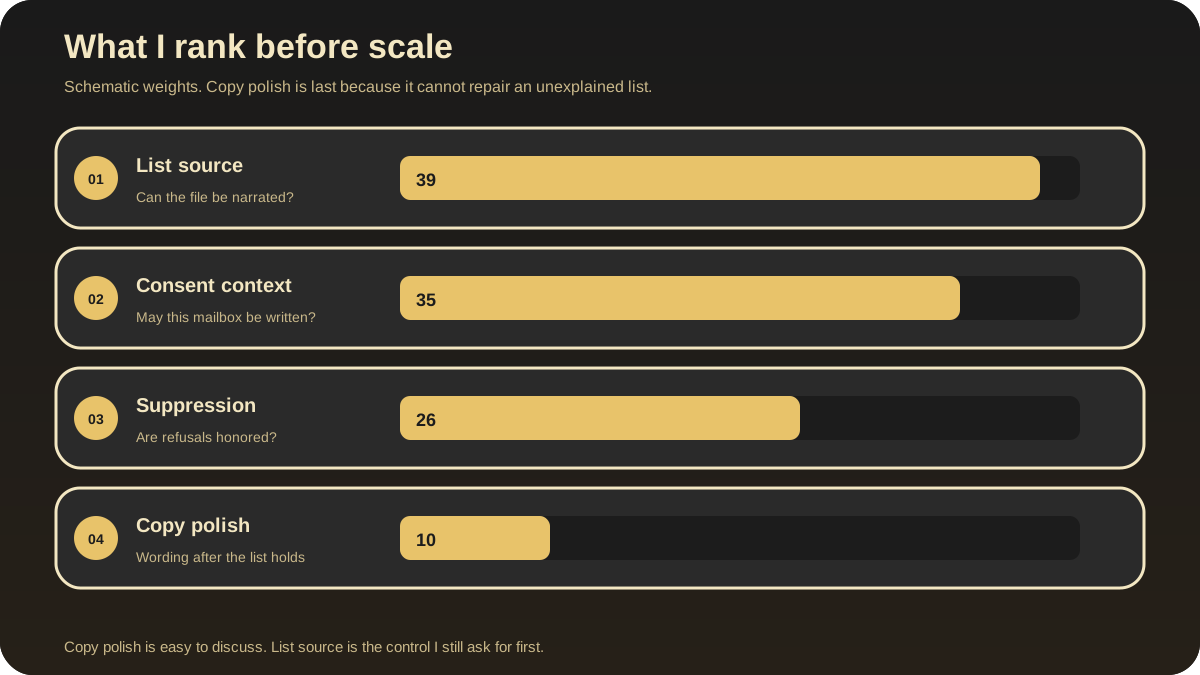
The view I will keep is narrower and less flattering. If the tutorial starts with prospect research and deliverability preparation, I treat those as the work, and I treat the short message as the remainder. I reject the tempting interpretation that a clever first line can rescue an unexplained list. It cannot. It can only make the unexplained list look more professional while it arrives. That is why I keep answers short when people ask me for a trick. The useful move is to stop the sequence whose list I cannot narrate. Research, a low-friction ask, and a planned follow-up are fine after that. They are not a substitute for it. You'll get a cleaner first line once the list can survive a source question. You will not get a cleaner domain by sending more of what you cannot explain. I would rather ship one reviewed batch than protect a calendar that nobody can defend. That is the interpretation I want rejected before anyone opens the template folder.
Kill one ungoverned sequence
I will walk the judgment on a bounded case so it does not stay abstract. The scenario is a small outbound team that still describes cold email marketing as an efficient way to send promotional messages directly to a targeted audience. The operating constraint is a weekly send target that the sequencer will hit whether or not anyone can explain the file. The working materials I am given are a purchased list, one shared sending mailbox, and one template. I am labeling the weekly target, the purchased file, and the shared mailbox as scenario_assumption values. I am not claiming a named client or a measured result. What I change is the order of work. I freeze new volume. I require a one-page list note: source, consent context, suppression path, sender identity, and what we will do with an objection. Until that note exists, the sequence does not go out. That is the opposite of write a better opener and keep the calendar. If we skip it, we are still doing direct mail with a faster report.
The result I expect to observe is not a heroic lift in replies. It is binary and slightly embarrassing. Either we can explain the list, or we discover we have been sending a file nobody owns. If we can explain it, I let a smaller, reviewed batch move and I watch complaints, opt-outs, and authentication warnings the way I used to watch open rates. If we cannot explain it, the decision is to kill that ungoverned sequence. I will use OKKI Go in this step only to search and review companies by product, buyer type, country, and exclusions before anyone unlocks a record. That is process, not magic. The edge is also plain. This judgment does not tell a writer which proof to put in paragraph two. It tells an operator which send to stop. If the mail is not commercial, or if the person already asked for the message, I do not drag this control into that room. I want the next week to start with one killed sequence and one list we can narrate.
The next send I am willing to keep
The next checkpoint I write on the wall is one question: which live sequence can we not explain, and who has authority to kill it this week? If nobody can name that sequence, we are still doing volume theater. If we can name it, we do the ugly work. We export the suppression file. We check the From identity. We stop adding names we cannot source. Then, and only then, I will talk about a shorter ask or a follow-up plan. I want the next meeting to start with a killed sequence, not with a new template. That is how I apply the judgment when the calendar is already full. You'll know we meant it when a send date moves and nobody tries to replace the missing volume with a purchased top-up. If they do try, I ask for the source note again.
I am ending on the action, not on a slogan. Pick one live sequence whose list you cannot explain, and kill it this week. Write the source, the consent context, the suppression path, and the sender identity for whatever remains. If we cannot do that, we are not ready to talk about scale. Cold email marketing gets its chance after the list can be narrated, not before.
Frequently asked questions
What is the single most important factor in cold email marketing?
Whether I can explain the list before I scale the send: source, consent context, sender identity, and suppression. Copy and tools come after that test.
What do most buyers get wrong about cold email marketing?
They treat it as faster direct mail and start with templates, tools, or volume. The mailbox does not reward an unexplained file that simply arrives more often.
How should you actually decide on cold email marketing?
Design campaign controls around consent context, relevance, sender reputation, and suppression before you optimize message scale. If the list cannot be narrated, stop.
When does cold email marketing matter most?
When you are sending commercial email to people who did not ask for this specific message, and the mailbox will treat the traffic as marketing rather than as a reply or a notice they already requested.