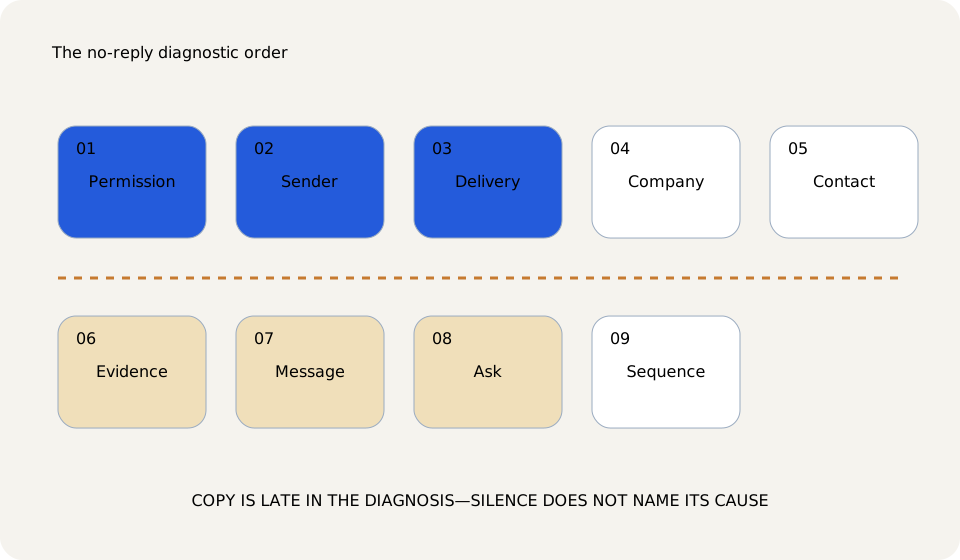
When cold email outreach gets no replies, the silence does not identify whether the failure came from permission, sender health, delivery, company fit, contact responsibility, evidence, message, ask, or sequence. Treating copy as the automatic cause can polish a downstream symptom while the real defect remains. Audit those layers in order, repair the first one that cannot support the next step, and rewrite only after the earlier conditions hold.
No replies do not prove the copy is the problem
The team has rewritten the subject line seven times. The opening has moved from formal to friendly, then from friendly to direct. A sentence about the recipient's city was added and removed. The product description is shorter. The call to action has changed from a meeting to a demo and back again. Replies remain scarce, so everyone opens the document for another round of edits.
This response is understandable because copy is visible and easy to change. No reply, however, is not a copy diagnosis. The message may have failed to reach the inbox. The address may be wrong. The company may only resemble the intended buyer. The recipient may not own the topic. The evidence may be generic. The offer may require trust the sender has not earned. The timing may be wrong. The recipient may simply choose not to respond.
A good editorial workshop therefore begins by closing the draft. Before judging wording, reconstruct the path the email had to travel and the business reason it carried. Copy is examined only after the earlier conditions are supported. That order prevents beautiful sentences from disguising a broken target.

Cold email outreach starts with lawful, transparent contact
Before deliverability or persuasion, establish whether and how the message may be sent. Cold B2B email rules vary by jurisdiction, recipient type, channel, lawful basis, and circumstances. The United States CAN-SPAM Act applies to commercial email and requires, among other provisions, accurate header information, non-deceptive subjects, identification and address requirements, and a working opt-out process. It does not create a general exception simply because the recipient is a business.
UK ICO guidance distinguishes corporate subscribers from sole traders and some partnerships, while data-protection duties can still apply when personal data is used. Other countries have their own consent, transparency, identification, and suppression requirements. A global list should never be treated as one legal context. Use current regulator guidance and qualified advice for your actual operation.
Identity is also a trust condition. The recipient should be able to understand who is writing, on whose behalf, why this business is being contacted, and how to stop future messages. Avoid deceptive reply formatting, misleading subjects, hidden identity, or a removal path that creates more friction than the original message.
Confirm permission, identity, and opt-out before sending
- ✓Recipient country and applicable rules reviewed
- ✓Recipient and subscriber type considered
- ✓Lawful basis or consent requirement documented where relevant
- ✓Sender and represented company are accurate
- ✓Subject does not mislead
- ✓Required address and transparency information is present
- ✓Opt-out is clear, honored, and connected to suppression
- ✓Data source and retention handling are reviewable
Verify sender and delivery health before editing the message
Mailbox providers publish sender requirements and support guidance that can change over time. Review current authentication, domain, DNS, reputation, message formatting, complaint, bounce, unsubscribe, and bulk-sender requirements with the provider and sending service you actually use. Do not rely on an old checklist copied from a template article.
Open and click signals are imperfect. Image blocking, privacy protections, link scanners, corporate security tools, and automated systems can create both missing and artificial events. Use them cautiously for operational context. Never write “I saw you opened my email” as though an event proves human attention or interest.
Delivery evidence determines whether copy can be judged
| Observation | Investigate | Do not conclude |
|---|---|---|
| Address bounces | Source, recency, formatting, domain, and verification process | The copy was rejected |
| Provider block or failure | Authentication, policy, reputation, volume, content, and provider guidance | The company is not interested |
| Sent or delivered with no reply | Company, contact, evidence, message, ask, timing, and sequence | A human read it |
| Open or click event | Treat as limited operational context | Buying intent or message-market fit |
Confirm company relevance before researching a contact
A personalized email to the wrong company is still wrong. Reopen the account evidence. What does the business actually sell, make, install, represent, or operate? Does it serve the use environment your product requires? Is it active in the territory? Is it an end user, distributor, integrator, adviser, peer supplier, or competitor? Which public fact supports your classification?
Industry labels are not enough. A company may mention food packaging because it manufactures film, audits safety, designs factories, sells machinery, or owns a production plant. Those roles imply different problems and conversations. If the email could be sent unchanged to all of them, the list has not carried enough business meaning into the draft.
Then audit the person. A senior title may be distant from the category; a specialist manager may understand it immediately. Choose a responsibility that can recognize, evaluate, route, or influence the question. When uncertain, make the uncertainty part of a modest ask: is this within your remit, or is another colleague responsible?
Both the company and responsibility must fit
- ✓I can state the company's likely commercial role
- ✓A public fact supports the product connection
- ✓No explicit exclusion applies
- ✓The contact's responsibility relates to the question
- ✓The company and contact evidence are current enough for the decision
- ✓If the role is uncertain, the message asks for routing rather than pretending certainty
Use one verifiable business reason to earn attention
Good cold email evidence is not trivia. A reference to the recipient's university, weather, or latest generic post may show effort without explaining relevance. Business evidence connects the company to the product: an adjacent portfolio, named service capability, a public project, an operating process, a customer segment, or a geographic route.
The evidence must be verifiable and proportionate. A facility expansion can justify asking whether a category is relevant; it does not justify claiming the company urgently needs your solution. A distributor's portfolio can justify a complementarity question; it does not prove the company is seeking a new supplier. Preserve the difference between what is known and what is hypothesized.
Five links turn evidence into a modest first question
- Company factA visible, current, and relevant observation
- Product factAn approved capability, use case, or constraint
- ConnectionWhy the two facts create a plausible business question
- UncertaintyWhat the sender does not know and will not pretend to know
- Next stepA small action that can resolve the uncertainty
If no evidence survives this chain, return the company to investigate or reject. Do not ask a language model to manufacture specificity. Generated confidence cannot replace a business reason. The responsible choice may be to research another fact, choose another responsibility, or not send.
Rewrite the draft only after the evidence holds
The following emails are illustrative, not tested templates or performance claims. Imagine a supplier of machine-vision inspection modules approaching a European line integrator. The weak draft reads: “Hi Anna, I noticed your impressive company is a leader in automation. We provide innovative AI inspection solutions that improve efficiency and quality. Can we schedule 30 minutes next week for a demo?”
The draft is short but unsupported. “Leader” is praise without meaning. “AI inspection solutions” is broad. “Improve efficiency and quality” could describe thousands of products. The message does not explain why an integrator was selected, where the module might fit, or why a stranger should reserve thirty minutes. The apparent copy problem is really missing evidence and an oversized ask.
A revised email with traceable evidence
Subject: inspection modules for food-line projects
Hi Anna,
Your company shows complete food-production line projects and support for several complementary automation brands. We make machine-vision inspection modules designed to integrate at defined points on those lines; I can share the interface and service requirements from our product material.
Would a one-page fit summary be useful for whoever evaluates new inspection components, or is another colleague responsible?
Best,
[Accurate sender identity and required details]
The revised version does not claim a need, project, budget, or intent. It states why the company appears relevant, bounds the product fact, and asks for a small routing or information decision. A reviewer can verify every material claim. That is a stronger editorial standard than counting personalization tokens.
Every line must do one necessary job
| Element | Job | Review question |
|---|---|---|
| Subject | Set an accurate context | Would the recipient feel misled after opening? |
| Company evidence | Explain why this company | Can a reviewer verify it? |
| Product connection | Make relevance concrete | Is it supported by approved material? |
| Uncertainty | Avoid pretending private knowledge | What do we still not know? |
| Ask | Earn the next small step | Is it proportionate to a first contact? |

Use OKKI Go to turn reviewed evidence into a human-approved draft
In OKKI Go, company search can begin with product, buyer type, country, positive clues, and exclusions. Candidate companies are available for review before deeper work. The seller selects companies whose business role is defensible, then can search within those companies for contacts using role or name cues.
For a selected company and contact, drafting can use company context and product information the user supplies. The useful input is not “write a catchy cold email.” It is the approved product fact, the verified company evidence, the intended business reason, the uncertainty to preserve, and the desired next step. That gives generation boundaries.
A person confirms recipients, subject, body, claims, compliance, and send action. This human checkpoint is essential because public information can be incomplete, responsibilities can change, product material can be misread, and legal context depends on the actual campaign. The system can show task or email status and failure reasons where available, supporting operational review after an approved action.
Four checkpoints from evidence to approved draft
- User inputSelected company and contact, approved product facts, business evidence, and intended ask
- System outputContext-aware subject and body options with recipient information
- Human confirmationTruth, role, relevance, compliance, recipient, subject, body, and whether to send
- Usable resultA bounded first message whose business reason can be traced
Give each follow-up a different job
Follow-up can compensate for timing and incomplete clarity, but it cannot repair a wrong target. Keep the sequence finite, compliant, and responsive to opt-outs and negative signals. The number and timing of touches should fit the market, channel, product, and applicable rules rather than a universal internet formula.
Three touches should test three different questions
| Touch | Editorial job | Example direction |
|---|---|---|
| 1: relevance | State company evidence, product connection, and modest question | Would a one-page fit summary help the responsible colleague? |
| 2: resolution | Add one approved technical or commercial detail | The summary covers interface and service requirements; is this category within your remit? |
| 3: routing or close | Make redirecting or ending easy | If another team owns this, who is appropriate? If it is not relevant, I will close the loop. |
Do not make every follow-up longer than the last. Do not invent scarcity, a recent visit, an internal referral, or previous interest. Do not change the core business reason mid-sequence merely to trigger a response. If new evidence emerges, verify it and decide whether it legitimately changes the hypothesis.
A no-reply sequence should end with a decision. Close, hold until a genuine revisit condition, investigate a known evidence gap, or reject the record. Endless automated follow-up keeps ambiguous data active and can create compliance and reputation costs. Respectful closure is an operational capability.
Send only after the claim, recipient, and ask survive review
The final review works best when another person can reconstruct the email without access to the writer's assumptions. Ask the reviewer to explain why this company, why this responsibility, which fact supports the connection, which product statement is approved, what remains unknown, and what the recipient is being asked to do. Any hesitation points to the layer that needs work.
Nine checks before the message leaves the system
- ✓Applicable legal and provider requirements are current and documented
- ✓Sender identity, headers, subject, address details, and opt-out are accurate
- ✓Company role and contact responsibility are supported
- ✓Every personalized fact can be verified
- ✓Every product claim comes from approved material
- ✓The email does not imply private knowledge or invented urgency
- ✓The ask is small enough for the available evidence
- ✓Follow-up has a distinct purpose and a defined end
- ✓Recipient, subject, body, and send are confirmed by a person
- ✓Status, failures, opt-outs, and replies have an owner
This review is not designed to make every email sound the same. Voice can vary. One message may be direct, another technical, another exploratory. The non-negotiable structure is ethical and evidentiary: accurate identity, legitimate contact, supported relevance, honest uncertainty, and a proportionate next step.
If the email passes and still receives no reply, the outcome remains useful when the batch was controlled. Classify what is known, preserve the target and evidence record, and decide whether another segment, responsibility, offer, or channel deserves a separate test. Do not rewrite history by claiming the recipient had a hidden objection.
When cold email outreach gets no replies, copy should not be the automatic defendant. Audit permission and identity, sender and delivery, company and contact fit, business evidence, message, ask, and follow-up in order. Rewrite only when the earlier layers hold. The resulting email may be simple, but every sentence has a reason to exist and every external action remains reviewable.
Choose one silent campaign and stop editing the subject line for a moment. In OKKI Go, trace a small sample from reviewed company to selected responsibility, verified evidence, supplied product fact, draft, human confirmation, and status. Repair the first layer that cannot support the next one. If the business reason survives that audit, the copy is finally ready for a meaningful edit.
Questions readers often ask
What is cold email outreach?Cold email outreach is an unsolicited first email intended to begin a relevant business conversation with a person who has not previously engaged. Responsible execution requires appropriate targeting, accurate identity, supported claims, applicable legal compliance, sender readiness, a proportionate ask, opt-out handling, and human oversight.
Why is my cold email not getting replies?Possible causes include permission or transparency problems, sender or delivery failures, wrong companies, wrong responsibilities, weak or unverified evidence, a generic message, an unconvincing offer, an oversized ask, poor timing, or ineffective follow-up. Silence alone cannot identify which one applies.
Is B2B cold email legal?The answer depends on jurisdiction, recipient type, data use, channel, and circumstances. Rules differ and change. Review current regulator guidance and obtain suitable advice. B2B status does not automatically remove identity, transparency, opt-out, data-protection, or other obligations.
How many follow-up emails should I send?There is no universal number. Use a finite sequence in which each touch has a distinct purpose, complies with applicable rules, respects negative signals and opt-outs, and ends when additional contact would not add legitimate resolution.
Should I track cold email opens?Open data can be incomplete or distorted by privacy controls, image settings, scanners, and automation. It may support limited operational review, but it should not be treated as proof that a person read the email or has buying intent.
Sources and further reading
- OKKI Go prospecting use cases — OKKI Go
- Cold Email Guide — Hunter
- How to Write a Cold Email — Woodpecker
- CAN-SPAM Act: A Compliance Guide for Business — Federal Trade Commission
- Business-to-business marketing — UK Information Commissioner's Office
- Email sender guidelines — Google
- Sender Support — Microsoft