A subject line is not a tiny billboard. It is a compact promise about why this message deserves attention, and the body has to pay that promise back.

Define the Job of a Cold Email Subject
"A quick question you cannot ignore." Clever? Perhaps. Honest? Only if the message contains a question the recipient can recognize and a reason it should not be ignored. Most bodies cannot carry that much drama. The line wins curiosity by borrowing a promise the email never earned.
The FTC supplies the non-negotiable floor for U.S. commercial email: the subject line must accurately reflect the message content. That rule does not hand you a formula. It gives you a harder editorial test. What, exactly, is this email able to promise without exaggerating what follows?
I define the job narrowly: help the right recipient recognize the relevant reason for contact before opening. Not create need. Not manufacture urgency. Not rescue a weak list or an unrelated body. Once you accept that modest job, the words stop being the starting point. Recipient evidence comes first.
Earn Recognition Without Manufacturing Urgency
"Falling behind on expansion?" sounds urgent. But where did "falling behind" come from? If your evidence shows only that the company announced expansion, the subject has converted an observable event into an unsupported problem. Recognition has become accusation, and the body must now defend a claim it never had.
A restrained alternative might name the observable context instead: "Coordination during your market expansion." That is not a universal template, much less a best line. It is usable only when the body explains why expansion is relevant, what coordination issue you are raising, and why the recipient is a reasonable person to ask.
Make a Promise the Email Actually Keeps
Read a subject as a promise, not a headline. "A faster way to qualify distributors" promises both a method and a speed advantage. Can the body support both? If it merely introduces a product, the answer is no. Delete the advantage or strengthen the body with support already allowed in the message.
This is where many tidy lines fail. They are grammatically clean but commercially dishonest. You do not repair that with a shorter synonym. You repair it by bringing the claim back to the evidence: a known context, a stated reason for contact, and a body that fulfills the same expectation.
Review the Subject Against the Message
Now put the subject directly above the body. Do not review it in a spreadsheet column by itself. The FTC's subject-to-content requirement makes the relationship the object of review. A line can sound plausible alone and become misleading the moment you read the message it introduces.
The challenge is not "Would I open this?" That question rewards the editor's curiosity. Ask instead: "What would I reasonably expect to find after opening, and does the body deliver it?" The second question exposes promise breaks before a recipient has to discover them.
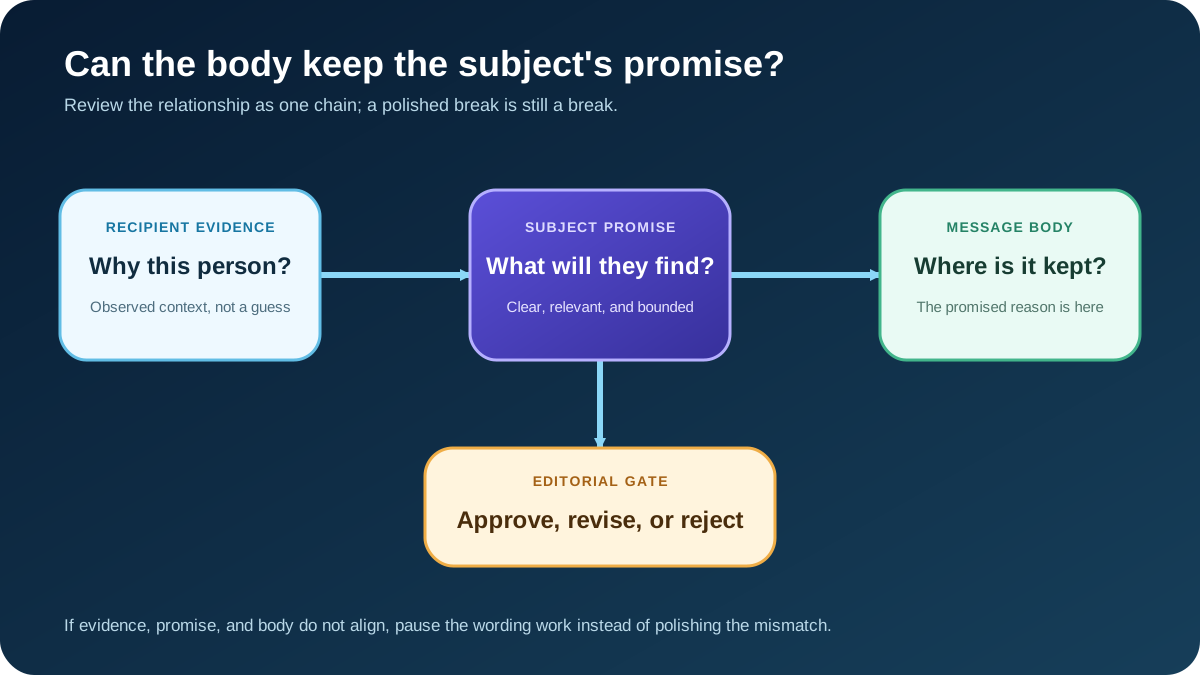
I use a three-part reading. What recipient evidence licenses the contact? What promise does the subject make from that evidence? Where does the body keep the promise? If one answer is missing, wording work should pause. A polished mismatch is still a mismatch.
Start With Recipient Relevance
Recipient relevance is a constraint, not a decorative token. A first name can identify the person while saying nothing about why the email belongs in that person's inbox. Begin with the evidence that explains the contact: a known company context and a defensible connection to the message you intend to send.
Then mark what you do not know. If you know the company entered a market but do not know the recipient's current problem, write from the event, not the imagined pain. "Question about your new market" is modest. It becomes honest only when the body asks a real question about that context.
Select a Pattern That Fits the Reason for Contact
Patterns can help you compress a reason; they cannot invent one. A context pattern names an observable event. A question pattern frames an issue the body genuinely asks about. A topic pattern states the working subject plainly. Choose the pattern after the reason for contact is settled, never as a substitute for it.
That is why a swipe file is the wrong center of gravity. The same line can be honest for one body and misleading for another. Treat examples as editorial probes: what evidence would this wording require, what expectation would it create, and which sentence in the body would fulfill it?
Keep B2B Sender Responsibility Visible
"It is B2B, so the subject rules are different." Not under the U.S. boundary established here. The FTC states that CAN-SPAM covers commercial messages and has no business-to-business email exception. Calling the recipient a professional does not release the sender from the subject-accuracy requirement.
Nor does a vendor or tool absorb the sender's responsibility. The FTC guide assigns compliance duties to senders and explains sender responsibility. So approval cannot be reduced to "the system generated it." Someone on the sending side must compare the proposed subject with the message and the applicable requirements.
Keep the jurisdictional limit visible. This evidence supports a U.S. commercial-email discussion. It is not a global rulebook, legal advice for every campaign, or proof that an individual message complies. Your review must account for the actual recipients, message, data, and places involved.
Prefer Clarity Over Cleverness
Cleverness becomes costly when it changes the reasonable expectation of the body. "Your access expires today" suggests an existing access relationship and a deadline. If neither exists, the problem is not tone. The subject has described a different message from the one you are actually sending.
Plain language is not automatically accurate, either. "Partnership idea" sounds harmless, but what partnership does the body actually propose? If the email is a product pitch, the soft noun can hide more than it clarifies. Accuracy asks what the recipient would reasonably understand, not whether the words look polite.
Check Length, Tone, and Risk in Context
Editors love a hard length rule because it is easy to enforce. This evidence provides none. Shorter is not automatically more accurate; longer is not automatically more relevant. Judge whether the necessary context survives compression and whether any remaining word overstates the relationship, urgency, result, or reason for contact.
Tone deserves the same contextual reading. "Checking in" implies a prior thread; "Invitation" implies something the body should identify; "Update" implies information the recipient can reasonably recognize as an update. Before approving a familiar phrase, ask which relationship or content promise it silently creates.
Bound the Documented OKKI Go Subject-Variant Workflow
A tool enters the argument only after relevance and promise integrity are defined. The official OKKI Go pages describe company context and product material informing outreach drafts, subject variants, team control, and review before send. That is a workflow description, not permission to skip editorial judgment.
The same first-party material describes the user confirming recipients, subject, and body before send, plus locked email-status visibility. The human confirmation is the useful boundary here. It keeps the subject, body, recipient context, and send decision available for one joined review.
Do not inflate that scope. The pages do not promise autonomous qualification, consent, compliance, fixed accuracy, deliverability, response, pipeline, or revenue. A candidate is not verified buying intent. A generated variant is not a validated winner. A visible status is not proof of commercial quality.
Hold Audience and Body Copy Constant
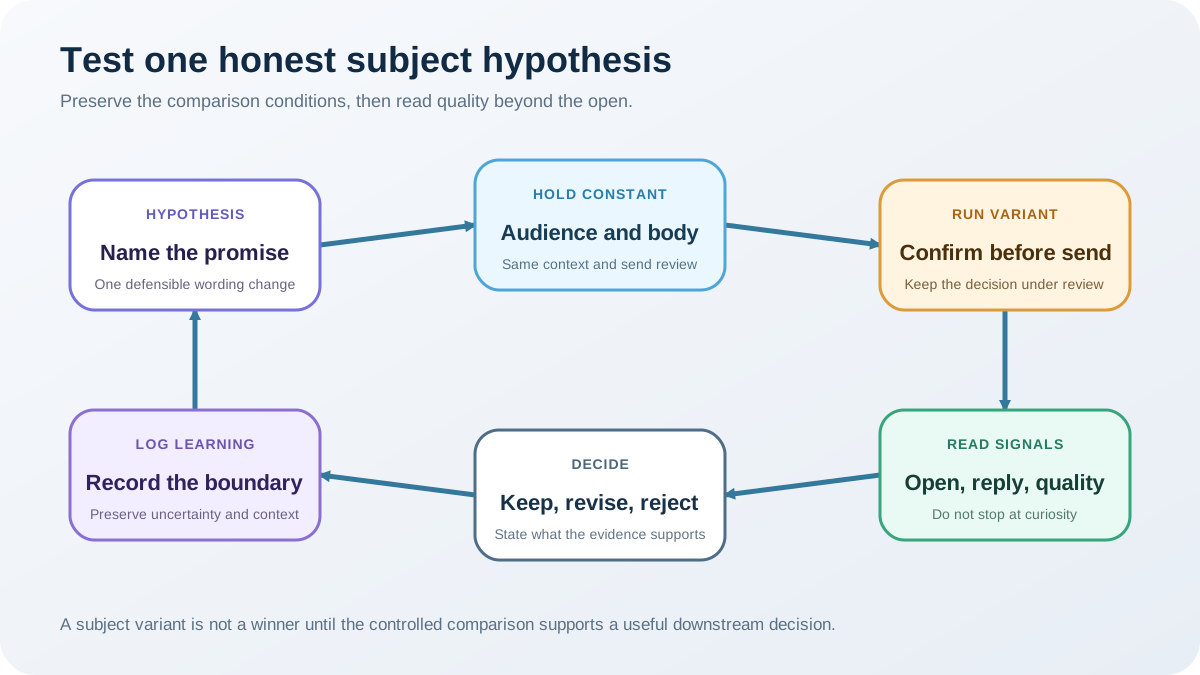
"Variant B got more opens." What else changed? If the audience, recipient evidence, send decision, or body moved with it, you cannot isolate the subject difference. A disciplined comparison holds the audience and body copy steady, then changes one defensible wording hypothesis at a time.
Write the hypothesis before sending. For example: "Naming the known market-expansion context will produce more relevant replies than a vague question, while the body and audience remain unchanged." This is not a forecast. It is a falsifiable editorial question that states what changed and which response deserves inspection.
Read Replies and Downstream Quality Alongside Opens
A visible email status can confirm only the state the product page documents. It cannot tell you that the subject promise was relevant, the reply was qualified, or the conversation moved usefully. Read that state beside replies and whatever downstream quality judgment your team has explicitly defined.
The verdict can be modest. Keep a variant when its promise is accurate and the combined response gives you a defensible reason to continue testing. Reject it when the body cannot keep the promise, even if curiosity rises. And when the sample cannot distinguish a pattern, record uncertainty instead of manufacturing a winner.
Take the next subject you plan to send and write one sentence beneath it: "The body keeps this promise by..." If you cannot finish that sentence with content already in the email, reject the subject. If you can, log one wording hypothesis and one reply-quality signal before the test begins.
Frequently asked questions
What is the job of a cold email subject line?
Its job is to help the intended recipient recognize the relevant reason for contact without promising more than the body supports. For U.S. commercial email, the FTC states that the subject must accurately reflect the message content. That is an accuracy floor, not a performance formula.
Should I start with a subject-line formula or recipient evidence?
Start with recipient evidence and the actual reason for contact. Then choose a wording pattern that compresses that reason without inventing urgency, a relationship, a result, or a problem. An example is useful only when you can name the evidence it requires and the body sentence that fulfills it.
Does CAN-SPAM apply to business-to-business email?
The FTC says the U.S. CAN-SPAM Act covers commercial messages and provides no business-to-business email exception. Senders retain compliance responsibilities. This answer is limited to the cited U.S. guidance and is not global legal advice or proof that a particular message complies.
Are opens enough to choose a cold email subject?
No conclusion here should rest on opens alone. Hold the audience and body steady, state the wording hypothesis, and read opens alongside replies and a locally defined downstream quality judgment. If the evidence is inconclusive, keep the result uncertain rather than declaring a winning line.
Does OKKI Go guarantee cold-email deliverability or replies?
No such guarantee is supported here. The official OKKI Go pages describe contextual drafting, subject variants, team control, confirmation before send, and email-status visibility. They do not establish autonomous qualification, consent, compliance, fixed accuracy, deliverability, response, pipeline, or revenue.
Explore OKKI Go
- Explore the official OKKI Go overviewReview the first-party description of contextual outreach drafting, subject variants, team control, confirmation before send, and email-status visibility.Official OKKI Go resource ↗
- Review the official OKKI Go use casesInspect the documented workflow in which company context and product material inform drafts and the user confirms recipients, subject, and body before sending.Official OKKI Go resource ↗