
Turn an overfull account list into a set of testable choices about fit, timing, engagement, and the evidence that earns the next action.

What a sales prospecting strategy must decide
A new sales leader inherits an overfull account list. One rep sorts by headcount, another by funding, and a third by title. The shortage is not tactics; it is a chain of decisions explaining why one account deserves capacity before another. A sales prospecting strategy defines whom the team will pursue, which conditions make the timing credible, how each segment will be approached, and what evidence permits an account to advance. Lead generation creates or captures demand, whereas prospecting decides which buyers merit attention. A downloaded guide may create a lead without proving fit, authority, urgency, or a relevant problem; an outbound researcher may identify a strong-fit account before anyone raises a hand. Inbound and outbound therefore begin differently but enter the same system of selection. The distinction becomes usable only when handoff states are visible: identified, researched, qualified for outreach, engaged, recycled, or disqualified. Each transition needs an owner and authorizing evidence, because a record should not advance on completed activity alone. Salesforce's lead documentation provides one platform example: status, assignment, history, and conversion are record elements, although its configuration is not a universal prospecting method. A plan must also separate failure of fit from missing research, unsuitable access, later timing, and explicit disqualification.
If it cannot explain why an account enters, advances, pauses, or exits, it describes activity rather than strategy.
Prospecting versus lead generation
The operational boundary is concise: lead generation expands the pool, while prospecting applies explicit evidence to decide who advances. Without that gate, captured demand and selected accounts collapse into one uninspectable queue. The purpose is controlled capacity allocation, not a semantic distinction between labels.
Give inbound and outbound different jobs
Inbound starts with a buyer request, registration, or reply; outbound starts with the seller's market hypothesis. Neither qualifies automatically: inbound checks fit and need; outbound needs a defensible selection reason and relevance test. Set service levels and market-specific rules for channel, recipient, transparency, objections, and suppression. ICO guidance shows obligations can vary by channel, recipient type, and personal-data use. Legal review and honored objections are design constraints.
Define the market and prioritize segments
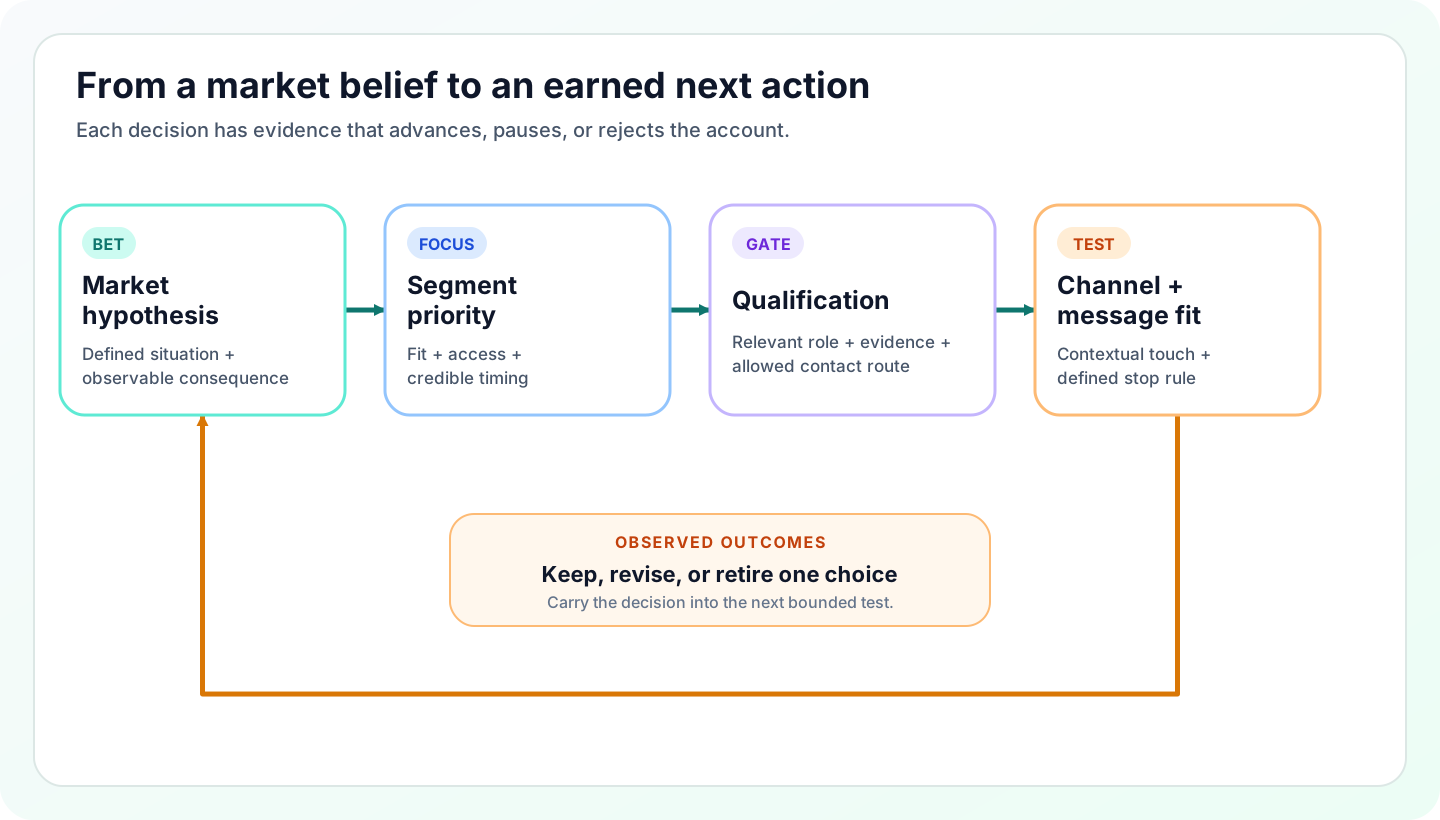
Start with a market hypothesis, not a giant filter export. State that companies in a defined situation may face a specific operational problem, while a named role may care because a visible consequence has appeared. Mark every uncertain part, since the hypothesis is useful because it can be wrong. Industry and size can describe the market, but timing requires an observable event such as an expansion, hiring pattern, technology change, or deadline. Before research begins, specify what evidence would strengthen or weaken the proposition and what finding would remove an account from the test. Turn that proposition into an ideal customer profile by separating stable fit fields from changing situation signals, then set a minimum threshold for each judgment. Segment priority should remain legible rather than disappear into an opaque score. Fit asks whether an account could plausibly gain value; access asks whether the team can responsibly reach a relevant role; timing asks whether there is a present reason to investigate. Choose a segment small enough for research and follow-up capacity, and write down the tradeoff. High fit without access may belong in a research queue, while moderate fit with strong timing may earn a bounded test. The written rationale fixes the priority decision before results are known, so later evidence can challenge the market assumption instead of allowing hindsight to redefine it.
Build an ICP with usable qualification signals
An ideal customer profile should guide the next decision, not decorate a slide. Separate stable fit fields from changing situation signals. The UK Government Data Quality Framework supports this discipline through defined dimensions, measurement, improvement, and accountable ownership. Ask instead whether the fields required for this decision are accurate, current, and traceable enough to use now.
Once criteria are explicit, research can populate the queue. With OKKI Go, a user provides a product, buyer type, country, and exclusions, then receives contextual candidate companies. The user chooses which candidates to unlock and may correct the route before contact discovery. This confirmation yields a narrower, hypothesis-aligned queue, not evidence of purchase intent. Keep the search conditions with the reviewed list so weak outcomes can be traced to the market assumption, data, or execution.
Rank segments by fit, access, and timing
Keep ranking transparent: estimate potential value, responsible access to the owning role, and evidence of a timely reason to investigate. Preserve the three judgments separately; their tradeoffs tell the team whether to test, research further, or wait, whereas a composite score hides which premise failed.
Turn priorities into a prospecting workflow
Turn the segment choice into a route with a research queue, required fields, qualification gate, owner, and next state. Discovery, contact, record, and drafting tools must serve those decisions. Keep unresolved fields visible and code every pause or exit, separating weak segments, weak data, inaccessible roles, and unverified timing. Research tests company fit, a recent specific trigger, its connection to a discussable problem, and the role owning the consequence. Stable fields include operating model, geography, scale, or technical environment; changing signals include expansion, an executive mandate, or a process change. Record the source and date of changing fields, plus accepted sources, freshness expectations, and owners. The UK Government Data Quality Framework offers an operating reference for defined dimensions, measurement, improvement, and accountable ownership, not a sales-data score. Conflicts lower priority because roles, events, or addresses can expire without invalidating stable attributes. Qualification requires company fit, a credible problem or change, a relevant role, and an allowed contact route. Unknown is not no; missing project evidence may make expensive personalization premature.
Research accounts and test trigger events
Research is complete for this stage when the required fields support a decision and the remaining uncertainty is explicit. Collecting additional facts without a decision purpose only obscures that boundary. A dated source and a decision owner make the stopping point inspectable.
Qualify before committing outreach capacity
Assign the next state explicitly: advance qualified accounts, return incomplete records for focused research, recycle plausible later timing, and disqualify failures of the market premise. Visible states and history reduce memory-based handoffs and provide a cleaner denominator for judging whether the strategy selects useful conversations.
Match channels, messages, and cadence
Qualification does not determine engagement. Choose channels by buyer context, permission, required proof, and recipient effort. Give each touch a distinct job: test relevance, offer evidence, or clarify an operating consequence. A cadence is the execution sequence for one segment hypothesis, not the strategy itself. Document audience, channel roles, message progression, spacing, reply branches, and exits so the team can diagnose problems without blindly adding touches.
Choose channels by buyer context
Email can carry an inspectable argument; a call can test understanding; a professional network can add context or a warmer route. Those are roles, not effectiveness promises. Choose for the segment and local rules. ICO guidance shows B2B treatment may differ by recipient type, channel, and personal-data use. Maintain a market checklist for identity, transparency, objections, suppression, and escalation, with qualified legal review where needed. Convenience does not establish permission or appropriateness; declining should be easy.
Adapt the value message by segment
Write from the segment hypothesis: name the change, connect it to an operating consequence, and offer a low-friction way to confirm or reject relevance. Personalization should improve reasoning, not append a company fact. In a reviewable OKKI Go workflow, the user supplies company context and product material; the system prepares a draft. The user confirms recipient, subject, and body before sending. The result is a reviewed message with visible status or failure reason, not an autonomous conversation or evidence of buyer intent. Preserve the approved draft and hypothesis version so feedback can be interpreted against what was sent.
Set follow-up, stop, and recycle rules
Set branches before the first touch. A relevant reply moves to a human conversation; a referral updates the role and restarts only when appropriate. A timing objection receives a recycle date; a contact objection triggers required suppression. Silence reaches a predetermined stop after the intended progression. Opens and clicks may show delivery or interaction, not need, authority, or willingness to buy. Stop rules protect buyer experience and preserve interpretability.
Measure and improve the strategy
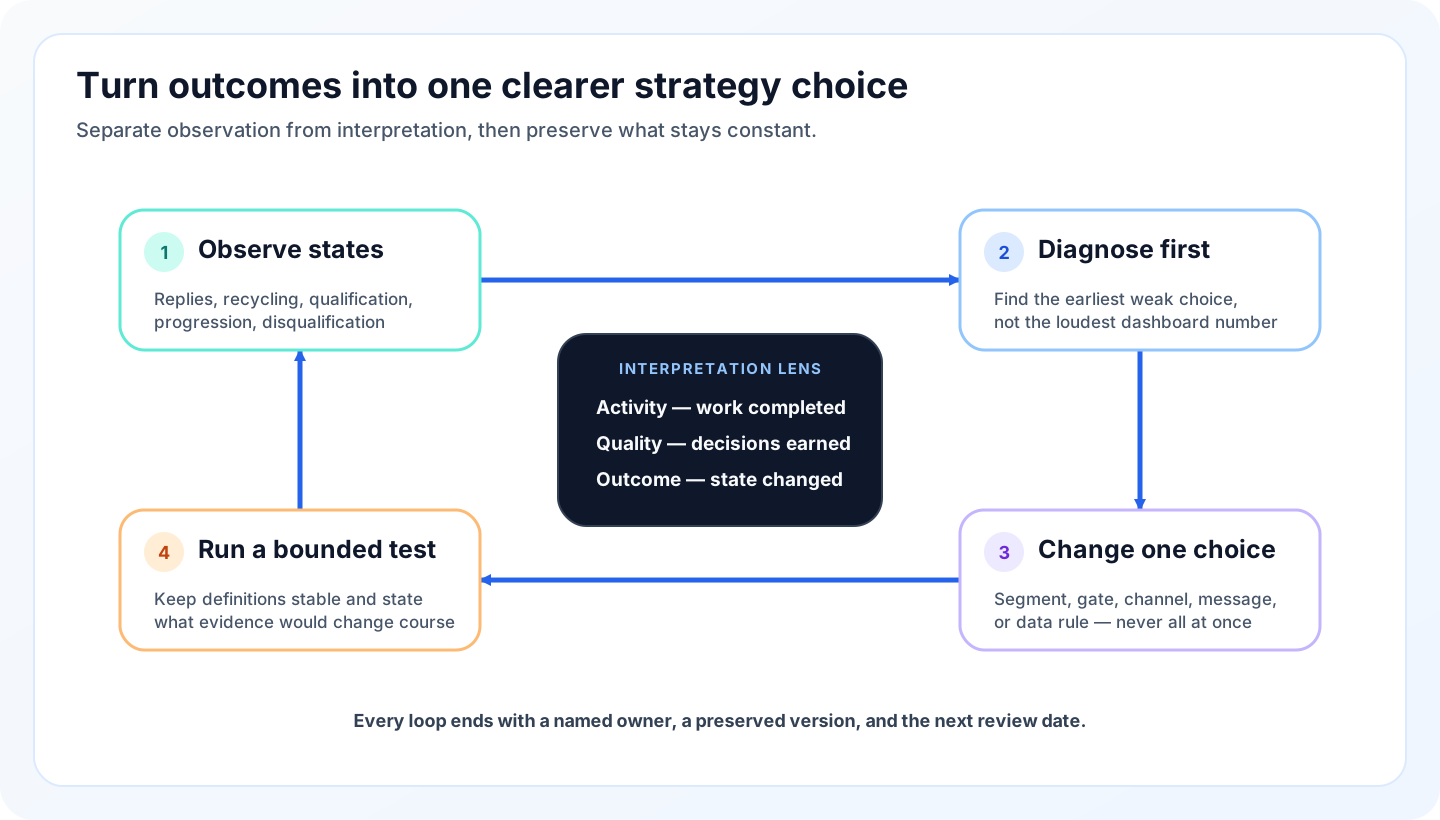
Review on a fixed rhythm while the original choices remain explicitly visible. Bring the segment definition, account-entry rules, qualification reasons, channel plan, message version, and response states together; otherwise later outcomes cannot be traced to the decision that produced them.
Separate activity, quality, and outcome measures
Activity measures describe work completed: accounts researched, contacts reviewed, or touches delivered. Quality measures inspect the decisions inside that work: records meeting required-field criteria, accounts passing qualification, or handoffs arriving without their evidence. Outcome measures describe the resulting buyer state through relevant replies, accepted conversations, progression, recycling, or disqualification. Keeping these three classes separate preserves the diagnostic chain. A rate without its matching denominator can conceal where the decision process actually broke. High activity with weak qualification points first to the list or gate; strong qualification with little engagement shifts attention toward access, channel, timing, or message fit; repeated conversation losses for one reason challenge the market hypothesis. Universal targets would erase those distinctions, so a team establishes a segment baseline, compares like with like, and holds definitions stable during the review window. An accountable owner also monitors stale fields, recurring gaps, and source conflicts before they surface as campaign failure. At review, the team traces outcomes backward to the earliest weak decision instead of changing the list, qualification rule, channel, copy, and cadence together. It changes one meaningful rule, states the supporting evidence in advance, preserves the other conditions, and records the version for the next bounded test.
Measurement then becomes feedback: activity confirms whether the process ran, quality whether its gates held, and outcomes whether the market and engagement assumptions deserve to continue.
Convert evidence into the next strategy decision
End with a decision sentence, not a dashboard tour: keep the hypothesis when qualification and buyer-state evidence agree; revise an ICP field or source after repeated fitness failures; change channel or message when qualified accounts reveal a different access pattern; retire a trigger repeatedly lacking meaningful consequence. Name constants, assign ownership, preserve the version, and schedule review.
Schedule the next strategy-feedback review now, and require one explicit keep, revise, or retire decision when the team meets.
Frequently asked questions
What is a sales prospecting strategy?
It is a linked set of choices about target accounts, timing evidence, qualification, engagement, and the signals that advance, pause, recycle, or disqualify an account.
Should inbound and outbound prospects use the same process?
They can share qualification states, but their starting context differs. Inbound begins with a buyer-initiated signal; outbound begins with a seller hypothesis and therefore needs an explicit selection rationale.
Which prospecting tools should a team choose?
Choose tools by the decision they support: company discovery, contact research, record stewardship, draft preparation, sending control, or status visibility. Keep human review where evidence or external action requires judgment.
How often should a prospecting strategy be reviewed?
Use a fixed rhythm that produces enough comparable evidence for the segment without letting weak rules run indefinitely. The useful interval depends on volume, capacity, cycle length, and risk.
What is the most common strategy mistake?
Changing several variables after a disappointing result. That hides which upstream choice failed and prevents the next cycle from producing reliable learning.