The useful boundary is not a universal definition. It is the local sentence that tells marketing and sales what a record means, who owns the next action, and when the plan must be reviewed.

What Do Authoritative Sources Actually Establish?
Marketing looks at a record and says, "We created the interest, so this is a lead." Sales looks at the same record and answers, "No conversation has happened, so it isn't ours yet." Both statements can be internally reasonable, and neither settles the operating question. The U.S. Small Business Administration treats marketing and sales as connected functions while also noting that their exact distinctions are not universally agreed. That is the useful starting point: authority supports coordination, not a single lead-versus-prospect dictionary. If you import a confident definition without deciding what it means inside your own sales path, the label will only conceal the dispute. The first task is therefore not to choose a winner. It is to ask what marketing has promised, what sales needs before acting, and which written plan can make the next action reviewable. Once those questions are on the page, the argument moves from ownership by assertion to ownership by agreement. Ask marketing to finish, "We have created..." Then let sales finish, "We can act when..." The gap between those sentences is the first local definition to negotiate. What would you change first?
Marketing and Sales Are Connected
The marketing case is strong: actions aimed at a target market need goals, a budget, and a way to be measured. The sales case is just as strong: those actions matter commercially only when they connect to a sales plan and a next step someone can own. The SBA planning guidance holds these concerns together. It places the target market, sales plan, marketing and sales goals, action plan, budget, and plan review in one operating frame. You do not have to erase role differences to use that frame. You do have to show how an inbound route or an outbound route enters the same sales path. Which action created the record? What context travels with it? Which planned sales step could follow? Those are coordination questions, not universal definitions. By answering them, a team can preserve specialized work on each side while making the connection explicit enough to inspect. Connection, in other words, is not blurred ownership. It is a visible relationship between planned actions and planned sales steps. Hand sales one sample record and ask, "Can you name the intended next step from this context alone?" A hesitant answer tells marketing exactly what its action failed to carry forward.
Their Exact Distinctions Are Not Universally Agreed
One response is, "Fine, then let's find the correct definition before we continue." The evidence in this pack does not provide one. Another response is, "If there is no universal distinction, the terms do not matter." That conclusion goes too far as well. Shared work still needs a boundary, because someone must know when to act and what the record can legitimately be said to represent. The resolution is local and explicit: define the terms for this plan, state where each role begins and ends, and keep the definition open to review. The local sentence must not quietly promote a candidate company into verified interest, a qualified opportunity, or promised revenue. Nor should it treat a captured response as sufficient context for every sales action. Ask both teams to name the minimum context they need and the action they will own. The result is not a taxonomy for the market. It is a working agreement for one coordinated system, written so a later review can challenge it. Read the draft definition aloud and ask, "What does this label authorize you to do?" If the two teams name different actions, revise the authorization rather than arguing about the noun.
How Should Your Team Define the Local Handoff?
Marketing may argue, "Give us room to test channels; a rigid handoff will slow learning." Sales may counter, "Give us stable criteria; changing inputs waste attention." A coordinated plan can respect both demands. The SBA guidance identifies the target market, sales steps, action plan, goals, costs, measurement, and updating as plan inputs. It does not dictate a universal funnel, qualification threshold, cadence, or benchmark. That leaves the team with real design work. For each inbound and outbound strategy, write the action channel, intended audience, context created, possible next sales step, owner, cost category, and review signal. Then write what does not follow automatically. A form response need not meet the team's local qualification rule; a candidate found for outbound review need not show buying intent. This plan is not bureaucracy added after the workflow. It is the place where both teams make their strongest operational needs compatible before activity begins and before a label is allowed to trigger action. Put the channel experiment and the sales acceptance rule side by side. Which field may marketing change, and which field must remain stable for sales to interpret the result? That division protects learning without making the handoff unpredictable.
Document the Target Market, Sales Steps, and Actions
The demand team says, "Start with the target market and the actions that can reach it." The prospecting team replies, "Start with the sales step and the context required before outreach." Put both statements in the plan. For an inbound strategy, name the planned action and what information may accompany a response. For an outbound strategy, name the market scope used to review candidate companies and the sales action that could follow. Do not force the channels into one identical starting state; connect them by documenting how either route enters the team's chosen sales steps. You can then evaluate tools by the job they perform inside that route rather than by a generic feature list. Does the tool support a named action? What context does it produce? Who reviews it? Which next step consumes it? The SBA guidance supports documenting the planning inputs and updating them; the particular answers remain the team's responsibility. That distinction keeps strategy practical without presenting local choices as an industry standard. Ask the inbound owner to map one response and the outbound owner to map one candidate into the sales plan. Where do their paths first require the same decision? That point, not identical starting labels, is the coordination opportunity.
Name the Team's Local Handoff Rule
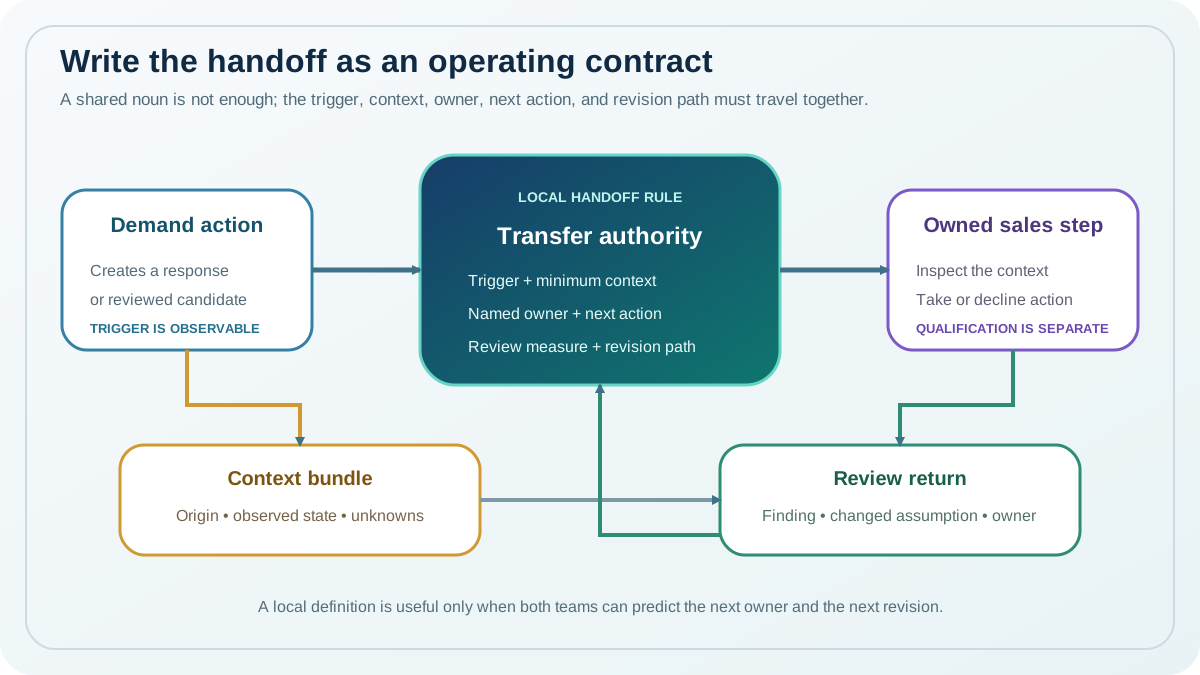
A workable local definition might say, "In this plan, lead generation names the approved actions used to create or capture interest in our target market; prospecting names the reviewed work used to select and approach specific candidate companies." That sentence is an example for negotiation, not a universal taxonomy. Sales should challenge it: Does captured interest contain enough context for the next step? Marketing should challenge it too: Does candidate selection feed useful information back into targeting? Revise the sentence until it includes a trigger, an owner, required context, the next action, a review measure, and a revision path. Keep qualification separate. The handoff may authorize a review or a sales action without declaring that the record meets the team's qualification rule. Write who makes that decision and what locally agreed context they inspect. When both teams can point to the same sentence and predict the next owner, the boundary is doing useful work. When they cannot, more volume will only multiply the ambiguity. Cover the owner clause and ask each team who acts next; then cover the context clause and ask what evidence travels. Any mismatch shows which part of the sentence is still ceremonial.
Where Does the Reviewed OKKI Go Workflow Fit?
The tool-first argument sounds efficient: "If one system can search, find contacts, draft outreach, and show email status, let the workflow define the handoff." The process-first reply is stronger: a tool can occupy steps in the plan, but it cannot decide what those steps mean for your team. The first-party pages for OKKI Go describe product context and target markets informing a search, users reviewing and revising candidate companies, selected contact access, drafting, confirmation of recipients, subject, and body before sending, and visible email status. Place that documented sequence inside the local operating plan. Name the target-market input, the person reviewing candidates, the point at which contact access is appropriate, the owner confirming the draft, and the plan review that receives the resulting status. The workflow is useful because its described review points can be assigned to local owners. Its scope does not establish autonomous qualification or any promised commercial outcome. The local plan remains the authority for meaning and action. Pause at each review point and ask the assigned person, "What decision are you making here, and what can this status not tell you?" If the answer includes qualification or outcome without local evidence, pull that meaning back into the plan.
Review Candidate Companies Before Contact Access
Prospecting may say, "A candidate list is the output we need." Marketing should ask, "Which target-market assumptions produced it, and what did review change?" The documented first-party workflow supports the second question: user context informs an initial search, candidate results can be reviewed and revised, and companies are selected before contact access. That sequence gives the team places to apply its local definition. It does not turn a candidate into verified buying intent or a qualified opportunity. Your plan should therefore record the context used for the search, who accepts or rejects a candidate, what revision is allowed, and which state permits the next step. If the reviewer changes the candidate pool, return that learning to the target-market and action assumptions rather than treating the change as invisible tool operation. This is where prospecting can improve lead-generation strategy without taking ownership of it: reviewed candidate outcomes become an input to the next planning discussion, not proof that the market or message is correct. Give marketing one rejected candidate and ask, "Which targeting assumption did this result challenge?" Give prospecting the proposed revision and ask whether it changes selection or merely relabels the miss.
Confirm Recipients, Subject, and Body Before Sending
The automation case says, "Drafting is preparation, so the system can carry the work nearly to the end." The accountability case answers, "The last review matters precisely because preparation can shape a consequential action." The documented workflow describes drafts and subject variants while keeping confirmation of the recipients, subject, and body before sending under team control. Use that confirmation point as a real handoff in the plan. Name the person who reviews the recipient context, checks that the subject and body match the intended action, and decides whether sending proceeds. Then decide which visible email status returns to the review loop. Do not infer from that status a guarantee of accuracy, deliverability, response, pipeline, or revenue. Do not infer consent or compliance either. The product description establishes workflow scope, not those outcomes or obligations. By preserving this line, the team can use a tool for reviewed outreach preparation while keeping qualification, sending authority, and result interpretation with named people. Ask the confirmer, "What would make you stop this send?" Ask the plan owner, "What may you learn from the later status, and what remains unknown?" Their answers define two different responsibilities.
Which Measures Belong in the Plan Review?
Marketing may ask to be judged by the reach or response created by its actions. Sales may ask to be judged by the quality of conversations or progress through its steps. Neither side should solve that tension by inventing one universal shared-volume benchmark. The SBA guidance supports comparing marketing and sales costs with generated revenue, measuring consistently, and using the results to identify which parts of the plan should be updated. That is a review discipline, not a prescribed dashboard. Choose measures that correspond to the local actions and handoffs you wrote earlier. Keep stage-specific measures where they explain a team's work, and bring costs and generated revenue into the shared plan review. Then ask whether the handoff itself is producing usable context: Are records arriving with the agreed information? Is the named owner taking the planned action? Are reviewer decisions revealing a targeting or process assumption that should change? Consistent measurement earns its value when it changes the plan, not when it merely declares one team busier. Let each team nominate one measure it controls and one finding that should reopen the shared plan. Can both explain how the review would change an action, owner, or target? If not, the measure is observation without governance.
Compare Marketing and Sales Costs With Revenue
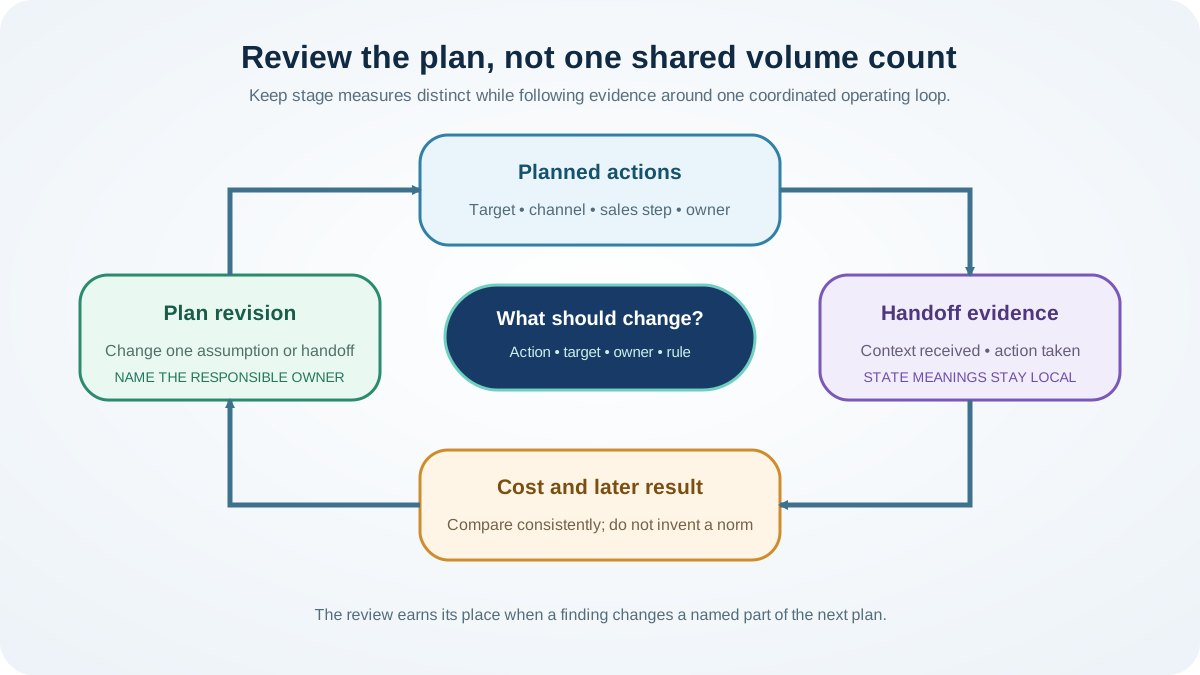
The volume argument is tempting: "Give both teams one number, and alignment will follow." But a shared count can blur exactly the roles the plan was meant to clarify. A marketing action, a reviewed candidate, an authorized handoff, and a later revenue result do not become interchangeable simply because a dashboard can count them. The evidence here supports a narrower shared review: compare marketing and sales costs with generated revenue consistently, then examine which plan inputs need attention. Keep the local stage measures that help each owner inspect their own work, but do not present an unsupported threshold as an authoritative qualification rule. Instead, trace the plan. Which target-market action incurred the cost? Which sales step received the record? Which owner accepted it? Which later result can be compared without changing what the earlier state meant? You are not searching for a magical ratio. You are building enough continuity to see whether the coordinated plan deserves more investment, a changed action, a revised handoff, or a different target-market assumption. Ask finance to point from a cost to the planned action, then ask sales to point from the accepted record to the later result. A broken pointer is more informative than forcing both teams into one count.
Update the Plan From Consistent Measurement
Sales says, "The handoff criteria are wrong; the context does not support our next step." Marketing answers, "Then show us which assumption failed so we can change the action or target." That is the feedback loop the local plan needs. Measure on a consistent basis, compare costs with generated revenue at the plan level, and use review findings to update the target market, sales steps, actions, ownership, or handoff sentence. Do not revise the label alone. If records arrive without required context, change the context rule or the action that produces it. If reviewed candidate outcomes repeatedly challenge the target assumption, return that observation to planning. If the owner cannot act at the named trigger, rewrite the trigger or ownership. The final test is plain: can both teams write one handoff sentence containing the trigger, owner, context, review measure, and revision path? If not, the system is not coordinated yet. Write that sentence before asking either motion to generate more activity. Exchange the sentence without its author names. Can you predict what sales will do, and can you predict what marketing will revise after a return? Two accurate predictions show that the feedback contract is finally shared.
Bring marketing and sales to the same page and write one sentence both can accept: the local trigger, the context that must travel, the next owner, the action that follows, the measure reviewed, and the condition that reopens the definition. A reviewed tool such as OKKI Go can then sit inside that contract at its documented search, contact, drafting, confirmation, and status steps without being asked to define qualification or promise an outcome. If the sentence cannot predict the next owner, revise it before either team adds volume.
Frequently asked questions
What is the difference between lead generation and prospecting?
There is no universal lead-versus-prospect taxonomy established by the authoritative evidence in this pack. Define both terms locally inside one marketing-and-sales plan, then state the trigger, owner, context, next action, review measure, and revision path that connect them.
How can a team coordinate inbound and outbound work?
Document the target market, action channel, context created, intended sales step, owner, cost category, and review signal for each route. The routes do not need identical starting states, but they do need an explicit path into the same coordinated plan.
Should a handoff also mean that a record is qualified?
Not automatically. A local handoff may authorize review or a next sales action without declaring qualification. Name the person who applies the team's qualification rule and the context that person must inspect; no universal qualification threshold is established here.
Where can a prospecting tool fit in the handoff?
Place the tool inside the local plan at a named job and review point. The first-party OKKI Go pages describe candidate-company search, review and revision, selected contact access, drafting, confirmation before send, and visible email status. That scope does not prove intent, qualification, consent, compliance, accuracy, deliverability, response, pipeline, or revenue.
Which metrics should marketing and sales review together?
Use measures that correspond to the team's documented actions and handoffs, and compare marketing and sales costs with generated revenue consistently at plan review. Keep stage-specific measures where they clarify ownership; do not invent a universal shared-volume benchmark.
When should the local handoff definition change?
Revise it when consistent review shows that required context is missing, the named owner cannot take the planned action, candidate review challenges the target-market assumption, or the measurement no longer helps the team update the plan.
Explore OKKI Go
- Explore OKKI GoReview the official overview of documented company search, contact discovery, outreach drafting, team-controlled sending, and email-status visibility.Official OKKI Go resource ↗
- Review the official use casesSee the first-party workflow description for candidate-company search, review and revision, selected contact access, drafting, confirmation, and sending.Official OKKI Go resource ↗