
A filled record can still send the wrong owner if the deciding field cannot be sourced.

A Complete Record Can Still Misroute
A lead object can present a title, an email address, a company-size band, and a close date as already filled, and still assign the wrong owner. Completeness of the row is not evidence that the deciding field is true.
Lead generation data, in the sense used here, is the inspectable residue of a targeting or qualification decision. Identifiers and firm attributes belong in that residue only when their source and freshness can be named.
The commercial claim follows from that definition. Lead-generation data has commercial value only when its provenance changes a targeting or qualification decision, because more fields can increase confidence without increasing truth.
A purchased file, a scraped export, or an enrichment append is not, by itself, lead generation data in this account. Those materials become decision data only when a field drawn from them will change who is selected or how a record is qualified.
Accuracy is not a decorative label added after an export looks full. ICO guidance identifies accuracy as a data-protection principle and explains that inaccurate personal data should be rectified or erased without delay where that is appropriate.
A stale job title used as if it were current is therefore not a small omission in an otherwise complete record. It is personal data being acted on after the fact that would have justified the action has expired.
- Identifiers that can be checked against a named source
- Company attributes used to include or exclude an account
- Role and contact fields used to select a person
- Workflow state that records assignment, status, and later conversion
- Source and refresh notes on any field that will drive outreach or routing
The boundary of that reading is narrow. UK data-protection guidance is not global legal advice, and it does not certify a vendor or a CRM instance. It names a duty: inaccurate personal data should not continue to be used as if it were current.
What the definition has to hold
First-party notes, campaign traces, public research, and purchased files may occupy the same lead object. The type that belongs in the definition is the type that can still be inspected after the decision has been taken.
Field provenance documentation from a data provider is therefore part of the definition, not an optional appendix. If a field cannot be shown to have a source, it cannot qualify an account or a person. It can remain as unused color.
Salesforce records lead status, assignment, conversion, and history as separately recorded elements. That separation is the shape required by the definition: a contact is a trail of state changes, not a frozen blob of attributes.
Accuracy limits later use
The accuracy principle does not require every unused column to be perfect. It constrains the fields that continue to be used. A definition that ignores that constraint treats lead generation data as inventory rather than as a decision record.
Platform documentation proves only that separate workflow concepts exist. It does not prove that any particular implementation is accurate or complete. The definition still requires those concepts to be available for review.
Qualification Is a Traceable State Change
The same claim returns as a mechanism. Qualification does not improve because more columns are populated. It improves when the state recorded for a lead can later be reconstructed.
A record enters. An owner is assigned. A status is set. Conversion either occurs or does not. History should keep those moves distinct. Targeting reads firm and role fields. Qualification reads the state those fields produce.
If either step consumes an untraceable attribute, the next step inherits a guess. The inherited guess then presents itself as a qualified flag. That is how a complete record still misroutes.
Salesforce lead documentation is useful because it refuses to collapse those elements. Status is not assignment. Assignment is not conversion. Conversion is not history. Without that separation, a single qualified mark can conceal a stale title, a recycled owner, and a conversion that never occurred.
The help text establishes available record concepts, not the accuracy of any instance. Field-governance policy is therefore the operational reading: explicit workflow state and traceable changes must remain available if qualification is to be reviewed.
Before an enrichment field is allowed to move a record, the decision that field will change should be named. A field that cannot change targeting or qualification has no role in the mechanism, however complete it makes the row appear.
The state path that can be checked
The path worth checking is short. Can the record show who searched, what was reviewed, what was unlocked, and which contact was then discovered? If those events remain distinct, qualification has a mechanism.
OKKI Go documents a review-before-contact order. That is a governance pattern, not a coverage claim and not a quality score.
- A named owner or assignment event
- A status that records a decision rather than a mood
- A conversion or hold that can be dated
- History that prevents those events from overwriting one another
- A source note on every field that moved the decision
Review before contact work
A tool that jumps from a keyword to a phone number skips the mechanism. The skip may still produce a filled record. It does not produce a reviewable qualification.
The documented company-then-contact order does not establish geographic coverage, compliance, or a quantitative quality score. It only shows that a review step can be placed in the record before contact discovery proceeds.
Provenance Decides Only at the Decision
The provenance rule holds when a field is about to change money, time, or exposure. Account selection for the current cycle is such a moment. Source and freshness are then the difference between a reviewable decision and a confident guess.
The rule breaks when no targeting or qualification decision is at stake. A research file that will not be routed may remain incomplete. An internal market map may carry weak attributes if no person will be emailed from those attributes.
An exception must also be allowed. If unprovenanced data consistently improved qualification without downstream errors, provenance would be less decisive than claimed. That exception cannot be the default, because consistency itself cannot be shown without inspectable state.
A threshold is required. The UK Government data quality framework treats data quality as a managed practice of defining dimensions, measuring them, improving data, and assigning ownership. If the dimension being measured cannot be named, quality has not begun.
If nobody owns a field, that field should not route a lead. Public-sector guidance does not validate a commercial database. It still supplies the ownership test that a commercial team can apply to one live field.
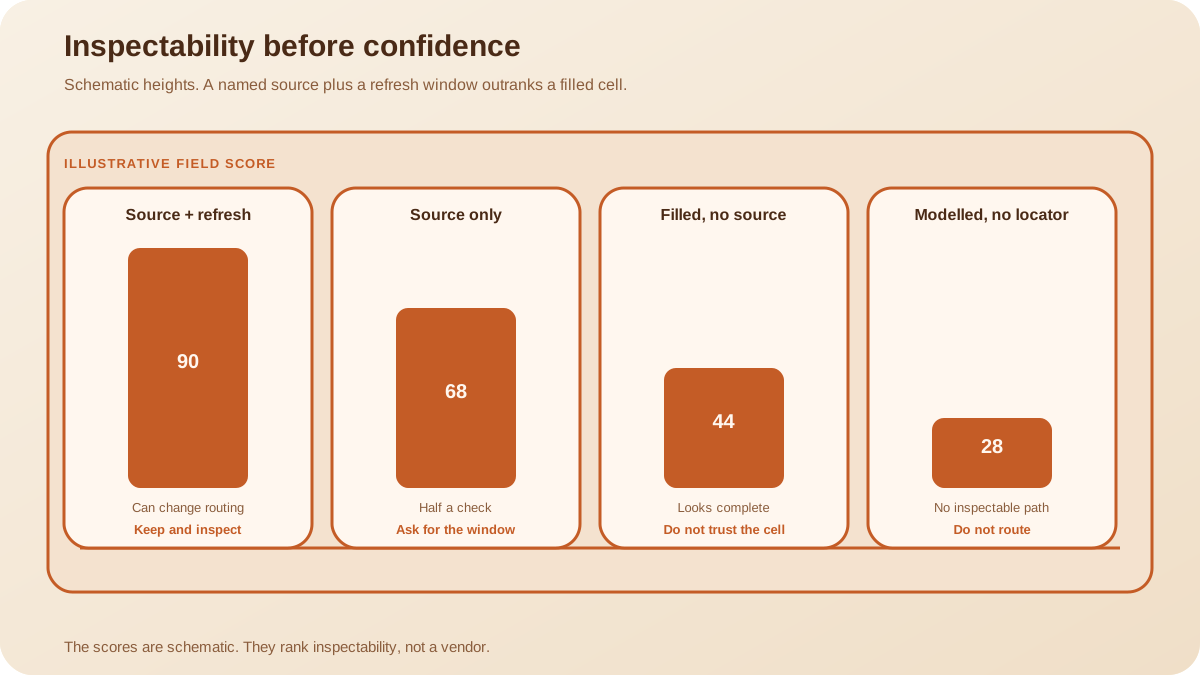
The bars are not a measured dataset. They state the article's ranking of inspectability: a named source plus a refresh window outranks a filled cell with no locator. That ranking is the threshold, not a vendor scorecard.
The recurring FAQ questions appear at this edge. What is the single factor? When does the data matter? Those answers are collected in the FAQ. The body needs only the stop line: if no targeting or qualification decision will use the field, provenance can wait.
Uses that can wait
- Research lists with no outreach in the current cycle
- Aggregate market notes that never become a person record
- Internal brainstorm files that will be rebuilt from first-party evidence
- Any metric that cannot be attached to a named field owner
Those uses can remain thin. Person records that will be routed or contacted cannot. The FAQ restates that split because it is the question most often asked at the boundary, and the body should not spend further space restating the same answers.
Research files can stay thin
The rule should not be carried into vendor scorecards, market-size theatre, or generic strategy decks. Those uses can function as rhetoric without field provenance. They also do not qualify a person.
For B2B contact information, a further refusal is required. Pipeline health should not hide the duty inside one composite number. Salesforce Pipeline Inspection keeps Push Count, Days in Stage, Recent Activity, and Contacts as separate fields.
A close date locked at review and later moved is a fact about the record. It is not a story about the buyer. Other CRMs may define those fields differently, so the meanings should be verified for the unit in use.
More Fields Are Not a Quality Method
The usual mistake treats a larger tool stack as automatically better lead generation data. More enrichment, more intent labels, and more modelled attributes are taken as quality. Completeness is thereby confused with truth.
That confusion is expensive because tools can now add plausible fields at scale. A title, a headcount band, a likely phone, and a buying-stage label can each look decided. None of them is decided unless source and refresh can be named.
Confidence rises. Truth may not. That is the present cost of untraceable confidence. A ranking of databases would answer a different keyword. This keyword is lead generation data, and the question is what a field can prove.
A tool is useful when it makes a review step cheaper or more explicit. It is not useful when it hides the review behind a filled export. Modern search does not, by itself, make a field current.
OKKI Go is cited only for a documented order: inspect companies before contact work. That sequence does not make a field current or complete.
Sequence over catalog
- Search interfaces that can be reviewed before unlock
- Enrichment pipes that must declare field source
- CRM writers that must keep status history
- Not proof that a person should be contacted
Those checks evaluate a tool as a place where review can occur. They do not produce a league table. A catalog of vendors would drift the keyword into a neighboring commercial claim that the recorded search intent does not require.
The tool reading that should be refused
Two readings should be refused. The first says that if the platform is modern, the data is current. The second says that if the export is full, the list is ready. Full is a spreadsheet property. Ready is a decision property.
A tool can be excellent at search and still leave a field that cannot be defended. Excellence at retrieval is not a substitute for field provenance documentation.
Attach Source and Refresh to One Live Field
Consider a weekly export used for routing. Title, email, company size, and a related opportunity close date are already filled. The team intends to route and email in the same week and cannot re-verify every row. That operating constraint is accepted for the case.
The common approach says that more complete contact and company data automatically improves lead generation. The case tests that approach against one live field rather than against a customer name or an invented win rate.
Scenario assumption: a filled title, email, and company-size field means the record is ready to route. Scenario assumption: the close date is locked at the start of the review week and treated as the snapshot. Scenario assumption: source notes will not be re-checked before outreach.
Those values are labeled working assumptions. They are not measurements from a vendor report. They can be dropped if a later review shows them to be false.
The inspection then changes. The four filled fields are no longer scored as one completeness number. Push Count, Days in Stage, Recent Activity, and Contacts are read as separate facts, as Pipeline Inspection defines them.
A review-snapshot slippage rate is then derived from how many locked close dates moved before the week closed. That rate is kept as its own observation. It is not folded back into a single health score.
What becomes observable is blunt. Rows that look complete still fail a routing review when the locked close date slipped, when recent activity is empty, or when no contact is attached. Completeness did not predict reviewability. The separate fields did.
A slipped date still does not establish a buyer-side cause. Field movement is not motive. Other CRMs can define those fields differently, so the meanings should be verified for the unit in use.
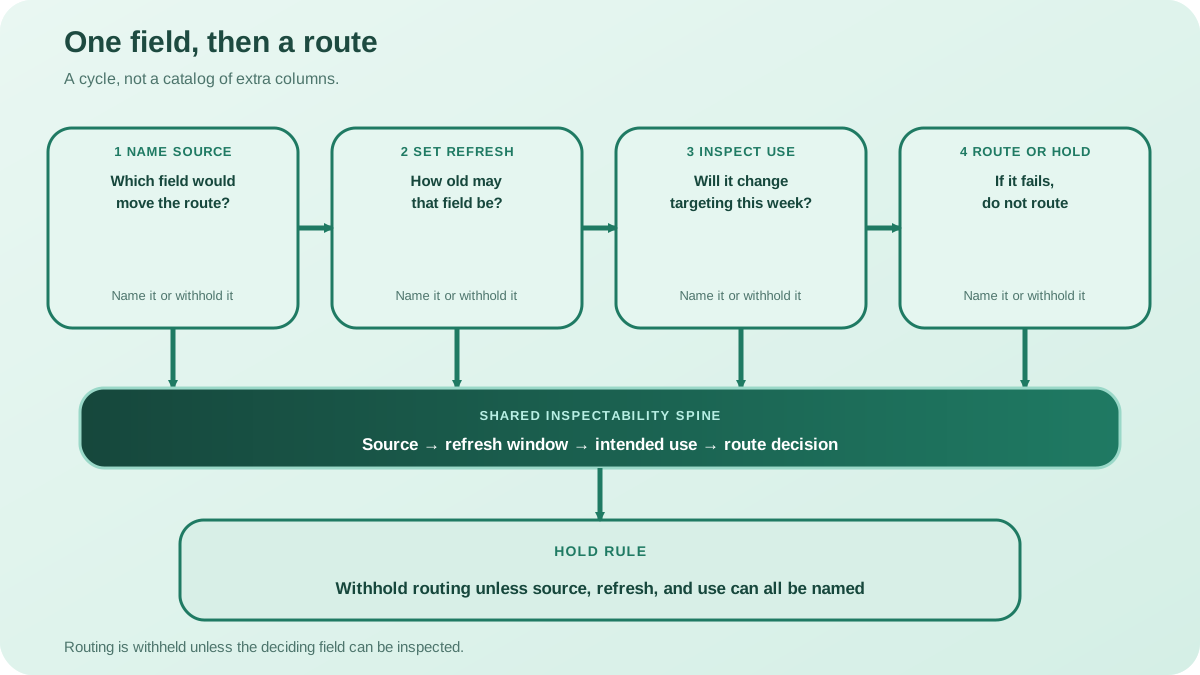
The decision that follows is the attachment rule. Source and refresh expectations are attached to every field used for outreach or routing. If they cannot be attached, that field does not route. Strategy, in this article, is that attachment, not a channel mix.
The case stops applying when the list will not be routed or contacted. It also stops if a customer name or a win rate is invented to make the example feel finished. Neither invention is used here.
The same checkpoint can be run in a CRM or a sheet. The platform is optional. Attaching source and refresh to one live field is not.
The checkpoint before the next route
The next checkpoint is short. Before an export is approved, the fields that will change targeting or qualification in the current week should be named. Those fields need a named source and a refresh expectation. The unused columns can wait.
- Which fields will change targeting
- Which fields will change qualification
- What source is accepted for each
- What refresh window is accepted
- What happens if the field cannot meet that window
One field is enough to start
The strategy does not require a full data-quality programme on the first week. It requires one live field, typically the title used to choose a person or the account match used to choose a route, to carry a named source and a refresh window.
If that one field cannot meet the window, it is withheld from routing. Additional columns may remain in the export. They do not spend trust they have not earned.
The test remains small. If a field will change targeting or qualification, it needs a named source and a refresh expectation. If it will not, it should not inflate the record. Additional columns can wait. They do not get to spend trust they have not earned.
Frequently asked questions
What is the single most important factor in lead generation data?
Provenance that can change a targeting or qualification decision. Source, freshness, and inspectable use decide whether a field is commercially usable. Extra attributes that cannot change those decisions only raise confidence.
What do most buyers get wrong about lead generation data?
They treat more complete contact and company fields as automatically better. Completeness can hide stale or untraceable attributes. Quality is decision-relative: a field matters when its source, freshness, and use can be inspected.
How should you actually decide on lead generation data?
A team should attach source and refresh expectations to every field used for outreach or routing. If those expectations cannot be attached, the field should not route or contact. Workflow state such as status and assignment should remain reviewable rather than collapsed into one score.
When does lead generation data matter most?
It matters most when a targeting or qualification decision is about to be made. Research files with no outreach in the current cycle can wait. Person records that will be routed or contacted cannot.