A useful lead-generation funnel is not a stack of stage names. It is a chain of observable transitions, each with entry evidence, an exit rule, an owner, and a return signal.

What Makes a Lead-Generation Funnel Observable?
The most misleading funnel is the one with a crowded top and no defensible answer to a simple question: what changed when a person moved from one stage to the next? A stage name records where the team placed a record. A transition should record the evidence that justified movement. Without that difference, attention can look like progress while qualified follow-up remains unexplained.
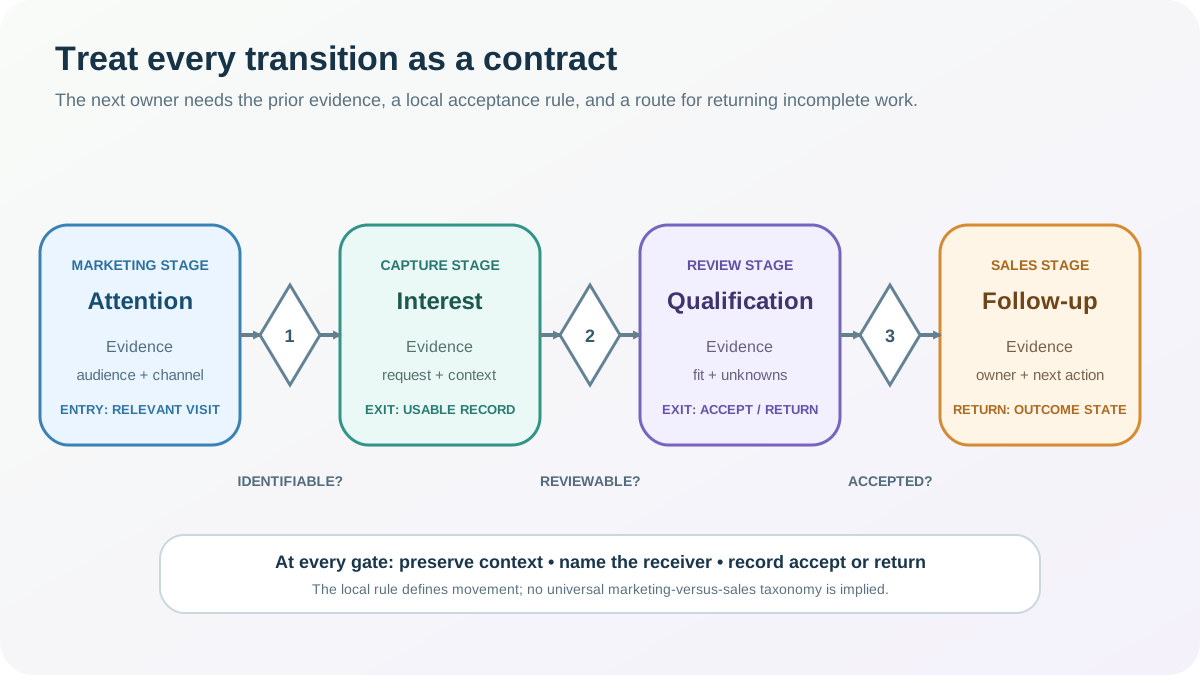
Where should the definition start? Before channels. The U.S. Small Business Administration's market-research guidance asks planners to examine demand, audience characteristics, market reach, saturation, pricing, and competitive conditions. That guidance does not promise leads from a market or channel; it helps you decide what evidence belongs at the funnel entrance. I sketch four transitions: market hypothesis to attention, attention to identifiable interest, captured context to qualification review, and review to an owned handoff. Beside each arrow, I write what must be observable before movement is allowed. A page visit may demonstrate attention, while a submitted request may make a person identifiable. Neither observation establishes qualification without the receiving team's local rule.
Now challenge the first arrow with me. Which market fact makes this audience worth approaching, and which missing fact would stop the action? If your answer is merely the channel name, the funnel starts too late. Challenge the second arrow differently: what did the person actually do, and what context survived capture? Finally, ask the qualification owner what evidence would be sufficient, insufficient, or contradictory. Those answers become entry and exit conditions, not decorative labels. When the team cannot answer one question, mark that boundary undefined; do not call it a conversion problem yet. The immediate output is a transition ledger that says what is known, who can judge it, and which weak record must be returned rather than advanced.
- Entry evidence: what the team knows before a record enters
- Exit rule: what observable change permits movement
- Owner: who accepts or rejects that movement
- Return signal: what the next stage sends back for review
Set the Entry and Exit Conditions
An entry condition should say what is known, not what the team hopes. For the first stage, that means grounding the audience choice in market evidence about demand, characteristics, reach, and competition. For later stages, it means carrying forward the observable result of the prior transition. A record should not arrive under a label that hides why it was admitted. What would you reject?
Separate Marketing Stages From the Sales Pipeline
A lead-generation marketing funnel follows movement from a defined market toward identifiable interest and a qualification handoff; the sales pipeline uses the operating states that follow the team's accepted handoff. Keeping that seam visible protects diagnosis. If the two are merged into one long ladder, a later sales delay can be misread as an attraction leak, while missing capture context can be hidden inside a pipeline status. Write one boundary sentence instead of searching for a universal diagram: marketing presents specified evidence, the receiving owner applies the local rule, and the record advances, returns for clarification, or stays unqualified. Then let sales interrogate the sentence. Would you accept a record that contains the observed action but omits the market context? If the answer is no, name the missing context as part of the handoff. Let marketing challenge it in return: when sales rejects a record, which reason comes back soon enough to change targeting or capture? If no reason returns, separation has become a wall rather than a seam. The useful distinction is therefore operational, not terminological. It tells each side what must travel, who decides, and how a disputed record moves backward. Test the boundary on one real path and ask both owners to predict the next state. Different predictions expose a handoff rule that needs repair before either side changes its stage names.
How Should the Funnel Stages Connect?
Once the stage conditions are visible, how do they become one operating funnel rather than separate reporting boxes? Connect each action to the target market, the intended sales step, a goal, a cost decision, a measure, and a review. The SBA's marketing-and-sales guidance groups those planning elements together. It does not prescribe a universal sequence or threshold; it supports the discipline of keeping action and review in the same plan.
This changes the tools question from feature volume to transition fit. Start with the result the next owner needs to inspect, then read the path backward: what evidence supports the qualification review, which capture action preserves that evidence, and which planned channel can reach the defined audience? Backward reading reveals arrows that exist only on the diagram. If the market assumption disappears at capture, the reviewer receives a name without the reason it entered the funnel. If the action is retained but its intended sales step is not, the next owner still has to guess. I ask the team to put the exact input and output for one transition on the table. Can the owner decide without reopening three systems or asking who created the record? If not, the connection is incomplete. The official OKKI Go site may be one reference in that tool review, but this article makes no product-capability claim from the link; judge it and every other candidate against the same local input, output, owner, and return-rule brief. Then define what happens when context is partial. Does the record wait, return to capture, or proceed to a limited review? A connected funnel needs that reverse route as much as the forward arrow. The tool earns a place only after the team can state which boundary it serves and how the plan receives the reviewed result.
- Tie each channel action to the target market it is meant to reach
- Tie each capture action to the next sales step it is meant to support
- Tie each goal to a measure the owner can review consistently
- Tie each cost decision to the update the team will make after review
Turn Attention Into Identifiable Interest
Attention is useful only when the team knows what it is meant to become. State the market, the action offered, the identifiable response expected, the cost allowed, and the measure that will trigger review. This keeps a channel from becoming a stage by itself. A channel carries an action; it does not supply the exit rule for the business.
Move Captured Leads Into Qualification
Qualification is not a warmer name for capture. It begins when a named owner applies the team's local acceptance rule to the context that survived the prior transition. Write the required evidence into the sales plan and give missing evidence its own route. Advancing, returning, and holding are different decisions; compressing them into one status makes the review loop unreadable. Ask the qualification owner a practical question: if this record arrived now, could you explain both the decision and the evidence behind it? A yes should produce the next owned sales step. A no should identify exactly what must return to the capture or channel owner. The reverse message matters because it tells the people managing the target market, action, goal, and cost which assumption deserves attention. Without it, the funnel counts movement but cannot teach the plan. Do not ask for a generic rejection reason. Ask whether the market context was wrong, the observed action was ambiguous, the required field was absent, or the local rule itself caused disagreement. Each answer points to a different repair. The connection is complete only when the receiving owner can act without guessing and the originating owner can understand a return without relitigating the whole record. Write those two promises beside the qualification boundary before you add another capture source.
Who Owns Each Funnel Handoff?
A handoff fails quietly when responsibility is assigned to a department rather than to an action. Marketing says the lead was delivered; sales says the lead was not usable; neither statement identifies who checked the context, when the check occurred, or what result returned to the plan. Before blaming either team, trace the record through the transition and name the decision at each side.
The SBA planning guidance connects marketing actions, costs, measurement, updates, and sales, which supports responsible ownership and consistent cost-to-revenue review without supplying a universal ratio. Turn that broad discipline into three named decisions. One person prepares the record and its context, another accepts or returns it under the local rule, and a third updates the plan from the accumulated outcomes; a small team may assign several decisions to one person, but it should not leave any decision anonymous. Now stage a handoff conversation. The sender asks, 'What must I include so you can judge this record?' The receiver answers with evidence, not a department name. The receiver then asks, 'Where do I return an incomplete record, and who corrects it?' The sender names the reverse route. That exchange separates a handoff from a dump more effectively than a shared dashboard. Choose a review rhythm those people can apply consistently rather than importing a cadence or ratio from outside the evidence. When missing context repeats, revise the transition definition. When complete context still produces disagreement, clarify the qualification rule. When both work but outcomes challenge the plan, send that finding to the owner of targeting, actions, costs, or goals. Trace one record forward to acceptance and backward to correction; every pause should reveal who has authority to accept, return, revise, or stop it.
- Preparing owner: preserves the evidence behind the record
- Receiving owner: applies the local acceptance rule
- Return owner: records why the result advanced, paused, or went back
- Plan owner: updates the market, action, goal, or cost assumption under review
Route Leads With Context and Timing
Routing should carry the reason for the handoff, not merely the record. The receiving owner needs the market context, the observed action, the intended sales step, and the evidence that satisfied the exit rule. Timing should be written as part of the local operating agreement: when the review begins, when a missing item is returned, and when an unresolved record stops advancing.
Return Sales Outcomes to Marketing
A return signal should be specific enough to change a planning choice. 'Accepted,' 'missing context,' 'outside the local rule,' and 'unresolved' preserve more meaning than a broad closed status. Give each signal a destination. Missing context goes to the person who controls capture; an outside-rule result goes to whoever owns the target-market assumption; unresolved ownership goes to the person responsible for the handoff design. Then ask marketing, 'Which of these findings would make you alter the channel action, goal, or cost allocation?' If the answer is none, the return categories are not connected to planning. Consistent cost-to-revenue review also belongs in the plan, but its role is bounded. It can compare marketing and sales costs with generated revenue over the team's chosen review period; it cannot supply the correct percentage or prove a transition caused the outcome. Cause requires reopening the record and locating the first place where evidence, authority, or decision meaning vanished. Have the sales owner choose one returned record and explain it to the marketing owner without using the stage label. Can the listener identify what must change? If not, rewrite the signal until it carries the observation, decision, owner, and requested correction. That is feedback the funnel can use rather than a verdict it can only count.
Where Is the First Funnel Leak?
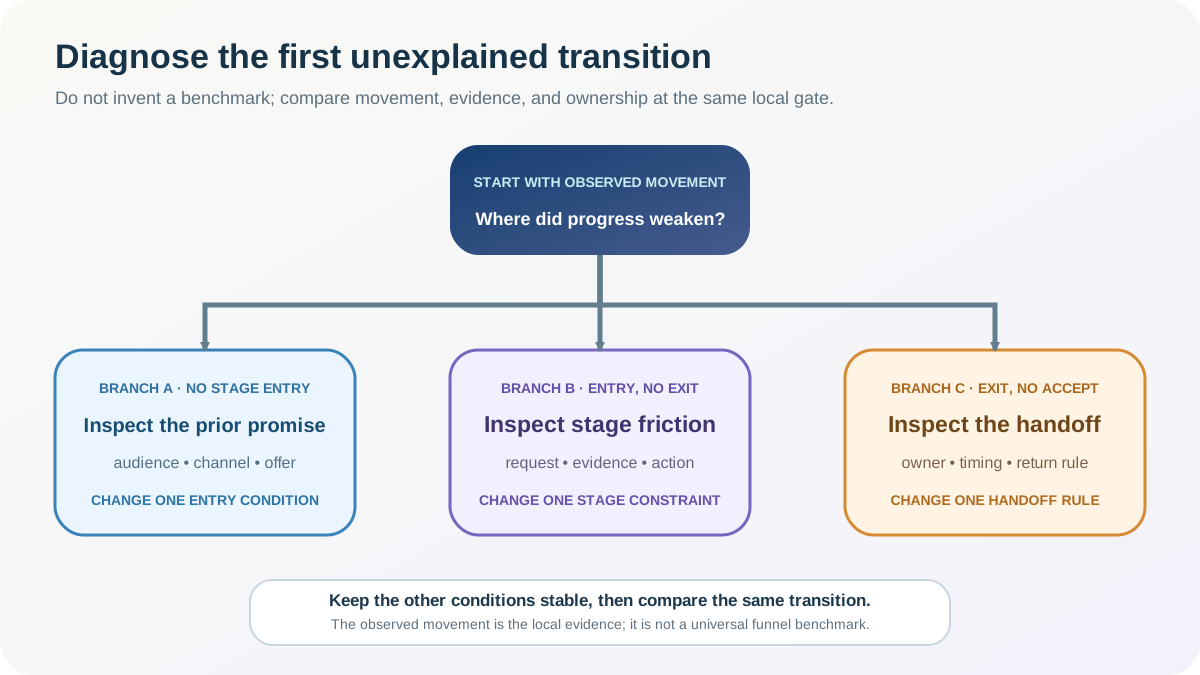
A funnel leak is not simply the stage with the smallest count. It is the earliest transition where the team cannot explain movement with its own evidence and operating rule. That definition avoids an invented benchmark. It asks whether the local chain works as designed before asking whether its volume resembles somebody else's funnel.
Why insist on local rules? The SBA notes that marketing and sales are connected even though their exact distinction is not universally agreed. A shared vocabulary may help discussion, but it cannot replace the handoff the organization actually operates. I diagnose that path from the entrance and stop at the first explanation that fails. Did market evidence shape the audience? Did the planned action create the identifiable response expected? Did capture preserve the context required for review? Did a named owner apply the stated qualification rule? Did the outcome return to the plan? The first no identifies the next repair site because later weakness may be its downstream consequence. Treat every measure as a question rather than a verdict. A small count does not say whether the wrong context entered, the exit rule was vague, the review never happened, or the return signal disappeared. Compare one observed record with the rule written for that exact boundary. I ask the owner, 'What should have been visible here?' Then I ask the next owner, 'What did you actually receive?' The difference is the leak description. Do not replace it with a borrowed conversion target. Preserve timing and ownership in the diagnosis as well: a correct record that waits without authority is a different failure from an incorrect record that moved quickly. Once the earliest mismatch is named, leave later stages alone until the team has tested the boundary that first broke the chain.
- Name the earliest transition whose movement cannot be explained
- Check the evidence available before and after that transition
- Confirm the owner and the local acceptance or return rule
- Change one constraint and observe what happens downstream
Measure Movement Between Stages
Measure the movement your own rules create. For each transition, record how many items entered under the stated condition, how many received an explicit decision, what decision occurred, and what context returned for review. Those observations make the transition inspectable. They do not, by themselves, establish a universal conversion target or explain every commercial outcome.
Change One Constraint Before Adding Tactics
Make the repair narrower than the diagnosis. Weak entry evidence calls for a sharper market question; lost capture context calls for changing what travels with the record; disputed qualification calls for rewriting the local acceptance rule; missing authority calls for assigning both the decision and its reverse route. Choose one constraint at the earliest failed transition so the next review can attribute what changed. Before adding traffic, content, automation, or software, write a four-part experiment: the boundary being repaired, the evidence check that failed, the owner making the change, and the downstream observation that will be reviewed. Would another tactic make that test easier to interpret, or merely send more records into the same ambiguity? If it is the latter, wait. When a system purchase is being considered, the official OKKI Go resource can sit beside the experiment brief as a vendor reference, but this mention asserts no capability; the team must compare any option with the same locally written constraint. After the change, follow a small set of records only far enough to see whether the repaired boundary now produces the intended evidence and decision. Do not alter a later stage at the same time. If qualification improves, you have a reason to continue the test. If it does not, reopen the earliest transition and ask whether the diagnosis, rule, or ownership was wrong. Controlled repair turns the funnel from a report into an operating experiment.
Write the funnel as transitions, not stage names. Circle the first transition that cannot show its entry evidence, exit rule, owner, and return signal. Change one constraint there and review what happens to qualification downstream before expanding tactics or budget.
Frequently asked questions
What is a lead generation marketing funnel?
It is the operating path through which a defined target market can become identifiable interest, reach a local qualification decision, and enter a responsible follow-up handoff. Each stage should have entry evidence, an exit rule, an owner, and a return signal.
Which stages belong in a lead-generation funnel?
Use stages that make your actual transitions inspectable: target-market fit, attention, identifiable interest, qualification, and handoff are useful operating questions. The names are less important than the evidence and decision required to move between them.
Is a lead-generation marketing funnel the same as a sales pipeline?
No. The lead-generation funnel explains movement from a defined market toward identifiable and qualified interest. The sales pipeline uses the operating states that follow the agreed handoff. They are connected, but merging them can hide where a leak began.
How should tools fit into the funnel?
Place a tool against one named transition. Specify the context it receives, the observable result it produces, the owner who reviews that result, and the signal returned to the plan. Do not let a product category define qualification or strategy.
Which funnel metrics should a team track?
Track movement under your own entry and exit rules, explicit decisions at each handoff, returned outcomes, and consistent cost-to-revenue review. These measures support local diagnosis; the cited guidance does not provide a universal conversion benchmark.
How do you diagnose the first funnel leak?
Start at the funnel entrance and stop at the earliest transition where movement cannot be explained by available evidence, an agreed rule, a named owner, and a return signal. Change one constraint there, then observe downstream qualification before adding volume.
Explore OKKI Go
- Explore OKKI GoReview the official product overview before mapping the workflow to a locally defined funnel transition.Official OKKI Go resource ↗
- Review OKKI Go use casesInspect the official use-case resources and compare them with the handoff, ownership, and review rules in your funnel.Official OKKI Go resource ↗