A useful stack is not the one with the longest feature list. It is the smallest chain of technologies whose jobs, handoffs, owners, exceptions, and review signals are explicit.

Define Planning Inputs Before Technology
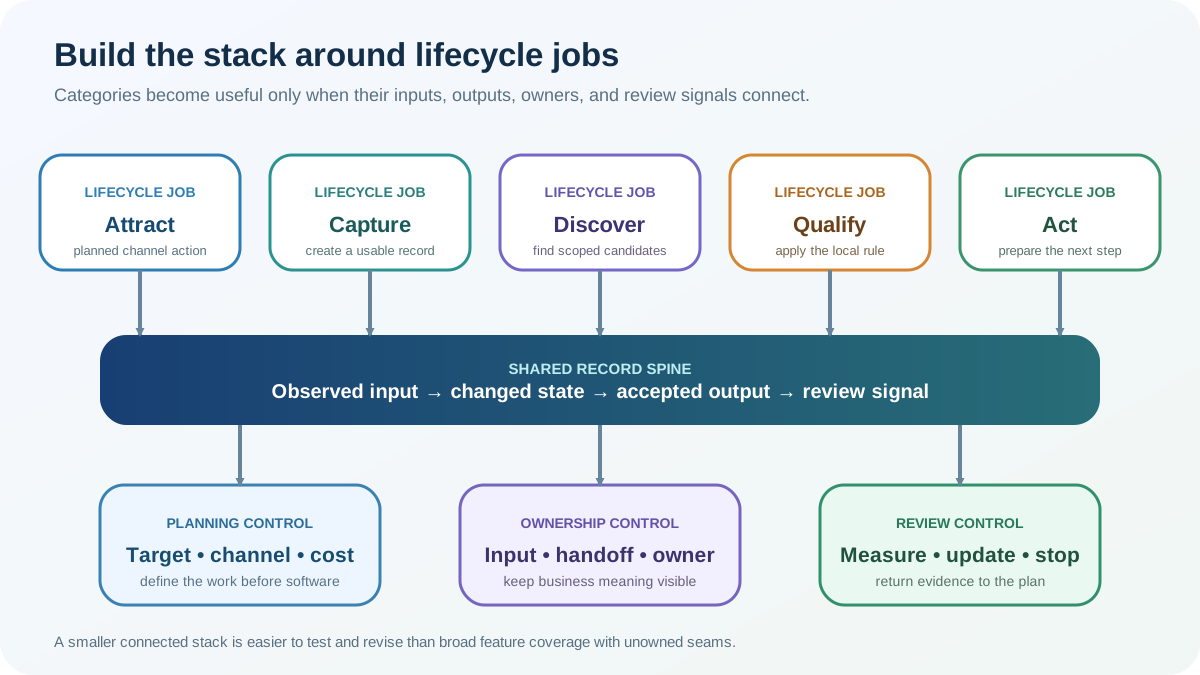
The stack diagram often looks complete until one asks who owns the line between two boxes. A capture system passes a record onward, an enrichment service appends fields, a qualification rule changes a status, and an outreach system prepares an action; yet the diagram may never say which market definition admitted the record, which sales step the status represents, or which result would justify keeping the technology. That unowned seam is the architectural problem. The U.S. Small Business Administration's planning guidance connects the target market and sales plan with goals, actions, budget, measurement, and periodic updating. Applied to technology selection, that sequence establishes the work before the software: define whom the team intends to reach, how the sales process moves, which channels carry action, what the work is meant to achieve, what it may cost, and how the plan will be reviewed. This guidance does not supply a universal funnel or qualification threshold. It supplies a disciplined order of decisions. Only after those decisions are explicit can a category name become useful, because the team can ask whether a tool performs a named lifecycle job or merely adds another place where a record can wait.
Attract and Capture Demand
Attraction and capture should be treated as two connected jobs rather than one broad software category. Attraction is the set of planned actions through which the target market may encounter an offer; capture is the controlled creation of a record that can enter the sales path. The design question is therefore not whether a platform has forms, pages, campaigns, or automation. It is whether the team has already named the target market, channel, intended next sales step, cost boundary, and review signal for that route. If those planning choices remain implicit, the captured record carries too little context for the next owner to interpret it, and the technology merely transports ambiguity. A sound evaluation follows the record across the seam: identify the information created at capture, the system expected to receive it, the owner who decides whether it can advance, and the observable state that returns to the marketing plan. That last element matters because measurement is not a decorative dashboard placed after deployment. It is the feedback through which the team updates the original target, action, budget, or sales assumption. Lead generation technology begins to form a stack only when that return path is part of the design.
Discover, Enrich, and Qualify Prospects
Discovery, enrichment, and qualification are also distinct jobs, even when one product presents them in a single interface. Discovery produces candidates under a defined market scope. Enrichment adds information that may help a later decision. Qualification applies a team's sales logic to decide whether a candidate should advance. Collapsing the three hides accountability: a richer record can appear more qualified even though no owner has assessed it against the planned sales path. The architecture should preserve the boundary between observed data, appended data, and the decision made from them. Before evaluating a tool, specify the target market it must search, the sales step its output is meant to enable, the action channel that will consume the output, the cost the team can support, and the measure that will trigger review. Then inspect the handoff rather than the feature menu. What information enters? What changed? Who accepts or rejects the candidate? Which exception returns it for correction? What measurable state reaches the planning loop? This is not a universal scoring model; the SBA guidance establishes planning components, while the team's own process must define its qualification rule. The distinction must remain visible.
Define AI Governance and Review Controls
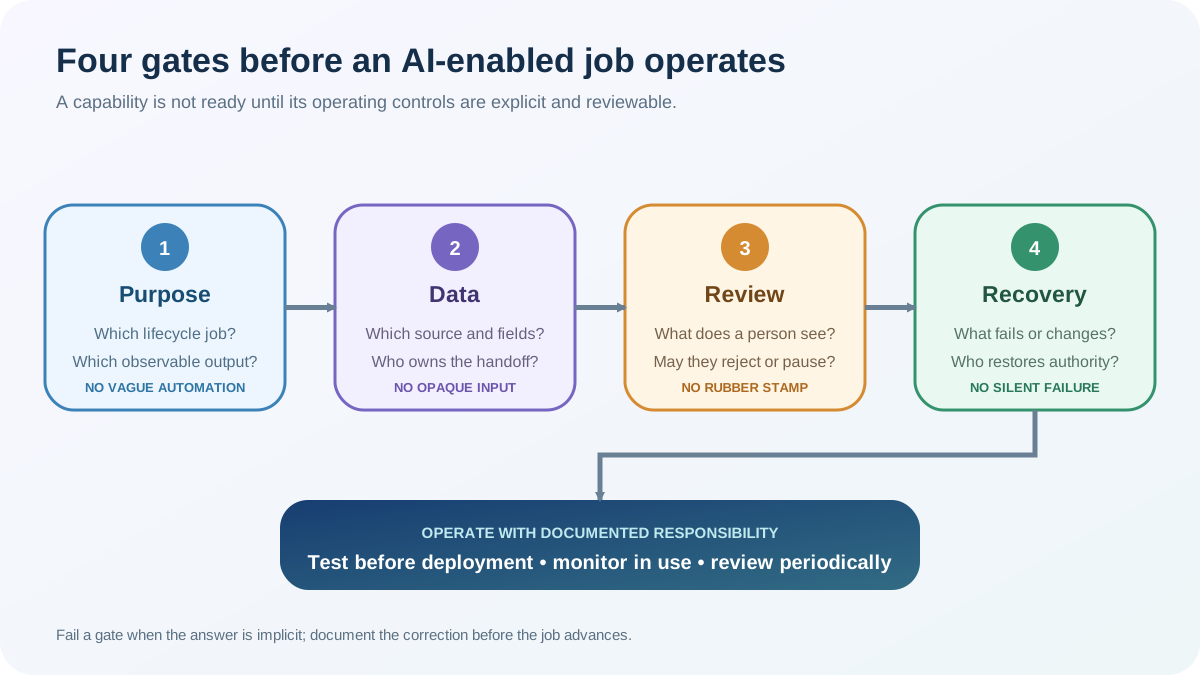
Once the lifecycle jobs are visible, AI-enabled technology changes the evaluation question from capability alone to governed operation. A generated classification, suggested company, drafted message, or recommended action is an output inside a process; it is not the process owner. NIST's voluntary AI Risk Management Framework calls for documented roles, communication, human-AI oversight, periodic review, testing before deployment, and monitoring during operation. It is use-case agnostic and does not certify a product or predict sales performance, but it offers a useful architecture discipline: each AI-enabled job needs a named accountable role, a defined human relationship to the output, a test basis, an operating monitor, and a review responsibility. That discipline reveals why a feature list is insufficient. Two systems can describe a similar AI capability while creating different operational burdens if one exposes inputs, decisions, and exceptions clearly and the other leaves them implicit. The team should therefore evaluate the control surface around the output, not only the output's apparent convenience. The next seam is ownership: who controls the data and integration through which that governed job actually runs? That is where governance becomes operational rather than merely declarative.
Assign Data and Integration Ownership
Data ownership begins with the authority to define what an input means, where it may move, and which system holds the accepted state. Integration ownership begins with responsibility for the transformation between those states. Those responsibilities cannot be inferred from the presence of a connector. For an AI-enabled lifecycle job, document the source information, the fields or context the system receives, the output it creates, the destination expected to consume that output, and the person accountable for the handoff. Then document who reviews the arrangement periodically and who communicates a material change to the people using it. This is the practical consequence of treating governance as an operating function rather than a policy page. It also keeps qualification intelligible. If an AI-enabled output contributes to a qualification decision, the owner must be able to distinguish the system's contribution from the team's acceptance rule and to explain which human retains authority to advance, reject, or revisit the record. Without that separation, the integration may move data correctly while the business meaning changes unnoticed. A named interface contract turns the technology from an opaque feature into a lifecycle component that can be tested and reviewed.
Set Human Review and Exception Paths
Human review is meaningful only when it occurs at a defined decision point and the reviewer has a real alternative to acceptance. A requirement to “keep a human in the loop” says little unless the operating design names the reviewer, the material presented for review, the decision that remains under human authority, the conditions for rejection, and the route taken when the output is unsuitable. Testing and monitoring belong on the same line. Before deployment, the team should document what will be tested for the particular job; during operation, it should document what will be monitored and who is responsible for acting on the result. NIST frames these as continuing governance and measurement responsibilities, not as a one-time declaration. For a lead-generation stack, that means a review signal must connect back to the lifecycle job. An error or exception should not disappear into a generic support queue if it changes which candidate advances, which message is prepared, or which action is taken. The exception path should return the item to the owner who can correct the input, revise the decision rule, pause the job, or revisit the technology. Only then does oversight govern the handoff rather than merely observe it.
Control Third-Party AI and Data Dependencies
The controlled workflow described so far still depends on components the team may not operate. Third-party software and data can fail, change, or create incidents at precisely the seam where one lifecycle job hands work to the next. NIST's voluntary framework calls for third-party risks to be monitored, controls to be documented, and contingency processes to exist for consequential failures or incidents. The framework does not establish a sales benchmark or validate any vendor. Its relevance is architectural: an integration is a dependency, not evidence of reliability. Therefore the evaluation must ask what happens when the dependency does not produce the expected input, output, or service state. Which job stops? Which records are affected? Who detects the condition? Which owner decides whether to pause, reroute, recover, or continue under a bounded alternative? A contingency is not merely a backup technology. It is the documented process that preserves decision ownership when the normal component cannot be trusted or used. This requirement changes the economics of the stack, because a feature's operational value cannot be separated from the control and recovery work required around its handoffs. The seam must remain inspectable.
Test Fit Against the Existing Workflow
Workflow fit is best examined by tracing one bounded job through the existing systems. Start with the named input and identify where it originates, which third party receives or changes it, which system accepts the resulting state, and which person owns the decision at the end. Then examine the failure path with the same precision. If the external component is unavailable, its output is unsuitable, or the data handoff cannot be relied upon, the team needs a documented control and a contingency process that returns authority to a named owner. This test is more demanding than asking whether two products integrate, because it makes the integration answer for business continuity and meaning. It also prevents AI from becoming a generic cure. An AI-enabled component should enter only where a defined job requires it, where oversight and tests can be specified, and where the surrounding workflow can continue under an explicit exception process. The fit decision is therefore conditional: the same category may be defensible in one lifecycle chain and unnecessary in another, depending on the input, owner, downstream action, and failure consequence. No category is universally required simply because it appears in a reference stack.
Check Evidence Quality and Measurable Outputs
A measurable output should describe the state created by the lifecycle job and available to the next owner, not a promise borrowed from a product page. That distinction keeps evidence within its proper boundary. Governance guidance can support the need for documented testing, monitoring, controls, and contingencies, but it cannot prove that a particular technology will improve lead quality or sales performance. A first-party description can establish what a product says it does, but not that its candidates represent buying intent or that its messages will produce a commercial outcome. Evaluate each claim according to that scope. Ask what source supports the capability, what limitation accompanies the source, which state the workflow can actually observe, and which owner reviews that state. Then connect the observed output to the original planning decision: does it help the team update the target market, sales step, channel action, cost allocation, or measurement plan? If not, the metric may be visible without being useful. The strongest evaluation record therefore pairs a bounded capability statement with an operating observation and an accountable review, leaving performance conclusions to evidence that actually supports them. That boundary protects the decision.
Bound the Documented OKKI Go Technology Scope
The first-party pages for OKKI Go describe a bounded set of prospecting jobs: company search, contact discovery, outreach drafting with subject variants, team-controlled review before sending, and visibility into email status. The use-case description adds the sequence around those capabilities: a user supplies a clear ideal-customer context, reviews candidate companies before selecting records to unlock, looks up contacts for selected companies, prepares contextual outreach, and confirms the recipient, subject, and body before a send. Read as an architecture, this is a chain of reviewable handoffs rather than proof of an autonomous lead-generation system. Candidate output remains candidate output; it is not verified buying intent or a qualified opportunity. Drafting remains a proposed communication under team control; it does not establish consent, compliance, deliverability, response, pipeline, or revenue. Those limitations are not minor disclaimers. They identify the work the surrounding process must still own: the market definition, qualification decision, operating controls, measurement plan, and review of observed states. First-party scope can show where a product may sit in a lifecycle map; it cannot decide whether that position solves the team's highest-cost seam. The boundary keeps stated scope separate from claimed business results.
Start at the Highest-Cost Handoff
A team considering the documented OKKI Go scope should begin by locating the handoff that currently consumes attention or loses decision context, then map only the relevant product job to that seam. If the problem lies before company selection, examine how the search context enters, how candidates are reviewed, and who decides which records may move forward. If the problem lies between a selected company and a prepared contact action, examine contact discovery, contextual drafting, subject variants, recipient and content confirmation, and the visible email state as separate handoffs. At each point, retain the evidence boundary. The official pages describe functions and workflow; they do not prove candidate intent, autonomous qualification, fixed accuracy, deliverability, response, pipeline, or revenue. The evaluation should therefore record the job, input, reviewable output, human decision, destination, exception path, and observable state for the one seam under consideration. That record allows the team to compare the product's stated scope with its own process without converting a capability description into a performance claim. The technology earns a place only if the owned handoff becomes clearer and more governable. That is the smallest defensible unit of comparison.
Expand Only After the Feedback Loop Works
Expansion should follow evidence that the first handoff is observable and reviewable, not enthusiasm for adjacent capabilities. The team should be able to see the input it supplied, inspect the output, identify the human decision, trace the resulting state, and return what it learned to the market, sales-step, channel, cost, or measurement plan. That feedback loop may show that the next problem sits in another lifecycle job, or it may show that the original planning assumption needs revision. Either outcome is more valuable than adding another disconnected tool. The documented product scope offers several possible jobs across company discovery, contact discovery, outreach preparation, controlled sending, and status visibility, but it does not make every job necessary for every stack. The minimum useful architecture is conditional on the team's process. If a component has no named owner, no defined input, no accountable acceptance decision, no exception route, or no review signal, remove it from the proposed design. A smaller chain with intelligible interfaces is easier to govern, test, monitor, and revise than a broad stack whose apparent coverage conceals unowned seams. The discipline protects budget and ownership as the stack evolves.
The architecture test is deliberately severe: for every box in the proposed stack, name the lifecycle job, input, output, owner, exception path, and review signal. A product such as OKKI Go can then be assessed against its documented search, contact, drafting, controlled-send, and email-status scope without turning that scope into an outcome claim. If a box still has no owner after the handoffs are drawn, remove it. The omission is not a loss of capability; it is the removal of operational debt.
Frequently asked questions
What is lead generation technology?
Lead generation technology is the set of systems assigned to defined jobs across the lead lifecycle. Evaluate it by the data, integration, owner, control, exception path, output, and review signal attached to each job, rather than by the number of features collected.
What should a team define before selecting lead-generation technology?
Document the target market, sales steps, action channels, goals, costs, and measurement plan first. Those planning choices reveal which lifecycle job exists, what its output must enable, and whether a technology category is necessary.
How should AI-enabled lead-generation technology be evaluated?
Document roles, human-AI oversight, testing, operating monitoring, periodic review, and the person responsible for each action. NIST's guidance is voluntary and use-case agnostic; it supports a governance method, not certification or a sales-performance claim.
Why does an integration need a contingency process?
An integration creates a dependency. For third-party AI or data, document controls, monitoring, and what the team will do if the component fails or creates an incident. The contingency should preserve decision ownership and return the affected job to a named owner.
What technology scope does OKKI Go document?
Its first-party pages describe company search, contact discovery, outreach drafting, subject variants, team-controlled review before sending, and email-status visibility. That scope does not prove autonomous qualification, consent, compliance, accuracy, deliverability, response, pipeline, or revenue.
How should a team choose the smallest useful stack?
Start with the highest-cost broken handoff. Add technology only when its lifecycle job, input, output, owner, exception path, and review signal are named, then expand only after the resulting feedback can update the team's planning decisions.
Explore OKKI Go
- Explore OKKI GoReview the official overview of documented company search, contact discovery, outreach drafting, team-controlled sending, and email-status visibility.Official OKKI Go resource ↗
- Review the official use casesSee the first-party workflow description for company candidates, review, contact lookup, drafting, confirmation, and sending.Official OKKI Go resource ↗