
The deciding line is not seniority. It is whether the operating problem stays inside sales or crosses the revenue journey.

Which Operations Team Belongs First?
Which team should come first? Sales Ops, if the problem can still be solved inside sales. That answer creates the harder question: what counts as inside? Salesforce draws the functional line around the sales process and sales-team productivity, while its RevOps definition spans the revenue journey across marketing, sales, customer success, and finance. The useful distinction is therefore scope of coordination, not title prestige. Salesforce's definitions were checked on August 24, 2026.
So is RevOps simply Sales Ops with a larger remit? No. A larger remit without a shared operating problem is only a larger job description. Ask what is failing. Is sales struggling to run its own process, maintain its own workflow, or help its own team work productively? The narrower function fits. Are several revenue teams unable to agree on the goal, the handoff, the metric, or the data definition? Now the problem has crossed the boundary that Sales Ops is designed to contain.
What about the tool stack? It cannot settle the choice. A CRM, a reporting layer, or a prospecting workspace such as OKKI Go may sit inside a workflow, but the presence of a tool does not tell you which teams must share ownership. Start with the operating disagreement. Then give the relevant function authority over the process and data decisions required to resolve it.
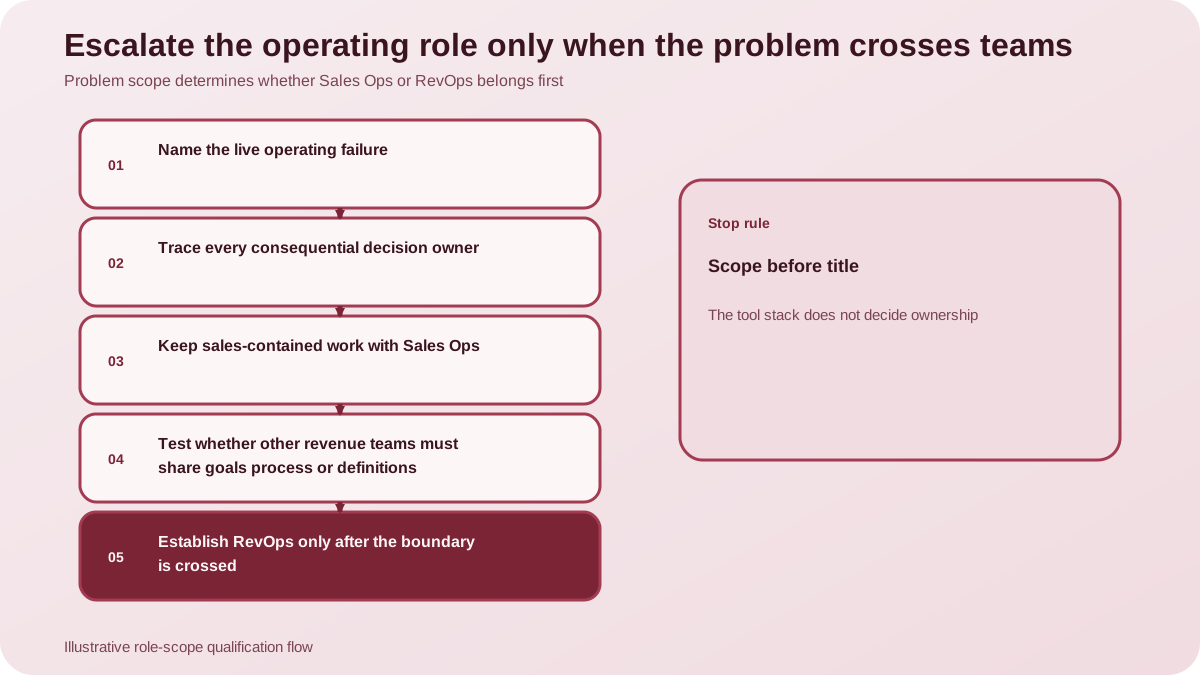
The Boundary Is Ownership, Not the Title
Could a company call a sales-contained role RevOps? It could. Would the label make the work cross-functional? It would not. The opposite is also possible: a person with a Sales Ops title may be asked to reconcile marketing, sales, and customer-success definitions without the authority to govern them. The title is weak evidence. The disputed decisions are stronger evidence. List them before writing the job description.
Where Does the Work Actually Live?
What should you compare first: responsibilities, reporting lines, or workflows? Start with workflows. Responsibilities are easy to copy from another company's org chart. A workflow reveals where one team's decision becomes another team's input. Salesforce's definitions make this visible. Sales Ops centers on the sales process and sales-team productivity. RevOps follows the broader revenue journey across several functions. The boundary appears at the handoff.
Then what should qualification mean in this comparison? It is not a lead score. It is a test of problem scope. Trace one disputed workflow from its first definition to its final owner. If every consequential decision remains with sales, qualify the work for Sales Ops. If marketing, sales, and customer success must adopt the same definition for the workflow to function, qualify the problem as cross-functional. That is the point at which a revenue-wide operating owner becomes coherent.
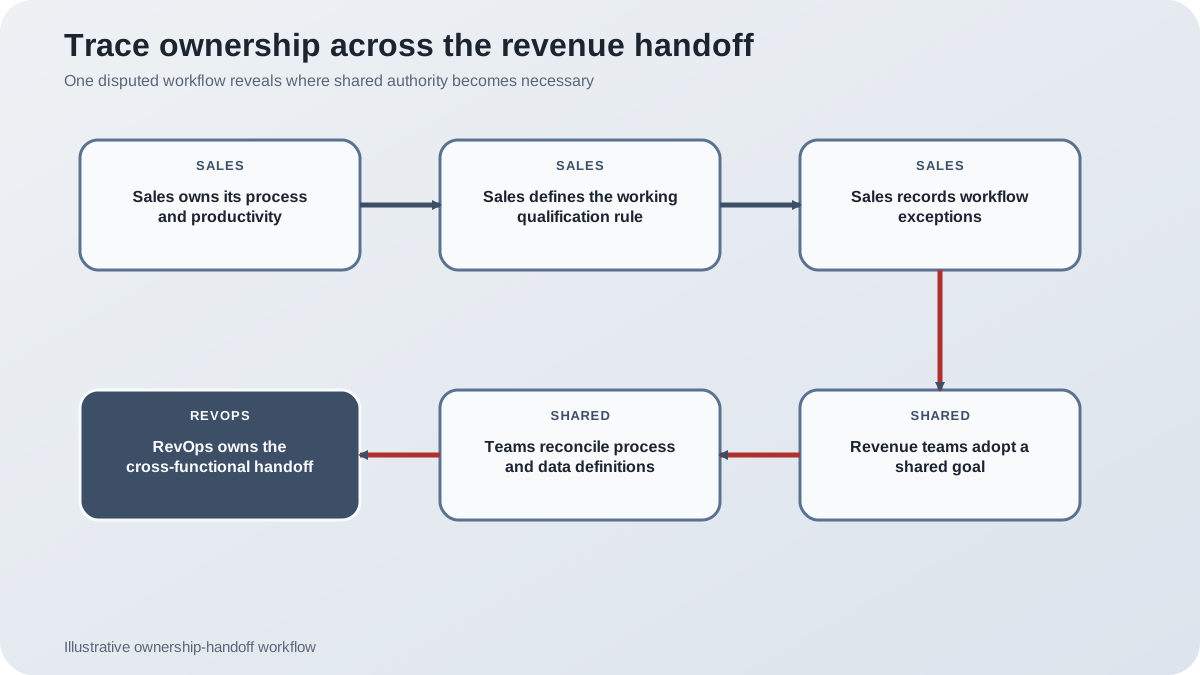
Trace the Decision Across the Handoff
How do you make that trace concrete? Follow the disputed definition to the point where another team must accept or change it. The exercise is deliberately narrow. It tells you whether the operating repair belongs to sales or requires shared authority; it does not attempt to redesign the whole revenue organization.
- Ask who defines the stage or status that starts the handoff.
- Ask who can change that definition when the next team rejects it.
- Ask whether the same metric and data definition survive the handoff.
- Choose the narrow role when sales can answer all three; choose the cross-functional role when ownership must be shared.
What Trade-off Do Org Charts Hide?
What does the narrower function buy you? Focus. Sales Ops can stay close to the sales process and sales-team productivity. What does that focus omit? It does not, by definition, resolve every disagreement that runs through marketing, sales, customer success, and finance. What does RevOps add? A mandate that can span that journey. What does the mandate still fail to prove? That centralization by itself improves revenue. The Salesforce material defines scope and practices, not an automatic outcome.
Which metrics belong in the decision? Not a generic scorecard. Use the metrics whose definitions are currently disputed. Salesforce's RevOps practices, published January 30, 2026 and checked August 24, call for shared revenue goals, standardized core processes and customer interactions, unified KPIs, and a single source of truth. Those are governance requirements. Their absence can reveal a cross-functional operating need, but their adoption should not be presented as proof that one title caused a commercial result.
A Metric Can Name the Missing Owner
Ask a smaller question: can the teams define the KPI without reopening the process that creates it? If yes, the issue may be reporting. If no, the argument is about ownership. The metric is useful because it exposes the decision path beneath it. It is not useful as a decorative dashboard item. This is also where tools stop being neutral. A system can preserve one definition only after someone has authority to choose it.
Which Role Fits the Situation in Front of You?
A company is debating its first operations hire. Sales owns the pipeline, while marketing and customer success touch the handoffs around it. What is the first useful question? Could sales repair the stage definitions and workflow without asking either neighboring team to change its own rules? Suppose the answer is yes. What follows? The broken work still lives inside sales, so Sales Ops is the smaller role that can own the repair. Is that answer permanent? No. It lasts only while the fix remains inside the same functional boundary.
Now ask the same question after marketing, sales, and customer success each give the handoff a different definition. Can sales repair the workflow alone? No, because its fix would stop at the next team's rule. Then who can settle the disagreement? A function with authority across the shared goal, process, metric, or data definition. That is when the choice turns toward RevOps. Has the broader title proved a better revenue result? No. The evidence supports the scope of the operating role, while commercial performance still has to be evaluated separately.
Ask Who Must Change Their Definition
Why use that question? Because it identifies the smallest authority capable of resolving the conflict. Salesforce's team-building guidance says a company may not need full operational support at first and may later outgrow division-specific operations before building a centralized team. The guidance, published October 4, 2024 and checked August 24, 2026, supports a staged choice. It does not supply a universal headcount or timing threshold.
When Does the Recommendation Flip?
When should you stay with Sales Ops? Stay while the disputed process, owner, metric, and data definition remain inside sales. When should you reconsider? Reconsider when another revenue team must change its workflow for the repair to hold. When should the recommendation flip? Flip when shared governance is no longer optional: the teams need common goals, standardized core processes, unified KPIs, or a single source of truth to operate the same revenue journey.
- Choose Sales Ops first when sales can own the repair and its definitions end at the sales boundary.
- Delay a full centralized function when the company does not yet need cross-functional operational support.
- Choose RevOps when several revenue teams must share the goal, process, KPI, or source record for the workflow to function.
- Treat the role as a governance decision, then configure tools such as OKKI Go around that ownership rather than asking the tool to choose it.
How do you make the strategy testable before hiring? Write down one live disagreement, the teams involved, the current owner, the definition each team uses, and the decision that stalls. Then ask whether Sales Ops could resolve it without changing another function's process. If the answer is yes, the narrower role still has room to work. If the answer is no, ask whether a RevOps owner would receive authority over the shared goal, core process, KPI, and source record that Salesforce identifies in its practices. If the authority is absent, changing the title does not change the mechanism. If the authority is present, define the first shared decision the function must settle. This short record is more useful than a long responsibility matrix because it connects the role to an observable conflict and a named decision. Review it again when the workflow crosses a new handoff, not merely when the company adds another tool.
The Last Question Before Opening the Role
Can you name two or more revenue teams that are using conflicting stage, handoff, attribution, KPI, or data definitions? If not, the broader role may be premature. If you can, ask one final question: will the new function have authority to resolve that conflict, or only a new title from which to observe it?
The practical choice is smaller than the titles suggest. Put Sales Ops where sales can own the repair. Create RevOps when the repair crosses teams and needs shared authority. Then ask the question an org chart cannot answer: who is empowered to make the shared definition stick?
Frequently asked questions
What is the practical difference between RevOps and Sales Ops?
Sales Ops is the narrower choice when the operating work remains inside the sales process and sales team. RevOps is the broader choice when marketing, sales, customer success, finance, or other revenue teams need shared operating definitions.
Should a growing company hire Sales Ops or RevOps first?
Hire Sales Ops first when sales can own the repair. Move toward RevOps when the repair requires multiple revenue teams to share goals, process ownership, KPIs, or data definitions. Growth alone does not decide the title.
Which conflict is the clearest signal that RevOps is needed?
Look for a handoff that cannot work because two or more revenue teams use conflicting stage, attribution, KPI, or data definitions and no single team can resolve the disagreement.
Can software settle the RevOps vs Sales Ops decision?
No. Software can preserve a workflow or definition after ownership is chosen. It cannot decide which function should have authority over a cross-functional conflict.